The Málaga Spanish Open delivered a serious weekend on court, but the bigger story was how it was presented. From a purpose-built arena in Plaza de la Marina to the debut of PickleVAR, the event showed how European pickleball is starting to think beyond participation and towards spectatorship.
- The Málaga Spanish Open drew 470 players across 691 matches, with participation up sharply on last year.
- Katie Morris and Mauro García claimed the headline Pro Singles titles, while María Costantino and Ignasi de Rueda won mixed doubles.
- The city-centre showcourt and PickleVAR debut pointed to a more ambitious phase for European event presentation.
A tournament that placed pickleball in the middle of the city
For anyone walking through Plaza de la Marina, this did not look like a normal European pickleball tournament.
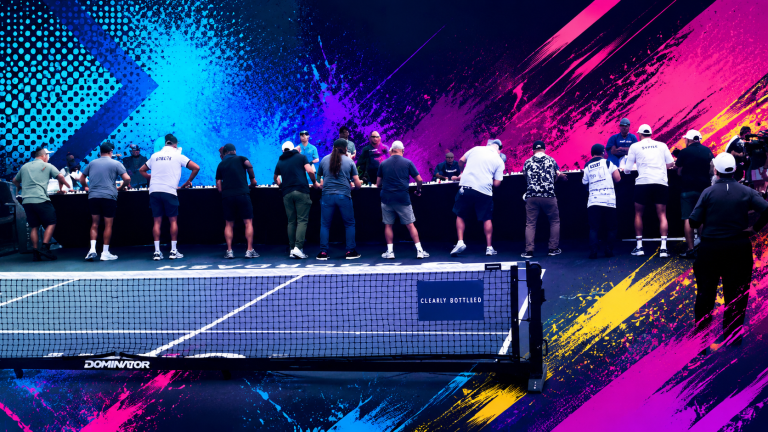
In the middle of Málaga, surrounded by restaurants, tourists and passing traffic, organisers built a temporary showcourt with grandstands, hospitality areas and a public-facing stage for the professional finals.
That setting mattered. European pickleball has often lived inside sports halls, tennis clubs and local leisure centres. In Málaga, it placed itself directly in the middle of city life and asked people to stop.
The Málaga Spanish Open, part of the Cervezas Victoria Pickle Pro Tour, brought together 470 players across 691 matches, with the tournament split between Torremolinos Sports Village and the Plaza de la Marina centre court.
Morris and García take the headline singles titles
On court, Katie Morris delivered one of the strongest performances of the weekend by winning the Women’s Pro Singles title.
The British player defeated María Costantino in the final, handling the added pressure of facing a Spanish opponent in front of a home crowd. It was not only a title win. It also reinforced Morris’s place near the front of the Pickle Pro Tour race.
Costantino still had a major say in the tournament. She returned to win mixed doubles alongside Ignasi de Rueda, giving the home support a title to celebrate after both players had entered the final day with hopes of a broader medal haul.
In Men’s Pro Singles, Mauro García claimed the title with victory over De Rueda. For Spanish pickleball, a home winner in the men’s singles final gave the weekend a strong domestic storyline as well as an international one.
Marina Sicic and Karolina Owczarek won Women’s Pro Doubles, beating Sabrina Méndez and Costantino, while Mateusz Matysik and Claudio Quiñones took the Men’s Pro Doubles title against Louis Laville and De Rueda.
If you’re following how the global game is shifting week by week, the World Pickleball Report breaks this down every day in our morning briefing.
PickleVAR was more than a gimmick
The debut of PickleVAR during the professional finals was one of the clearest signs that the event was trying to operate at a different level.
On the surface, it was a video review system. But the more important point is what it suggests. Tours do not invest in officiating technology unless they believe the product is becoming commercially and professionally significant.
That does not mean Spanish pickleball has suddenly become a fully mature professional ecosystem. It has not. European tours still face clear challenges around player depth, funding, broadcast consistency and long-term event sustainability.
But the direction of travel was obvious.
Europe already has players. Now it needs spectators.
The strongest part of the Málaga story was not simply that more people entered the tournament. Participation figures are useful, but they are no longer enough on their own.
Europe already has recreational players. The harder challenge now is building events that people actually want to attend, follow and talk about afterwards.
Málaga offered one possible answer. Put the sport somewhere visible. Build a proper stage. Treat the finals like an event, not just the last matches on a long order of play.
The result was a tournament that felt less like a closed competition and more like a public sports product.
Why it matters
For Spanish pickleball, the weekend strengthened Málaga’s case as one of the country’s most important event cities. For the Pickle Pro Tour, it showed a willingness to raise production standards rather than relying only on participation growth.
For European pickleball more widely, it hinted at the next challenge.
The sport has spent years persuading people to play. In Málaga, it also tried to persuade people to watch.
That is a meaningful difference.
For a clearer view of where the sport is heading each month, you can download the latest free issue of World Pickleball Magazine.
Further Reading
- Latest pickleball news from around the world
- Tournament coverage and results
- Rankings and player profiles
- Regional pickleball coverage

Chris Beaumont
Founder and Editor-in-ChiefChris Beaumont is the founder and Editor-in-Chief of World Pickleball Magazine. Chris follows the global game closely, reporting on the latest news, developments, stories and tournaments from all five continents. He also hosts the World Pickleball Podcast, interviewing people at…
View All Articles →