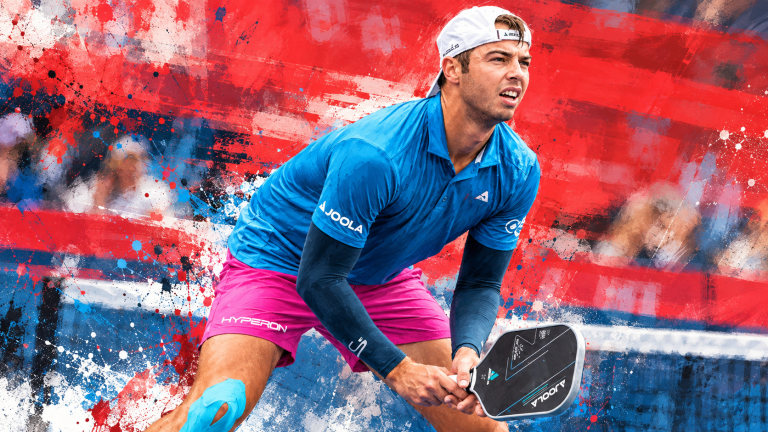

Ben Johns’ early exit in Sacramento will be recorded as another result. The more revealing shift is that it no longer feels like one that needed explaining.
- Ben Johns’ loss reflects a change in how men’s singles draws are being read
- His section was viewed as difficult before play began, not after
- The draw is now shaped less by one name and more by how many matches can genuinely be lost
Ben Johns losing early in Sacramento will be written up as another upset.
It is not the right way to read it.
The more important point is that his path through this draw did not feel secure before the tournament began. That is where the shift sits. Not in the loss, but in the absence of certainty around his progression.
For a long time, Johns’ presence in a section imposed order. It did not guarantee outcomes, but it narrowed the likely ones. That effect is weaker now.
The expectation has moved
This is no longer about a single match.
It is about how the draw is interpreted in advance. When the bracket was set, the conversation was not about whether Johns would come through cleanly. It was about how difficult that route looked and how many matches in it carried real risk.
That matters because it changes the baseline.
An early loss can still happen in any sport. What is different here is that it no longer requires a stretch to explain it.
The draw no longer revolves around one name
Johns’ exit did not break the draw. It exposed how it was already structured.
In his section, JW Johnson moves forward not as an outsider but as a player who was always capable of shaping that part of the bracket. Elsewhere, players such as Federico Staksrud have come through their opening matches without disruption, maintaining control in other sections.
That contrast is the point.
The tournament has not tipped into unpredictability everywhere. It has separated into areas where control still exists and areas where it does not. Johns’ section fell into the latter before the first ball was struck.
If you’re following how the global game is shifting week by week, the World Pickleball Report breaks this down every Wednesday.
This is not about decline
There is a temptation to read this through the lens of decline.
It does not hold.
Johns remains one of the most complete players in the sport. What has changed is the density of the field around him. The number of matches that require full attention from the start. The number of players who can take a match away without needing something to go wrong.
That reduces margin.
Not enough to remove him from contention, but enough to remove the assumption that he will move through sections unchallenged.
What this says about men’s singles
Men’s singles is no longer organised around inevitability. It is organised around how many matches in a section can genuinely be lost.
Some sections still hold their structure. Others now expose risk immediately. The difference between them is not always the seed next to a name, but the number of viable matches sitting in front of that player.
That is what Sacramento has brought into focus.
What else happened, and what Thursday now demands
Johns’ exit reshaped one part of the draw. It did not define the whole of it.
In men’s singles, the picture is uneven. His section has opened, but others have held. Staksrud has progressed without disruption, while players such as Hunter Johnson are also through, keeping structure in other areas of the bracket. The draw has not collapsed. It has divided into sections where control still exists and sections where it has already been removed.
In women’s singles, the leading names remain in place, but the route has not been straightforward. Kate Fahey had to recover from a slow start to beat Kwon Mihae, while Elsie Hendershot also came through a three-game opener, setting up a Round of 16 meeting between the two. Catherine Parenteau and Kaitlyn Christian are both through, but the number of extended matches early in the draw suggests that progression is being earned rather than assumed.
Doubles, for now, is more stable.
In men’s doubles, Johns remains firmly in the tournament alongside Gabriel Tardio, and the top pairings have largely handled their opening assignments. Mixed doubles has followed a similar pattern, with established combinations progressing without disruption. Women’s doubles sits slightly closer to the singles picture, with leading teams advancing but with enough resistance to suggest that the later rounds will tighten.
That sets up a Round of 16 that now carries more weight than it first appeared.
In men’s singles, Johnson’s next match becomes the continuation of the story that began with Johns’ exit. Not because of the result itself, but because it will show whether that section settles or continues to open. Staksrud’s match against Tama Shimabukuro offers a different test, one that should indicate whether the top seeds can reassert control elsewhere.
In women’s singles, Fahey against Hendershot is no longer a routine progression match. Catherine Parenteau against Albie Huang and Kaitlyn Christian against Lina Padegimaite carry similar weight.
Across doubles, the Round of 16 is where early stability starts to be tested. Tardio and Johns against Bellamy and Hunter Johnson stands out in men’s doubles, while Jorja and JW Johnson against Julian Arnold and Allyce Jones is one of the strongest matches in mixed.
For official tournament brackets and results, see the PPA Tour.
For years, Ben Johns shaped the draw. In Sacramento, the draw moved on without him.
For a clearer view of where the sport is heading each week, you can join the World Pickleball Report here.
Further Reading
- Latest pickleball news from around the world
- Tournament coverage and results
- Rankings and player profiles
- Regional pickleball coverage

Chris Beaumont
Founder and Editor-in-ChiefChris Beaumont is the founder and Editor-in-Chief of World Pickleball Magazine. Chris follows the global game closely, reporting on the latest news, developments, stories and tournaments from all five continents. He also hosts the World Pickleball Podcast, interviewing people at…
View All Articles →