
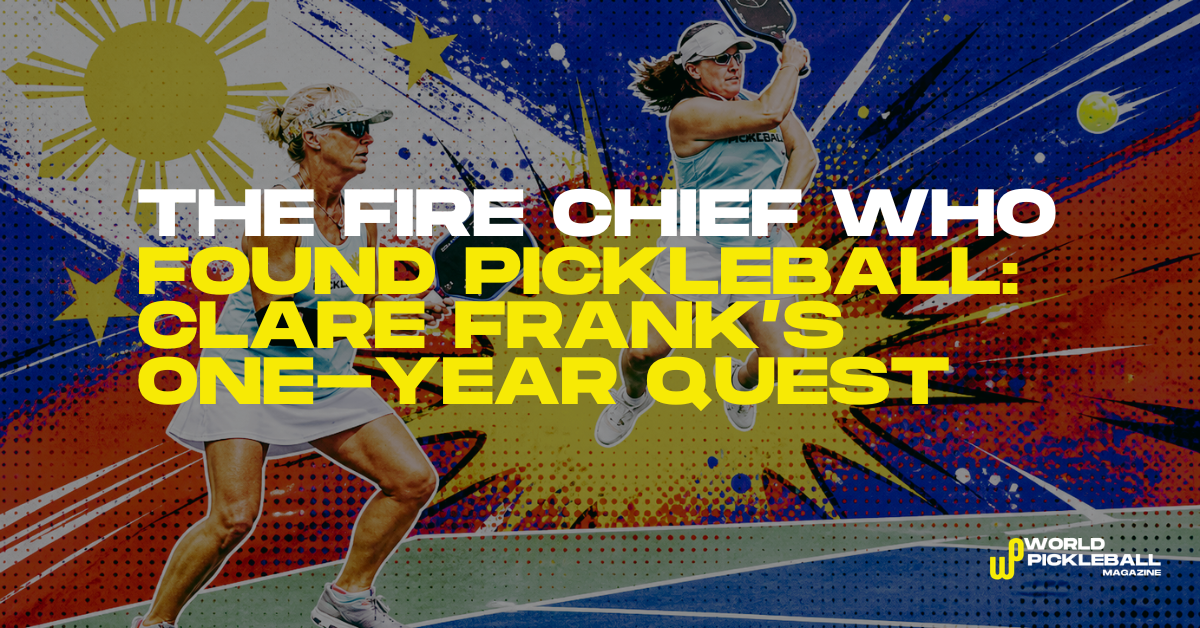
“The fear of death was not in my mind, but the fear of losing pickleball was… there was some insane gravity going on, pickleball gravity that makes you need to play the game.”
Clare Frank was sitting in an operating chair, wide awake, while a doctor sliced into the back of her neck to remove a lump.
For someone who spent three decades running toward blazing flames and retired as California’s first female chief of fire protection, high-stakes situations were nothing new.
Key Takeaways
- Clare Frank, a fire chief from California, went from picking up a paddle to competing nationally within a single year
- Her ‘agro’ competitive mindset, forged through decades in the fire service, translates directly to high-pressure pickleball
- Frank’s rapid rise highlights how athletic backgrounds in other disciplines can accelerate pickleball development
This article features in the May 2026 issue of World Pickleball Magazine. For the full collection of features, interviews, coaching insights and global coverage, download the complete magazine here.
But as the scalpel did its work, her mind didn’t drift to the possibility of chemotherapy or mortality. Instead, it locked onto a single, unexpected fear:
What if this means I can never play pickleball again?
It was in that moment that Frank realised how much hold the sport had taken. To understand why a plastic whiffle ball carried that kind of weight, she embarked on a spontaneous, year-long journey across the country, chronicling her experiences in her upcoming book, Just One More Game: A Pickleball Quest.
Joining the World Pickleball Podcast for a 7:00 a.m. interview—sounding a little “froggy” but eager to talk shop—Frank broke down the pull of the sport, the psychology of the “agro” player, and what she learned from courts stretching from Baja, Mexico, to a maximum-security prison yard.
The “Agro” Mindset
Spend any time around a paddle rack and it becomes clear that pickleball courts mirror human behaviour. Frank describes the ecosystem as a collection of distinct personalities—from the upbeat “cheerleaders” to the spin-heavy “ping-pongers” and the rule-focused traditionalists.
She places herself firmly in one category.
“Firefighting is all about… you put the fire out,” Frank explains. “You go towards the fire, you open up on it, and then everyone’s safe. So that’s kind of how my body learned.”
On court, that translates into an aggressive, fast-paced style—hitting hard, taking risks, and favouring instinct over patience.
She knows that to keep improving, she needs to access a more measured, strategic side of the game. But the pull is always there. Left unchecked, she defaults to what feels natural: attack first, think later.
If you’re following how the global game is shifting week by week, the World Pickleball Report breaks this down every Wednesday.
If you're following how the global game is shifting week by week, the World Pickleball Report breaks this down every day in our morning briefing.
What the Game Reveals
Her year-long journey wasn’t built around theory. It was built around moments.
One of the most striking came inside Donovan State Prison, a maximum-security facility. Playing alongside inmates, she saw how quickly the game strips away hierarchy. During one rally, an inmate drove an easy put-away straight into the net. All four players burst into laughter.
For a brief moment, everything else disappeared.
Outsider. Insider. Rival. Teammate.
Everyone on the court was the same.
At the U.S. Open Pickleball Championships in Naples, Florida, the scale shifted completely.
Frank watched 55-year-old tennis legend Andre Agassi partner with 18-year-old phenom Anna Leigh Waters against a pair of teenagers.
“To get to watch Andre Agassi play any sport is a treat,” she says.
But what stood out wasn’t just the star power. It was the mix. Generations sharing the same court, the same space, the same stakes. A combination that rarely exists elsewhere in sport.
Then there were the days that felt less structured, but just as revealing.
Driving from court to court with friends, chasing clear skies and dry surfaces, she recalls the group looking “very much like junkies chasing a fix.”
Pickleball, she realised, taps into something deeper.
Not just exercise.
Something closer to reward.
A cycle of play, connection, and repetition that keeps pulling people back.
Honouring Something Bigger
The most meaningful moment of the year came in Los Barriles, Mexico.
The tournament happened to fall on World Down Syndrome Day, a date that carried personal significance. Frank’s late sister, Annie, had been born with Down syndrome.
Struggling early in the event, Frank and her partner paused, checked in, and asked for help.
What followed was a shift.
Channeling Annie’s stubbornness, they fought back, defeated the top seeds, and walked away with gold.
As the conversation moved toward what comes next, the ideas remained open. A sequel. A global version of the same journey. Or, as joked during the podcast, a breakdown of which dog breeds would dominate the kitchen line.
(For the record, Frank backs a Golden Retriever to enjoy every second while losing most points, while the smarter money is on a Belgian Malinois.)
But the answer she was looking for is already clear.
It wasn’t found in theory or explanation.
It was found in moments like the one in that chair.
When everything else fell away, and the thing she wasn’t ready to lose wasn’t the life she had built.
It was the game she had discovered.
For a clearer view of where the sport is heading each week, you can join the World Pickleball Report here.
Further Reading
- Latest pickleball news from around the world
- Tournament coverage and results
- Rankings and player profiles
- Regional pickleball coverage

Chris Beaumont
Founder and Editor-in-ChiefChris Beaumont is the founder and Editor-in-Chief of World Pickleball Magazine. Chris follows the global game closely, reporting on the latest news, developments, stories and tournaments from all five continents. He also hosts the World Pickleball Podcast, interviewing people at…
View All Articles →

