
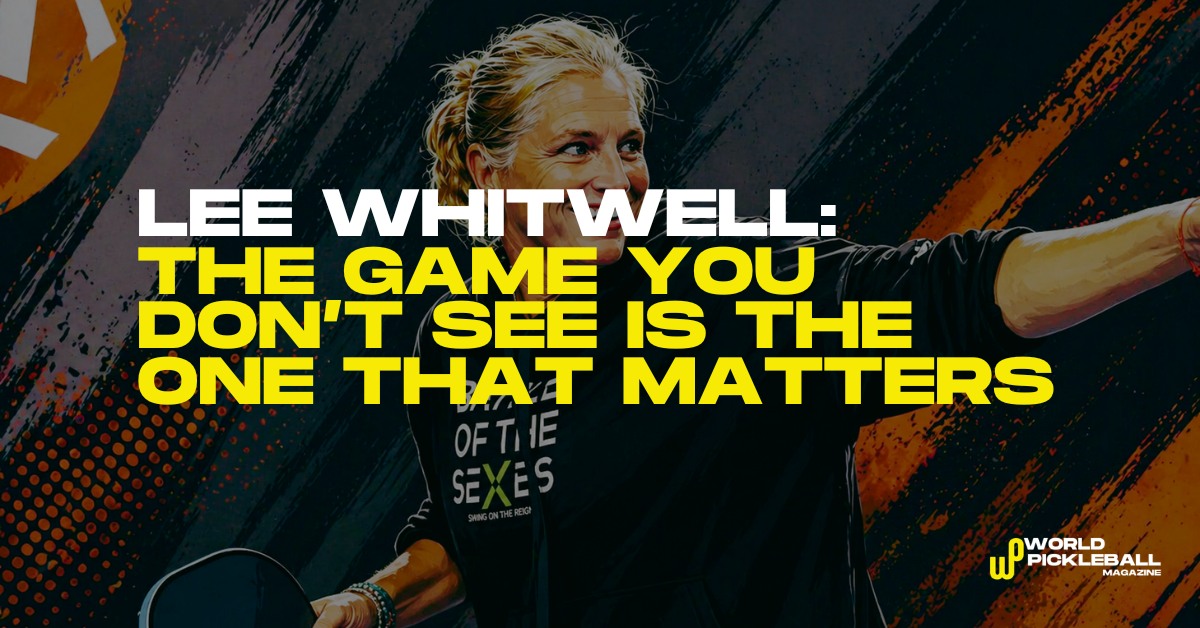
There is a point, somewhere deep into a match, where the rallies stop being about the ball.
The movement is still there. The rhythm, the patterns, the familiar geometry of pickleball. But something shifts. The decisions slow down. The air tightens. Players begin to hesitate, to reach for shots that are not quite there.
Key Takeaways
- Lee Whitwell’s coaching philosophy focuses on the game you don’t see: the mental patterns, emotional triggers, and decision-making that happen between points
- The article explores how elite pickleball performance depends more on psychological preparation than physical skill, a principle central to Chimp Management
- Whitwell’s approach draws on sports psychology principles applicable to players at every level
This article features in the May 2026 issue of World Pickleball Magazine. For the full collection of features, interviews, coaching insights and global coverage, download the complete magazine here.
In a long dink exchange, it often looks harmless at first. Eight, ten, twelve balls traded safely crosscourt. Then one player presses, just slightly. The ball sits a fraction higher. The reply comes a touch quicker. And suddenly the rally breaks, not because of brilliance, but because someone has forced a moment that wasn’t there.
At that level, the difference is rarely technical. It is emotional. It is the moment where patience gives way to urgency, where a player decides they need to take control, rather than trust the pattern that got them there.
This is where Lee Whitwell believes the match is decided.
Not in the swing, but in the space before it.
“I don’t need to beat you,” she says. “I need you to beat you.”
At the highest level, where margins are thin, Whitwell is not trying to overpower opponents. She is waiting. Watching. Letting pressure build until it turns inward.
The mistake, when it comes, rarely looks dramatic. A ball pushed half a foot too far. A volley mistimed by a fraction. A decision taken just a moment too early. But to Whitwell, those errors are not accidents.
They are the end result.
Whitwell’s relationship with the game has never been purely physical. She talks about patterns, about pressure, about presence. About how matches are shaped long before the final points are played.
“You can occupy space in someone’s head,” she says. “And once you’re there, you don’t need to do much.”
That is not theory. It is the layer of the sport that decides matches.
The Game Between Points
At the level where everyone can execute, the difference is not who can hit the better shot. It is who can stay clearer for longer. Who resists the urge to rush. Who recognises the moment before it arrives.
Most players don’t lose because they were outplayed.
They lose because they sped up.
That understanding sharpens with time.
Whitwell has seen the sport evolve, expand, professionalise. She has competed long enough to understand both the level required and the cost of maintaining it.
The physical side does not disappear. If anything, it becomes harder to manage. The repetition. The strain. The constant need to adapt just to stay at the same level.
“You have to understand your body,” she says. “You have to know what you can do, and what you can’t.”
There is no illusion of ease here. Only management.
The players who last are not the ones who push hardest every day. They are the ones who learn where the edge actually is, and how not to cross it too often. They understand recovery as well as effort, and they treat longevity as something that has to be worked at deliberately, not assumed.
But if the body sets the limits, the mind defines the edge.
What Whitwell returns to, again and again, is control. Not control over the opponent, but over self. Over reaction. Over expectation. Over the instinct to force a point instead of letting it come.
If you’re following how the global game is shifting week by week, the World Pickleball Report breaks this down every Wednesday.
If you're following how the global game is shifting week by week, the World Pickleball Report breaks this down every day in our morning briefing.
Reading the Invisible Patterns
This is where matches tilt.
Not in the obvious exchanges, but in the moments where one player decides they need to do more, and the other is content to do less.
There is discipline in that restraint. And there is a kind of quiet confidence behind it.
The belief that if you stay present long enough, the other player will give you what you need.
Away from the pro game, Whitwell sees something else entirely.
“There are millions of people playing who don’t care about pros,” she says. “They care about what it gives them.”
That matters more than most people in the sport want to admit.
Because it challenges the idea that pickleball revolves around elite competition. It doesn’t. The pro game is visible, but it is not the centre.
The centre is everywhere else.
Public courts. Club sessions. Temporary nets on borrowed space. People turning up after work, not to chase rankings, but to feel something different to the rest of their day.
Pickleball works because it fits into lives easily. But it stays because it gives something back.
Why Mental Preparation Matters
Routine. Connection. A sense of progress that is immediate and shared.
It is also, quietly, a rare kind of competitive space. One where improvement is visible within weeks, where players of different backgrounds can share a court, and where the balance between challenge and enjoyment is easier to find than in most sports. That balance is difficult to manufacture. In pickleball, it tends to appear naturally.
That is why the sport holds people.
Not because of what happens on the biggest stages, but because of what happens every day.
And yet, the same patterns run through both worlds.
The hesitation under pressure. The rushed decision. The attempt to force a point that isn’t there. Whether it is a pro final or a club game, the mistake often looks the same.
The difference is only how clearly it is understood.
Whitwell’s perspective cuts through that.
“I don’t need to beat you. I need you to beat you.”
It is not just a tactic. It is a way of seeing the game.
Because once you understand that, pickleball stops being about hitting better shots.
It becomes about making better decisions.
And in that moment, the game you thought you were playing changes completely.
For a clearer view of where the sport is heading each week, you can join the World Pickleball Report here.
Further Reading
- Latest pickleball news from around the world
- Tournament coverage and results
- Rankings and player profiles
- Regional pickleball coverage

Chris Beaumont
Founder and Editor-in-ChiefChris Beaumont is the founder and Editor-in-Chief of World Pickleball Magazine. Chris follows the global game closely, reporting on the latest news, developments, stories and tournaments from all five continents. He also hosts the World Pickleball Podcast, interviewing people at…
View All Articles →

