
The Day Trader, The Pioneer, The Switch-Hitter: Inside the Mind of Jack Munro
By Chris Beaumont, Editor-in-Chief
Download the full March 2026 World Pickleball Magazine for free
Tsu City, Japan — Jack Munro is thousands of miles from his college campus, fighting off the exhaustion of an international flight, and preparing to play men’s doubles in a time zone that has entirely inverted his internal clock. It is just another week in the life of a young man who is redefining the architecture of a modern professional athlete.
Munro is, by all accounts, a walking contradiction in the best way possible. At 21 years old, he is a college senior grinding his way through an economics degree at the university in Austin. Yet, he is also a seasoned veteran of the professional pickleball circuit who has been dominating the sport since he was 10 years old. Coming off a staggering 2025 season where he secured 14 gold medals and a ridiculous 94% win rate in men’s doubles, Munro is currently the reigning number one male player on the A tour.
But to understand Jack Munro, you cannot just look at his trophy cabinet. You have to look at the unique mechanics of his swing, the muted pop of his paddle, the foundational pillars of his life philosophy, and the unlikely childhood injury that set his extraordinary trajectory in motion.
The Sling That Changed Everything
Every great athlete has an origin story, a singular inflection point where fate intervenes. For Munro, that moment arrived on a baseball diamond in the Dominican Republic.
At just 10 years old, Munro was a high-level baseball prodigy travelling with Team USA. He was a pitcher, throwing with his right arm, until the unthinkable happened: he blew his arm out and fractured his growth plate. “It was just a blessing in disguise,” Munro reflects.
Forced into a right-arm sling, a young Munro found himself messing around with a pickleball paddle in his left hand alongside his father. What started as a way to pass the time while injured fundamentally rewired his athletic mechanics. When the sling finally came off three months later, Munro didn’t revert to his natural right hand; instead, he kept playing lefty while slowly mixing his right hand back in. The result? One of the most lethal ambidextrous skill sets in professional pickleball.
Munro’s early immersion into the sport was catalysed by his parents, who were quiet pioneers of the game’s explosion. Before the pandemic brought pickleball into the mainstream, his parents founded a non-profit called Pickleball United and hosted a unique “Triple Crown” tournament in Simi Valley, California. The format was revolutionary for its time: three days of gender doubles where players had to compete with a different partner each day. Because hotel rooms weren’t provided, the Munro household became a makeshift dormitory for the sport’s early elite.
“We hosted every single top pro,” Munro says, casually listing off future legends who crashed on his living room couches, including Ben Johns, Lucy Kovalova, Kyle Yates, and Daniel Moore. The exposure was invaluable. By the time he was 12 years old in October 2016, Munro received an official email from the USAPA promoting his rating to a 5.0—long before the DUPR rating system even existed.
Yet, growing up as a teenage pickleball prodigy wasn’t always socially glamorous. “My friends definitely made fun of me,” Munro admits, noting that he did independent study in middle school to travel for the sport. He was constantly surrounded by adults three or four times his age, fostering a rapid maturity and an “old soul” disposition. Today, the sport’s stigma has vanished. “Now, obviously, my friends are calling and asking for paddles,” he laughs, noting how perfectly the situation has come full circle.
If you're following how the global game is shifting week by week, the World Pickleball Report breaks this down every day in our morning briefing.
The Day Trader’s Mindset
While his mechanics were forged by a baseball injury, his elite court psychology was moulded by the volatile swings of the stock market. During high school, Munro became deeply obsessed with stocks and day trading. He started with paper trading for months before risking his own money, eventually diving into high-risk options trading.
The endeavour ultimately wiped out his financial account, but it deposited something far more valuable into his mental reservoir. “Trading was like my life back then, and I’m so glad it was because it taught me to control your emotions,” Munro says. He learned the hard way that you cannot let a red or green portfolio dictate your self-worth, nor can you make desperate, emotional trades to chase losses.
He maps this directly onto the pressure of professional pickleball. “You have to be so in tune with how you feel, and what you do being two different things,” he explains.
This stoic, analytical approach birthed one of Munro’s foundational life pillars: Everything is patterns and trends..
“I literally study it and execute it to a tee,” he says. “The speedups that I hit, the return placement to where somebody’s likely going to sit… everything is patterns.” Munro operates on a strict formula of observation: if he sees an opponent do something twice, he prepares to jump on the pattern early. “If it happens three times, then I’ll be like, ‘Okay, this is a set pattern.’ You’re stupid if you think the pattern’s not going to repeat itself after that”.
This hyper-logical processing extends to his own side of the net, particularly when analysing his rare defeats. Munro is a subscriber to the counterintuitive philosophy that you should actively optimise for losing. “If you learn more when you lose, then you should optimise to lose,” he argues. “As soon as I started being like, ‘Okay, if I lose I’m going to get further ahead,’ then I stopped being afraid of losing”. Eliminating the fear of failure completely eradicated his tournament nerves.
He points to a painfully early exit at the AP Mesa tournament in October 2024 with his partner Will Howells as a prime educational moment. The pair were knocked out at 9:00 a.m. in the round of 16. “That one hurt because it taught me a lot about how you need to treat every single match with the utmost respect,” Munro reflects, acknowledging he had walked onto the court cold, skipping his rigorous warm-up routine. He learned he couldn’t just “yawn his way to the finals,” no matter what seed he held.
The Anatomy of an Ambidextrous Assassin
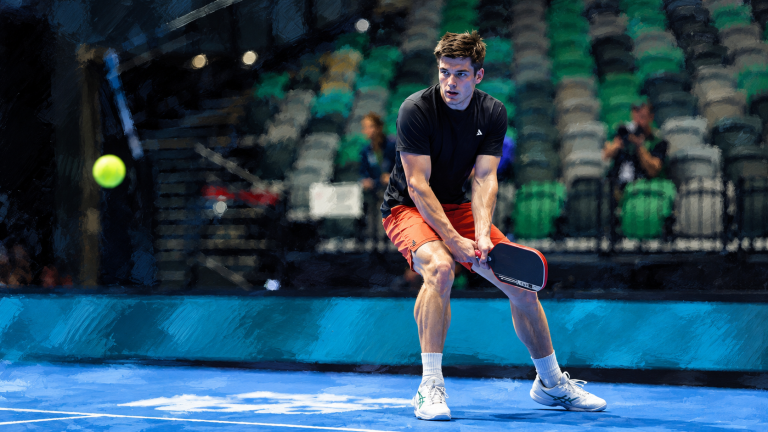
To watch Jack Munro at the kitchen line is to watch a puzzle that his opponents are constantly trying, and failing, to solve. His ambidexterity isn’t just a party trick; it’s a meticulously crafted weapon.
It took nearly six months for his left-handed play to become truly subconscious. To accelerate the neural pathways, Munro would force himself to brush his teeth and eat meals with his non-dominant hand. Today, his mind doesn’t even consciously process the switch. “If I get lobbed, I just turn to go to whatever hand just by sheer instinct,” he says.
Munro views his two hands as distinct tools with different profiles. He rates his lefty game as a 6.5 out of 10, utilising it for quicker, snappier reactions and heavy spin. His right hand, which he grades at a 5.5, naturally feels more stable for backhand volleys out of the air and overheads, heavily relying on the muscle memory of his childhood baseball throwing motion.
The most common tactical error his opponents make is targeting a perceived weakness that simply doesn’t exist. “They try to lob me because they think that I have a backhand overhead, and then it turns out I just switch to the other hand and hit a forehand overhead,” Munro smirks. Once his opponents realise the lob is ineffective against a player without a true backhand wing, they are forced to completely retract their game plan.
As if facing two forehands wasn’t visually confusing enough, Munro recently removed another critical data point from his opponents’ arsenal: sound.
In a move that surprised some in the industry, Munro became the flagship athlete for Owl Sports, wielding their signature quiet paddle. The decision was purely performance-driven. “My game is consistently tricky and hidden and spinny,” Munro says. “What this paddle does really, really well is it mutes the audio. So now you don’t know how hard I’m hitting it… You don’t know if I’m going for a full bang or if I’m going for an off-pace ball.”.
By depriving his opponents of the auditory cues that denote pace and spin, Munro gains a massive split-second advantage in the short sprints to 11 points. While some players miss the satisfying “pop” of a traditional paddle, Munro insists the Owl replaces sound with enhanced physical feedback. “You hit a filthy overhead and you just feel it a lot more,” he notes. Furthermore, he firmly believes quiet paddles will soon “take the market by storm” as the sport grapples with noise complaints globally.
The Pioneer’s Vision
Munro’s decision to wield the Owl paddle perfectly aligns with another of his core pillars: pioneering. “Everything I wanted or everything I have done was with the intent of pioneering a new way rather than being a carbon copy,” he states emphatically.
This independent streak heavily influenced his tour alignment. During a period when many top professionals engaged in bidding wars between rival leagues, Munro remained fiercely loyal to the A tour. The decision ultimately came down to “alignment” and bandwidth. The A tour gave Munro the flexibility to pursue his economics degree at Austin, aggressively build his digital content presence, and found a national championship-winning college program, Longhorn Pickleball.
“I love how the A supported that,” Munro says, praising the tour’s dedicated staff who treat players like family rather than “a pawn on the chessboard”. His loyalty is also deeply personal. Following his breakout performance at an A NextGen tournament in San Antonio, Ken Hermann recognised Munro’s talent and elevated him to the national team. The tour comped his international registration fees, providing crucial early-career exposure. “Loyalty is another word that’s a foundational pillar in Jack’s life. They’ve given me no true reason to dip,” he affirms.
While Munro has no animosity toward the rival PPA—and even had tournaments lined up with heavyweights like Riley Newman, James Ignatowich, and Zane Navratil before the PPA instituted a top-50 exclusivity rule—his current path provides unparalleled freedom.
That freedom has allowed Munro to flourish as an athlete-entrepreneur. He reaches over a million fans a month online, a venture that actively improves his pro game. Taking cues from creators-turned-pros like Kyle Kozuta and Tanner Tomassi, Munro finds that filming content forces him to study film and break the game down analytically, accelerating his own development.
He is also aggressively expanding his international footprint. Fresh off a bronze and gold medal performance in Malaysia with partners Rose and Ryan Fu, Munro is looking toward the future of the global game. He is a staple at the English Open, marvelling at its growth to nearly 3,000 players over the last four years, and views the European community as an extended family.
Never one to rest, Munro is already planning his next grand venture: a luxury, intensive pickleball getaway in Split, Croatia, slated for late May or early June 2026. Limited to fewer than 12 spots, the week-long trip combines intense “live ball” drilling, highly customised PDF feedback reports for every player, and cultural excursions ranging from waterfall hikes to wine tastings.
As the interview winds down, the clock ticks deeper into the Japanese night. Munro has a men’s doubles bracket waiting for him when the sun comes up. But you get the sense that whether he’s analysing a stock chart, breaking down a film session, or switching his paddle to his left hand to fire a cross-court dink, Jack Munro’s mind never truly powers down.
He is charting a course that looks like no one else’s. And in a sport that is evolving at breakneck speed, the quiet pioneer with the ambidextrous swing might just be exactly the blueprint professional pickleball needs.
For a clearer view of where the sport is heading each week, you can join the World Pickleball Report here.

Chris Beaumont
Founder and Editor-in-ChiefChris Beaumont is the founder and Editor-in-Chief of World Pickleball Magazine. Chris follows the global game closely, reporting on the latest news, developments, stories and tournaments from all five continents. He also hosts the World Pickleball Podcast, interviewing people at…
View All Articles →