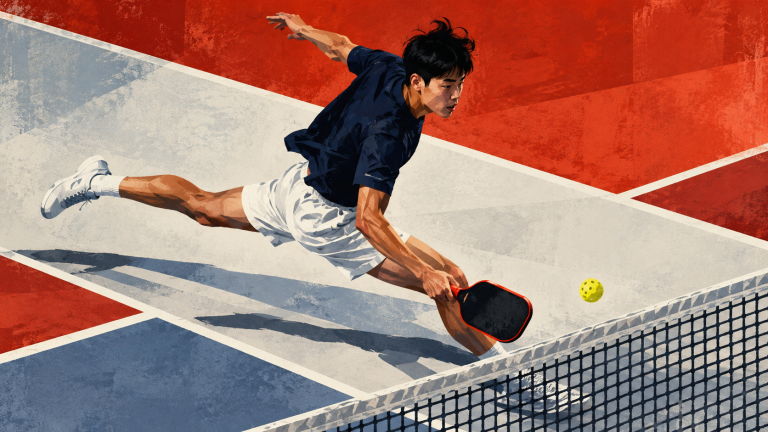

Eight million Chinese people now regularly play pickleball. In Hebi, the more revealing story is what has been built around them: courts, competitions, manufacturing, tourism and the beginnings of an entire sporting economy.
Key Takeaways
- China now has around eight million regular pickleball players, with approximately 20 million people having tried the sport, according to Bai Xilin of the General Administration of Sport.
- Hebi has built around 1,600 pickleball courts and trained more than 380 coaches and referees as it attempts to integrate the sport into everyday life.
- The city’s existing industrial base is being used to manufacture pickleball equipment, with local companies exporting products to Europe, the Americas and Southeast Asia.
- China is developing a more structured competitive pathway alongside its participation growth, while PPA Tour Asia and Major League Pickleball Asia are expanding the professional game across the region.
- Hebi provides an early example of how pickleball can become part of a city’s economic and cultural strategy rather than simply another recreational activity.
There are pickleball courts beneath an elevated highway in Hangzhou. Suzhou has opened a 23-court complex. In Nanjing, 11 courts sit on the 51st floor of a shopping centre, high enough above the city to offer players a panoramic view between points.
Then there is Hebi.
In this city in northern Henan Province, pickleball has escaped the boundaries of the court altogether. An industrial base associated with coal chemicals, rubber and plastics is being used to manufacture equipment. National championships bring hundreds of players into the city. Pickleball has been pushed into schools, villages, businesses, tourist attractions and residential communities. More than 1,600 courts have been built and local officials increasingly talk about the sport as part of Hebi’s identity.
Three years after it began seriously pursuing pickleball, Hebi offers one of the clearest examples of something much bigger happening across China.
The headline numbers are already extraordinary. Bai Xilin, director of the Tennis Administration Centre under China’s General Administration of Sport, says eight million people regularly participate in pickleball in China and around 20 million have tried it, while suggesting that the active playing population could eventually reach 30 million.
Participation estimates on that scale should always be treated carefully, particularly in a sport expanding so quickly that definitions of an “active player” can vary.
But the significance of China’s pickleball expansion does not depend upon every projection coming true, because something considerably easier to see is being built underneath those numbers.
Courts, competitions, factories, coaches, officials, businesses and professional pathways are beginning to connect.
China is assembling a pickleball ecosystem, and Hebi might be the place where its different parts can most clearly be seen coming together.
China’s Pickleball City
Earlier this month, hundreds of competitors travelled to Hebi for the 2026 China National Pickleball Championships, the latest edition of the country’s highest-level national championship.
That would have been difficult to imagine when Hebi began seriously developing the sport in 2023.
By 2025, the city had built around 1,600 pickleball courts across a network extending from higher-standard centres at county and district level through towns, streets, villages and residential communities. Its promotion programme has taken pickleball into government organisations, rural communities, schools, companies, commercial areas and tourist attractions, with local authorities reporting cumulative participation of more than one million people.
The city has also trained more than 380 coaches and referees and developed more than 280 core competitive players.
The intention is not difficult to see.
Hebi has not built a showpiece facility and waited for people to discover it. It has tried to make pickleball ordinary: a court close to home, a competition somewhere in the city, somebody capable of teaching the game and equipment that can increasingly be manufactured locally.
Piece by piece, the infrastructure begins reinforcing itself.
Why Hebi?
The more interesting question is why this happened here.
Hebi’s traditional industrial strengths include coal chemicals, rubber and plastics, hardly the conventional foundations of an aspiring sporting city. They may, however, have made pickleball unusually suitable.
The city has used its existing industrial base to develop a supply chain stretching from raw materials such as polypropylene through to finished sporting equipment. Companies including Henan Geli Sports Goods and Zhuoxing Sports have become part of that strategy.
At Geli, the transition is already measurable.
The company began producing pickleball equipment in 2024 after previously working in rubber and plastic products. Its pickleball equipment sales exceeded 25 million yuan in 2025, more than 50 per cent higher than the previous year, and it expects sales to pass 50 million yuan during 2026. Products are exported to Europe, the Americas and Southeast Asia.
That changes the meaning of Hebi’s court-building programme.
Plenty of cities are investing in pickleball because residents want somewhere to play. Hebi is attempting to connect participation with manufacturing, tourism, events and urban identity, creating economic activity around the people holding the paddles rather than regarding recreation as the end point.
There are early signs that this can work.
According to the Henan provincial government, major tourist attractions in Hebi recorded a 42 per cent year-on-year increase in visitors during the 2025 National Pickleball Championships, with tourism and related spending exceeding 15 million yuan.
That does not make pickleball a cornerstone of the city’s economy. It does demonstrate why local government might see more in the sport than recreation.
A tournament fills courts for a few days. If competitors also fill hotel rooms, eat in restaurants, visit historic Xunxian and the Qihe River, buy locally manufactured products and associate Hebi with the sport when they leave, its economic footprint begins to spread.
The court becomes the starting point rather than the product.
China is finding places for people to play
Hebi is the most concentrated example, but the physical expansion is visible elsewhere.
In Hangzhou’s Gongshu District, around 6,000 square metres beneath an elevated highway have been converted into a five-court pickleball park. Suzhou has opened a 23-court facility, while in Nanjing 11 standard courts have been constructed on the 51st floor of a shopping centre.
The examples sound quirky until considered as urban policy.
Pickleball’s relatively small footprint gives cities options. Land does not necessarily have to be acquired for an entirely new sports complex. Existing recreational facilities can be adapted, commercial property can incorporate courts and otherwise awkward urban space can be reused.
That matters in dense Chinese cities where space carries enormous value.
Bai has described pickleball through what he calls its “Three Lows and Three Highs”, referring to characteristics including a low barrier to entry and relatively low costs alongside its social, health and wider economic benefits.
Strip away the slogan and the logic is compelling.
A sport that can accommodate different generations, operate in adaptable spaces and place relatively large numbers of people within a modest physical footprint fits many of the problems urban sports planners are trying to solve.
China is also beginning to give those players a more formal competitive structure.
The China Pickleball Circuit, organised by the Tennis Administration Centre of the General Administration of Sport and the Chinese Tennis Association, now contains different tiers for open, team and junior competition, with events staged across the country and a national ranking system beginning to provide structure above grassroots play.
That development may ultimately matter more than another headline participation figure.
Competition changes the equation
Recreational participation alone does not create a sporting ecosystem.
Competition does something different. It gives players reasons to practise, creates demand for coaching, requires referees and organisers, sends players between cities, establishes rankings and rivalries and gives manufacturers somewhere to demonstrate products.
China is beginning to develop those layers at the same time.
Its professional game remains immature compared with the United States, and enormous recreational numbers should not be confused with an established professional market. But Asia’s competitive landscape is moving quickly around it.
PPA Tour Asia has created a regional professional structure, Chinese players are becoming increasingly visible within it and the inaugural Major League Pickleball Asia season will include the China-based Dragon Warriors when competition begins later this year.
Hebi itself has also become a venue for international exchange.
In August, 24 American teenagers visited the city and played alongside local youngsters, an encounter supported by the Henan provincial authorities.
The symbolism is difficult to miss. Pickleball was invented in the United States in 1965. Six decades later, American teenagers are travelling to an industrial city in Henan to play a sport the city has adopted as part of its own identity.
The manufacturing question
There is another reason Chinese pickleball deserves attention well beyond China.
The country’s domestic pickleball equipment and services market exceeded 1.8 billion yuan in 2025, according to figures attributed to the China Sporting Goods Federation, with forecasts suggesting compound annual growth of 47 per cent over the next five years.
Forecasts that aggressive deserve caution.
The underlying industrial question is more interesting anyway.
China already possesses vast manufacturing capacity and sits deep inside international sporting-goods supply chains. If its domestic pickleball market continues expanding, it has the potential to occupy several positions within the sport simultaneously.
It can make the equipment, consume the equipment, develop the players and, increasingly, stage the competition.
That combination could have consequences throughout pickleball.
For international equipment brands, China represents an enormous potential customer base but also an increasingly capable domestic manufacturing competitor. For professional organisations, it offers players, audiences and host cities. For factories already embedded in global paddle and ball supply chains, a substantial home market creates another source of demand alongside exports.
China does not have to displace the United States at the centre of the sport for any of this to matter.
It simply has to become large enough that decisions made inside Chinese cities, factories and sporting organisations begin affecting the game outside them.
More than a participation number
This is why China’s pickleball story should not be reduced to eight million players.
That number is striking. What surrounds it is more important.
A participation boom can disappear. People try sports and stop playing them. Facilities open and later sit empty. Early commercial enthusiasm can run ahead of sustainable demand.
Infrastructure is harder to dismiss.
When cities create courts, train coaches and referees, establish competitions and incorporate a sport into public programmes, they begin giving participation somewhere to go. When businesses manufacture equipment and find customers at home and abroad, another layer develops. When tournaments bring visitors and spending into a city, local government acquires another reason to keep investing.
None of this guarantees that pickleball will become one of China’s major sports. There remains a vast difference between rapid early adoption and something embedded across generations.
But China does not need every optimistic forecast to come true for the consequences to be substantial.
Even a fraction of the present trajectory would create one of the world’s largest pickleball populations, backed by considerable manufacturing capacity and an increasingly formal competition structure.
And that is what makes Hebi so revealing.
Three years ago, it was an unlikely candidate to become synonymous with an American paddle sport. Today it has around 1,600 courts, national competition, hundreds of trained coaches and officials, manufacturers exporting pickleball products overseas and a local government explicitly connecting the sport with tourism, industry and the city’s identity.
The usual question about China is how many people will eventually play pickleball there.
Hebi suggests that question may be too small.
The more important one is what China will build around them.
Further Reading
- PPA Tour Asia: Latest WPM coverage from the professional Asian tour
- Major League Pickleball Asia: WPM’s coverage of the new six-franchise league
- Henan Provincial Government: How Hebi is developing its pickleball industry
- General Administration of Sport of China: China Pickleball Circuit information
- Henan Provincial Government: US-China youth pickleball exchange in Hebi

Chris Beaumont
Founder and Editor-in-ChiefChris Beaumont is the founder and Editor-in-Chief of World Pickleball Magazine. Chris follows the global game closely, reporting on the latest news, developments, stories and tournaments from all five continents. He also hosts the World Pickleball Podcast, interviewing people at…
View All Articles →