
The Report
The Asian calendar is starting to bite
World Pickleball Report sponsored by PKLBull
The system is starting to biteToday we look at PPA Asia’s relentless calendar, Madrid’s federation-backed pickleball hub and Kuala Lumpur’s proof that results are starting to change player value.
This is the World Pickleball Report, brought to you by PKLBull.
Pickleball is no longer just adding events.
It is starting to build systems.
In Asia, the calendar is becoming dense enough to shape careers, strain budgets and force players to treat the circuit like a full professional pathway.
In Spain, the country’s tennis establishment is moving deeper into pickleball through a permanent Madrid hub. And in Kuala Lumpur, the medals told one story while the deeper market signals told another.
The better question is no longer whether the sport is expanding.
It is who can survive the structures now being built around it.

Big feature: PPA Asia’s calendar is starting to look relentless
The most important detail about the Asian pickleball calendar right now is not the number of events.
It is the lack of breathing room.
Macao, Beijing, Tokyo, Singapore, Ho Chi Minh City, Shenzhen, Kuala Lumpur and Hong Kong now form a run that looks less like a loose collection of tournaments and more like the outline of a connected professional system.
What matters: Asia may be building professional pickleball’s second serious competitive geography outside North America, but the travel, cost and physical demands will test who can actually keep up.
Read the PPA Asia calendar analysis

The May issue gives the bigger picture
The daily news shows what moved today.
The magazine helps explain why those movements matter.
Across global development, tactics, player stories, pro tours and the business of the sport, the May issue gives you the deeper read in one place.
Download the free May 2026 issue
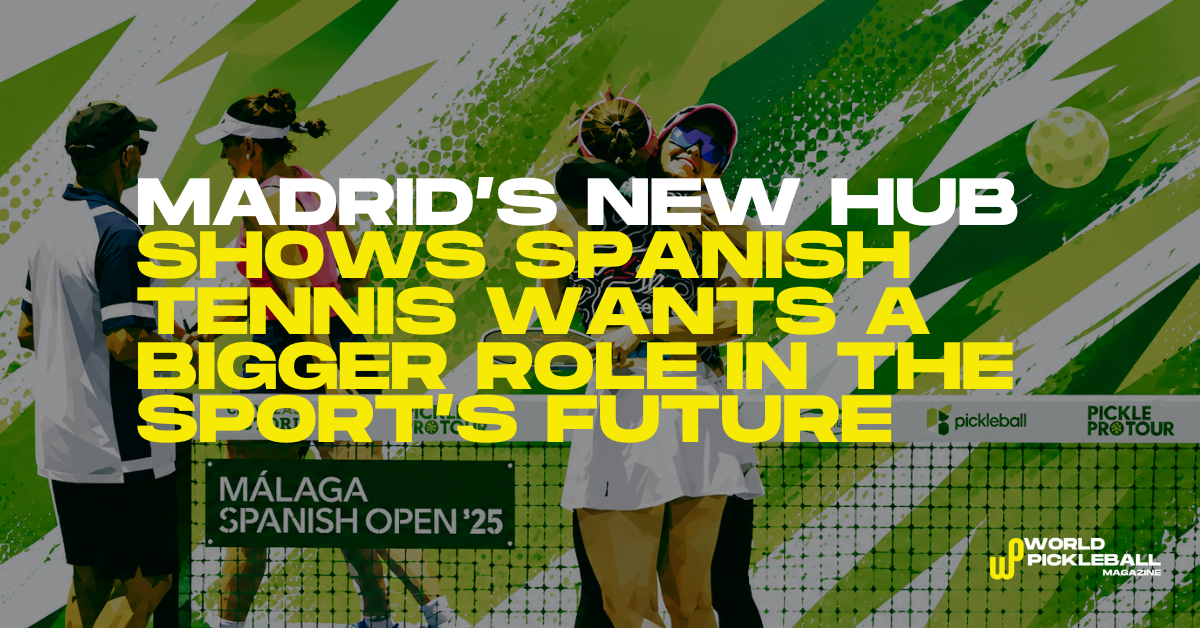
Madrid shows Spanish tennis wants a bigger role
Spain’s largest dedicated pickleball hub is not only a court-count story.
The new El Tejar de Somontes project shows how deeply the country’s tennis establishment is beginning to position itself inside pickleball’s future.
That may bring stability, better coaching pathways, stronger events and more commercial confidence. But it also raises a serious question for Spanish pickleball: who gets to shape the sport as it becomes more formal?
What matters: Spain may become an important test case for federation-backed pickleball, but it should not be treated as the whole European model yet.

Kuala Lumpur turned results into market signals
Hien Truong and Chao Yi Wang left Kuala Lumpur with singles gold medals, but the deeper story was not only who won.
It was what the results may now mean.
Truong’s unbeaten title run strengthened his standing as one of Asia’s most valuable emerging professionals. Nasa Hatakeyama’s qualifier run showed that Japan’s competitive ceiling may be higher than many assumed.
What matters: PPA Tour Asia is starting to influence rankings, reputation, recruitment and player value, not simply hand out medals.
Read the Kuala Lumpur player-market piece
Sponsored: PKLBull
Most paddles are priced like luxury products.
That does not mean they should be.
Good paddles. Dinky price. No bull.
One thing to watch
The next question is not whether pickleball can add more events, venues and markets.
It clearly can.
The harder question is whether the sport can build systems that players, tours, federations and fans can actually live with.
Asia is testing the limits of calendar density. Spain is testing federation involvement. Kuala Lumpur showed that player value can now shift quickly outside North America.
The sport is becoming bigger. More importantly, it is becoming more demanding.