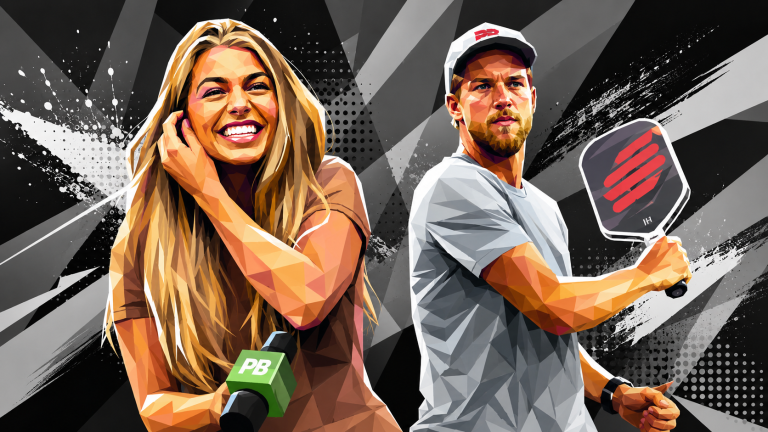

Angelina Jolie’s appearance at the Support+Feed Pickleball Invitational attracted attention. The more interesting story may be why pickleball is increasingly becoming the sport charities, communities and organisations choose when they want to bring people together.
- Angelina Jolie and her son Pax joined participants at the Support+Feed Pickleball Invitational in Los Angeles.
- Charity and community organisations are increasingly using pickleball as a fundraising and engagement tool.
- The sport’s greatest cultural impact may be its ability to connect people who would not otherwise share the same space.
The Story Behind the Celebrity Photograph
Angelina Jolie was one of the most recognisable faces at the Support+Feed Pickleball Invitational in Los Angeles.
She was also, in many ways, beside the point.
The headlines naturally focused on Jolie and her son Pax, who attended the event organised by Maggie Baird’s Support+Feed initiative.
That is understandable. Few public figures attract attention as consistently as Jolie.
Yet celebrity appearances are only part of the story.
The more interesting question is why events like this continue to choose pickleball in the first place.
Because the Support+Feed Invitational is not an isolated example.
Across North America and increasingly beyond it, charities, businesses, schools, community groups and fundraising organisations are turning to pickleball as a way of bringing people together.
That trend may tell us something important about the role the sport is beginning to play in modern culture.
If you’re following how the global game is shifting week by week, the World Pickleball Report breaks this down every day in our morning briefing.
More Than a Fundraiser
The Support+Feed event used pickleball as the vehicle for a charitable cause.
That is becoming increasingly common.
Celebrity charity tournaments, corporate pickleball days, local fundraising events and community awareness campaigns have all started incorporating the sport into their programmes.
Across the United States, the sport has appeared in celebrity-led exhibitions, school fundraisers, club charity days and community festivals. The details vary, but the format is often similar: use a simple, social sport to bring people into the same physical space.
The reasons are not difficult to understand.
Most people can learn the basics quickly.
Most people can participate without years of experience.
Most people can share a court with someone whose ability level is significantly different from their own.
That accessibility matters.
When organisers want participation rather than perfection, pickleball offers something many sports struggle to provide.
A low barrier to entry.
The Social Architecture of Pickleball
Pickleball is often described as easy to learn.
That is true.
But it may not be the most important thing about the sport.
Its real strength could be social rather than athletic.
Many sports are excellent spectator products.
Fewer are effective social products.
Pickleball encourages interaction almost by design.
Players rotate regularly.
Games are short.
Conversations happen naturally between matches.
The environment tends to feel welcoming rather than intimidating.
As a result, people who might never normally share the same sporting space often find themselves standing on neighbouring courts.
A beginner. A former professional athlete. A local business owner. A retiree. A celebrity. A teenager.
That combination is unusual.
And increasingly valuable.
Pickleball May Be Becoming What Golf Once Was
Every generation seems to develop activities that function as social connectors.
For decades, golf occupied that space in business and fundraising circles.
Charity days, networking events and corporate relationships often revolved around the golf course.
Pickleball is unlikely to replace golf entirely.
But it is increasingly serving a similar function, with one important difference.
Participation requires less time, less money and far less experience.
That distinction matters.
The sport’s critics sometimes dismiss pickleball precisely because it is informal.
Yet many organisers appear to value it for exactly the same reason.
The qualities that make pickleball less intimidating are often the same qualities that make it useful.
As WPM has explored through pieces such as Four Pickleball Debates Every Player Faces, the sport’s wider meaning often sits in the everyday experiences around the game, not just in elite competition.
Why Charities Keep Choosing It
Charity events succeed when people want to attend.
That sounds obvious.
Yet many fundraising activities struggle with accessibility.
Golf can be expensive.
Tennis can expose differences in ability quickly.
Competitive team sports often create barriers for newcomers.
Pickleball tends to lower those barriers.
The objective shifts from performance to participation.
The event becomes less about identifying the best player and more about creating an enjoyable experience.
That is particularly valuable when the real purpose is raising money, increasing awareness or building relationships.
The cause remains the focus.
The sport becomes the connector.
What This Says About Pickleball Culture
It is tempting to view celebrity appearances as evidence that pickleball has entered the cultural mainstream.
There is some truth in that.
Yet focusing entirely on celebrities risks overlooking something more significant.
The attraction is not simply that famous people show up.
It is that the sport creates an environment where participation feels possible.
Golf charity days often separate participants by ability.
Tennis exhibitions often separate professionals from amateurs.
Pickleball has a habit of placing everybody inside the same ecosystem.
That may be one reason organisations continue returning to it.
The sport is not replacing the cause.
It is helping people gather around it.
The Bigger Story
Angelina Jolie’s appearance ensured the Support+Feed Pickleball Invitational attracted attention.
The event’s significance, however, was never really about celebrity.
It was about connection.
That distinction matters.
Because if pickleball continues expanding its cultural influence, it may not be because of professional tours, broadcast deals or celebrity endorsements alone.
It may be because the sport keeps finding ways to bring together people who would otherwise never occupy the same space.
The celebrity drew the cameras.
The cause provided the purpose.
The court created the connection.
That may prove to be pickleball’s most important cultural contribution.
Further Reading
- Latest pickleball news from around the world
- Tournament coverage and results
- Rankings and player profiles
- Regional pickleball coverage
For a clearer view of where the sport is heading each month, you can download the latest free issue of World Pickleball Magazine.

Chris Beaumont
Founder and Editor-in-ChiefChris Beaumont is the founder and Editor-in-Chief of World Pickleball Magazine. Chris follows the global game closely, reporting on the latest news, developments, stories and tournaments from all five continents. He also hosts the World Pickleball Podcast, interviewing people at…
View All Articles →