Inside a climate-controlled 10-court complex in tropical Hainan, an ambitious academy is assembling a professional training apparatus for Chinese pickleball—betting that dedicated full-time coaching will produce Asia’s next global champions.
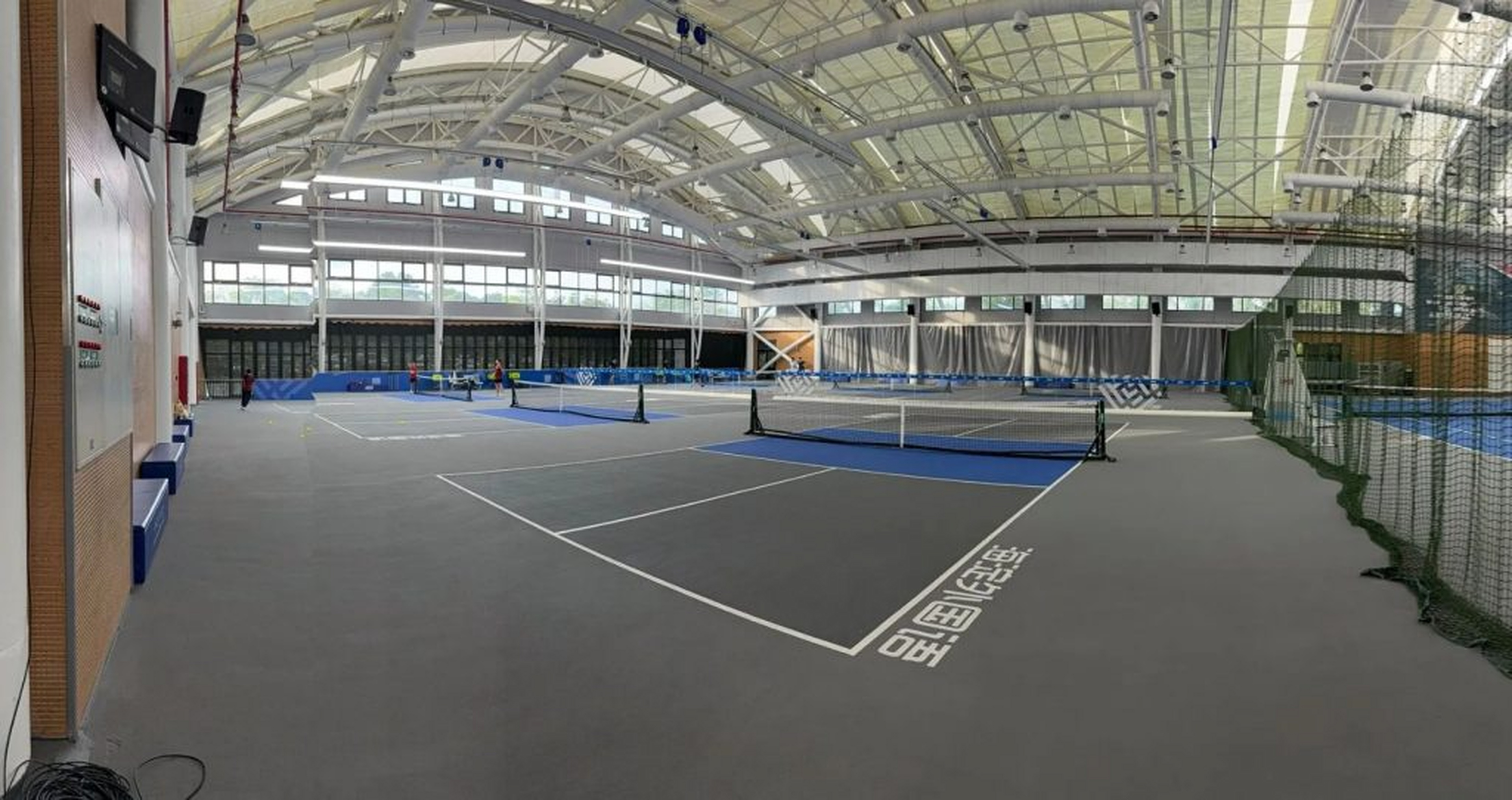
Inside the Qionghai campus of Beijing Haidian Foreign Language School, 10 indoor pickleball courts sit beneath air conditioning.
Around them is much of what a developing athlete might need: accommodation, dining facilities, gyms, physiotherapy and recovery services. Approximately 2,000 students attend the campus. A proposed second phase would add another 19 indoor courts, including a dedicated stadium court.
The scale is impressive. Mike Newell knows that it proves very little on its own.
“You can build incredible facilities, and that’s fantastic,” he says. “But ultimately, you have to be able to develop the players who walk through the door.”
Inside This Feature
The Hainan Infrastructure: Ten indoor air-conditioned courts, dedicated athlete dorms, sports medicine, and strength facilities.
The High-Performance Blueprint: Adapting China’s legendary table tennis and badminton talent development models to pickleball.
The Three-Year Timeline: Why coaches believe rapid youth development will bridge the gap to American and European tours.
That is the test facing the Asia Elite Pickleball Academy, which is due to open officially on Hainan Island in September 2026.
Developed through a partnership involving Ram Sports and Beijing Haidian Foreign Language School, AEPA has been designed as a residential high-performance environment rather than another large venue. Its players will be able to train, study, eat, recover and compete within one campus.
“It’s much more than a collection of pickleball courts,” Newell says. “We’re building a genuine high-performance academy environment.”
I have known Newell for more than five years, and throughout that time he has rarely been satisfied with looking at what a racquet sport already is. He wants to know where it is going next.
His career has taken him across almost every level of tennis, from recreational coaching to high-performance development. He has built and managed academies, held a senior role with ATP International and worked with the Pat Cash Tennis Academy in Australia. More recently, he has moved deeply into pickleball as a coach while continuing to compete at pro masters level.
Hainan may be his most ambitious project yet.
10 Courts
State-of-the-art indoor climate-controlled courts dedicated to daily professional training at the Qionghai campus.
The Missing Daily Environment
Pickleball’s growth across Asia is increasingly visible at tournaments. Vietnam, Malaysia, the Philippines and other emerging markets are producing larger fields, stronger players and increasingly ambitious events.
Competition, however, provides only part of a development system.
A player may travel to an international tournament, face a higher standard for several days and then return home without the coaching, training partners or daily structure required to sustain that progress. The calendar is growing faster than the high-performance environments supporting it.
AEPA is intended to address that gap.
FACILITIES Pristine indoor courts sheltered from Hainan’s intense tropical humidity.
The academy will offer full-time residential programmes, educational options for juniors, high-performance coaching and access to physical preparation and recovery services. Its athletes should be able to measure their development in months and years rather than in occasional tournament weekends.
China gives the project extraordinary potential.
Its established cultures in badminton, table tennis and tennis have produced athletes with sophisticated hand-eye coordination, movement skills and competitive experience. Those sports also provide coaches, training systems and families already familiar with the demands of long-term athletic development.
The opportunity lies in adapting those strengths to a different game.
“The Chinese players’ work ethic is off the charts. Full stop,” Newell says.
“You can walk into a table tennis training environment in China and see kids who can barely see over the top of the table, and they’re already grinding away, hitting thousands and thousands of balls every week.”
Repetition alone will not create elite pickleball players. Nor will success in table tennis, badminton or tennis transfer automatically. Each sport brings habits as well as advantages, and pickleball has its own movement patterns, tactical demands and pace of decision-making.
AEPA must work out which qualities to retain, which to reshape and which to teach from the beginning.
China already has athletes accustomed to disciplined training. Newell’s job is to build a programme worthy of that commitment.
If you're following how the global game is shifting week by week, the World Pickleball Report breaks this down every day in our morning briefing.
An Asian Academy Based in China
There is a reason it is called the Asia Elite Pickleball Academy.
Newell wants the campus to serve players from across the region, with athletes from Australia, Europe, North America and elsewhere eventually travelling to Hainan to train.
That international mix could become one of the academy’s most useful features.
Pickleball is being shaped by athletes from a wide range of sporting backgrounds. Tennis converts may arrive with powerful groundstrokes and an instinct for controlling space. Table tennis players bring fast hands, deception and an understanding of spin. Badminton develops explosive movement and overhead skill. Japanese soft tennis has produced its own grips, swings and angles.
A permanent academy able to bring those influences together would give its players something difficult to reproduce within a national programme. They would encounter unfamiliar techniques and ways of constructing points every day.
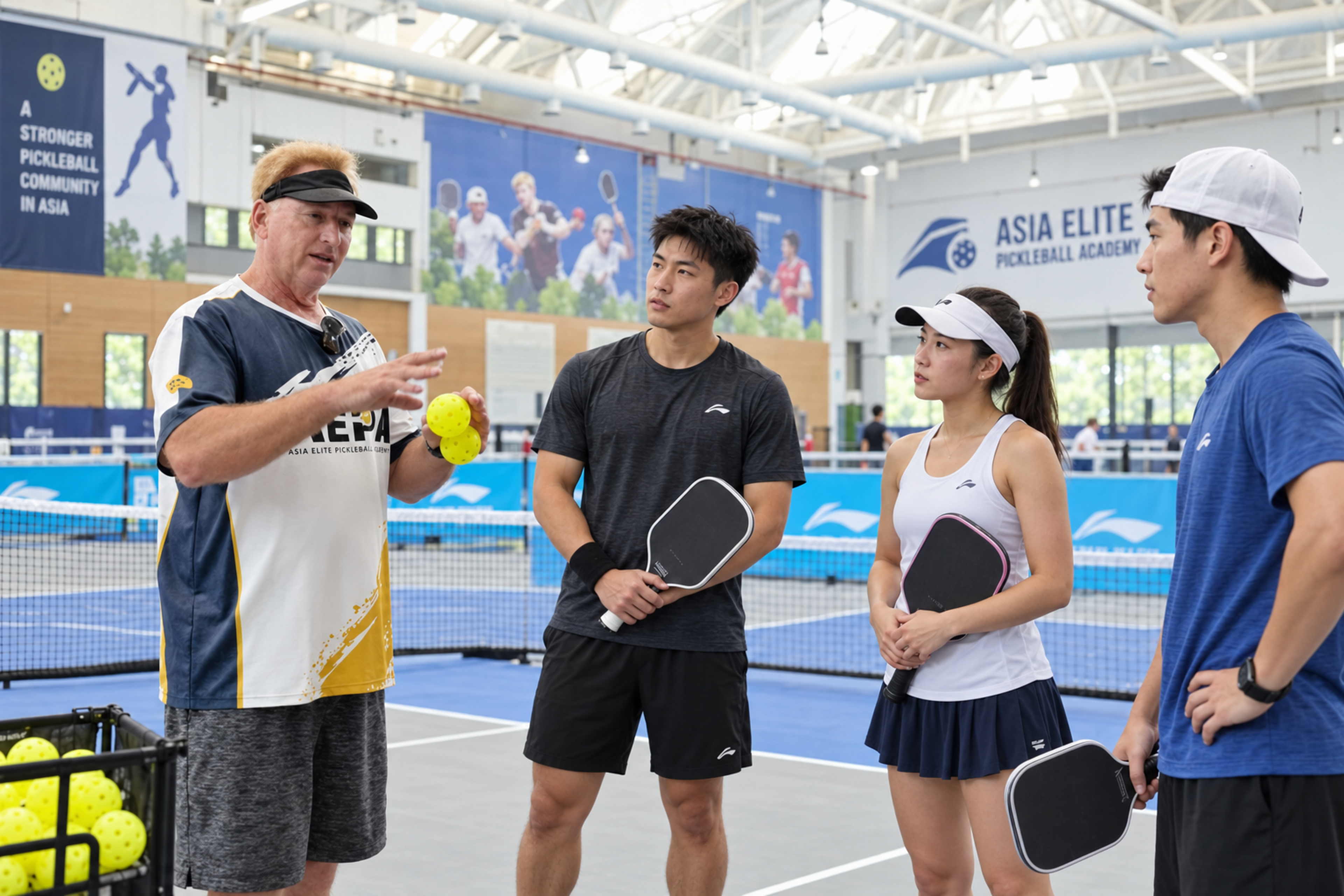
TRAINING Young athletes undergoing intensive drill regimens to build sound mechanical fundamentals.
The academy’s philosophy is also being shaped with input from Seymour Rifkind, whom Newell describes as one of his favourite mentors and an important figure in pickleball’s international development.
Facilities may attract players to Hainan. The range and quality of the people training there will determine whether they stay.
Coaching a Sport That Has Not Settled
Newell’s tennis background informs his coaching, although pickleball has also forced him to question some of the conventions formed in a mature racquet sport.
Tennis technique has been studied and refined across generations. Its coaching systems have broadly accepted models for strokes, movement and tactical development.
Pickleball remains far less settled.
Its best players use different grips, swings and movement patterns. Some techniques that appear unconventional through a tennis lens are highly effective within pickleball’s smaller court and rapid exchanges.
Newell points to Riley Newman and players arriving from Japanese soft tennis as examples. Their methods may not fit a traditional technical model, but their results demand attention.
He has seen another kind of individuality in Tama Shinabukuro, a young player with a skateboarding background whom Newell calls “the conductor”. The nickname comes from Shinabukuro’s ability to direct points and create shots other players may not see.
Newell wants AEPA to provide clear foundations without turning every athlete into the same player.
“We obviously need to teach strong fundamentals, movement, decision-making, strategy and technical efficiency,” he says. “But as coaches, we also need to recognise what makes an individual athlete special and be very careful that we don’t coach that uniqueness out of them.”
The balance will be difficult.
An academy needs structure. Its coaches must share principles and players require reliable ways to measure improvement. A rigid technical model, however, could remove the instincts or movements that give an athlete an unusual advantage.
In a sport this young, today’s unconventional technique can become tomorrow’s standard.
“We’re not just teaching the game,” Newell says. “We’re still helping discover what the game can become.”
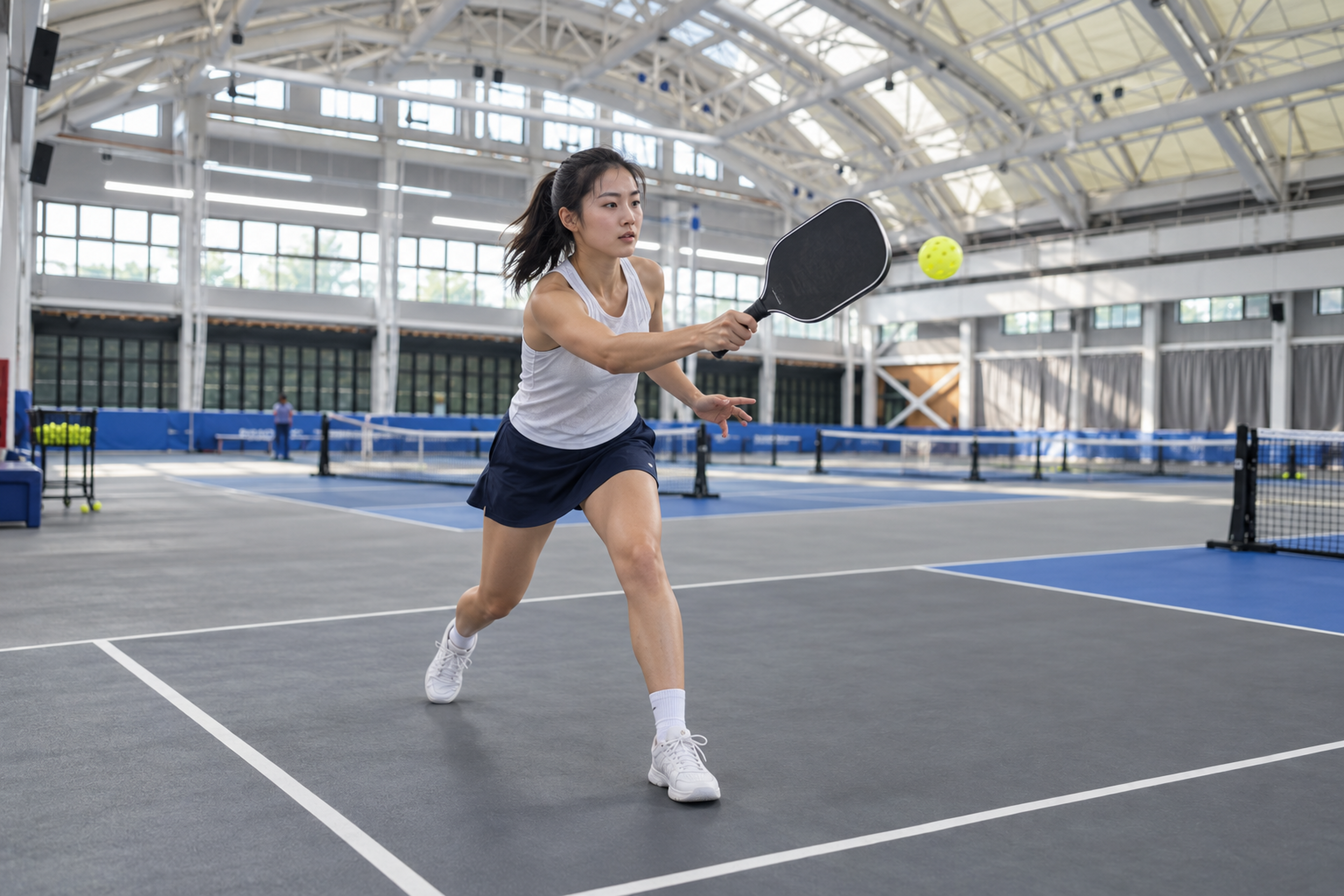
HIGH PERFORMANCE Combining paddle skills with modern athletic conditioning and sports science.
3 Years
The aggressive development timeline envisioned to take talented junior athletes from raw fundamentals to the top of Asian competition.
“In three years, you can take a disciplined athlete who has never held a paddle and turn them into an Asian champion if they train every single day.”
Head Coach, Hainan International Pickleball Academy
Three Years From Beginner to the Top of Asia
Newell has already tested elements of the academy model on a smaller scale.
In 2025, he recruited and coached the Ram Sports professional team, travelling with its players and providing an early version of the environment he now wants to establish permanently in Hainan.
Roos van Reek became its clearest development story.
Newell began coaching van Reek around three years ago, when she had never played pickleball. She was a tennis coach with whom he had previously worked in Australia, and he recognised athletic ability and an appetite for training that he believed could transfer.
He first had to teach her a new game. Their work later expanded through the Ram Sports Pro Team, which brought international travel, stronger competition and more intensive coaching.
Within three years, van Reek had risen to the top of the women’s game in the Asia-Pacific region. Newell also regards her as comfortably one of the world’s top 15 female players, although pickleball’s competing tours and ranking systems make exact global comparisons difficult.
Her wider significance to AEPA is clearer.
Van Reek entered pickleball with transferable qualities but no history in the sport. Daily coaching turned those qualities into pickleball skills. Competition then exposed the areas that training needed to address.
The process could be repeated, though the outcome cannot be guaranteed.
A large academy will encounter athletes who develop at different speeds and require different methods. Some will flourish. Others may prove better suited to the sport they came from. The strength of AEPA will depend on whether it can recognise both quickly enough.
Newell now wants to find out what happens when the model is given a permanent home.
Professionals, National Teams and College
Producing professional players would give the academy its most visible measure of success. Newell has broader ambitions for its graduates.
He believes the developing collegiate pickleball system in the United States could eventually provide educational opportunities for talented Asian juniors.
“If one of our athletes can use their pickleball ability to help create an opportunity to study in the United States, compete in a fantastic collegiate environment and graduate with a degree, that’s an incredible outcome,” he says.
NEXT GENERATION Building China’s future tournament roster from a disciplined grassroots pipeline.
The pathway is still emerging. College pickleball does not yet offer the established recruitment and scholarship structure found in many traditional American sports. Its growth nevertheless creates possibilities that did not exist for young pickleball players a few years ago.
Within five years, Newell hopes AEPA graduates will be competing professionally, representing their countries and pursuing university opportunities.
Brisbane 2032 sits just beyond that period. Pickleball is not currently on the Olympic programme, and there is no certainty that it will be added. Newell still allows himself to imagine what it would mean if an athlete developed at the academy eventually reached that stage.
“If, five years from now, we can look around the world and see players who came through the Asia Elite Pickleball Academy competing professionally, pursuing university opportunities and wearing their country’s colours in international competition, then I’ll be able to sit back and say, ‘Yep, we did our job.’”
Before any of that can happen, the academy must do the daily work.
Courts must be filled with the right coaches and players. Junior education must fit around training. International athletes must be persuaded to make Hainan part of their development. Progress must continue after the excitement of the opening has passed.
Nineteen additional courts would make the facility larger. Better players would make the academy matter.
The 7XL Reality Check
Building an international academy in another country inevitably brings the occasional cultural lesson.
Newell received one during an AEPA adult camp when participants were issued academy shirts manufactured in Chinese sizing.
He admits he is currently around 92 kilograms, rather than his preferred fighting weight of 85. Even so, he was not prepared for the label inside his shirt.
7Xl.
“I can walk into Nike or Adidas and buy an XL, and it’s usually relatively baggy on me,” he says.
“Apparently, though, according to Chinese sizing, I’m a 7XL.”
Newell has arrived in Hainan with plans for future professionals, international training groups and perhaps, one day, an Olympian.
Chris Beaumont is the founder and Editor-in-Chief of World Pickleball Magazine. Chris follows the global game closely, reporting on the latest news, developments, stories and tournaments from all five continents. He also hosts the World Pickleball Podcast, interviewing people at…