
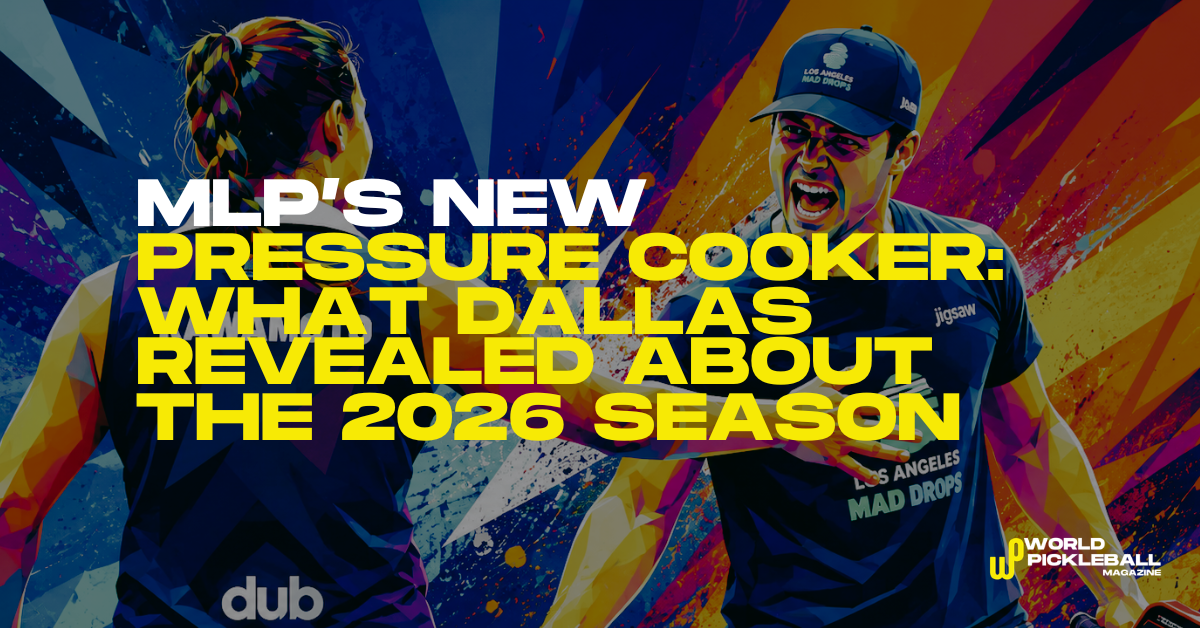
The Los Angeles Mad Drops may have left Dallas with the first MLP title of 2026, but the opening weekend revealed something bigger than one team’s victory. Major League Pickleball’s new structure has already changed the behaviour of the league itself.
- The Los Angeles Mad Drops opened the 2026 Major League Pickleball season with a title win over the Columbus Sliders in Dallas
- MLP’s revised standings system immediately raised the pressure across group-stage play
- The debut of the Owl AI review system exposed how quickly teams will search for tactical loopholes
By the end of opening weekend in Dallas, one thing already felt different about Major League Pickleball.
Not the winner.
The pressure.
Group-stage matches carried the tension of elimination ties. Teams burned through challenges to interrupt momentum swings. Bench reactions sharpened. DreamBreakers felt less like entertainment devices and more like survival mechanisms.
And the season was only a few days old.
That atmosphere was the clearest takeaway from Dallas, where the Los Angeles Mad Drops claimed the opening event of the 2026 season with a 3-1 victory over the Columbus Sliders.
The Mad Drops Took The Title, But The Format Shaped The Weekend
The Sliders struck first in the final when Danni-Elle Townsend and Alix Truong edged Catherine Parenteau and Jade Kawamoto 13-11 in women’s doubles.
From there, Los Angeles stabilised quickly.
Ben Johns and Max Freeman helped swing momentum back in men’s doubles before the Mad Drops closed the tie through mixed doubles, including an 11-6 win for Kawamoto and Johns over Truong and Andrei Daescu.
The Mad Drops completed the weekend unbeaten and collected 25 standings points under MLP’s revised 2026 scoring structure.
But the most revealing part of Dallas was not simply who won. It was how quickly the league’s new incentives changed player and team behaviour.
If you’re following how the global game is shifting week by week, the World Pickleball Report breaks this down every day in our morning briefing.
Why The Matches Suddenly Felt Different
MLP’s updated standings model heavily rewards event placement, dramatically increasing the value of every pool-stage result. In previous seasons, parts of opening weekends could drift once qualification scenarios became clearer.
Dallas rarely felt like that.
Matches carried urgency immediately because the new format compressed the margins between gaining momentum and falling behind in the standings race. Teams were no longer simply trying to survive weekends. They were chasing separation points from the opening day onward.
The effect became especially visible during Los Angeles’ comeback victory against the St. Louis Shock. Trailing 0-2, the Mad Drops recovered to force a DreamBreaker before winning 21-15.
In previous MLP environments, early-season ties sometimes felt experimental. Dallas felt optimised.
That distinction matters.
Professional sports leagues become more sophisticated when teams stop reacting emotionally and start responding strategically to incentive structures. Dallas showed MLP entering that phase quickly.
The official Major League Pickleball calendar now carries a different kind of weight because each stop can shape the standings picture almost immediately.
The Owl AI Loophole
The clearest example arrived through the league’s new Owl AI review system.
Technologically, the system offered obvious benefits. Reviews were faster, broadcasts had cleaner replay integration, and officiating transparency improved.
But teams almost immediately identified a secondary use for challenges.
Timeouts.
Late in games, players repeatedly used reviews on marginal or clearly unsuccessful calls simply to interrupt momentum, slow opponents down or create extra recovery time between points. The reviews became tactical resets disguised as officiating disputes.
That development may prove one of the most important lessons from opening weekend.
Because it revealed something fundamental about where MLP now sits competitively: teams are no longer simply playing matches. They are actively searching for edges inside the structure of the league itself.
Rule systems create behaviour. Players and coaches optimise around incentives. If a loophole exists, somebody will eventually weaponise it.
Dallas suggested MLP may have accidentally created a strategic timeout mechanism within its challenge system.
A More Ruthless Competitive Environment
League intervention now feels likely.
Potential fixes could include harsher penalties for failed reviews, restrictions on late-game challenges, retained challenges only for successful appeals, or timeout deductions linked to unsuccessful reviews.
What matters most is not the exact solution. It is the speed at which the loophole emerged.
The season barely started before teams identified exploitable margins.
Dallas also hinted at something else: the league may now have genuine competitive depth beyond one or two dominant rosters.
Rather than feeling top-heavy, opening weekend suggested five to seven teams could realistically win events depending on matchups, mixed doubles combinations and DreamBreaker performance.
That parity appears driven by several overlapping factors: stronger roster balancing, increasing tactical sophistication, improved depth across mixed doubles, tighter margins between elite teams and the volatility built into the current format.
Even the way top players approached matches felt different.
Johns, in particular, looked less like a superstar pacing himself through another regular-season stop and more like a player recognising how thin the margins now are. His court coverage in mixed doubles repeatedly tilted momentum back toward Los Angeles, particularly during extended transitional exchanges.
That intensity reflected the wider atmosphere around the event.
MLP no longer feels experimental. It feels compressed. Sharper. Less forgiving.
And once professional leagues reach that point, optimisation accelerates quickly.
What This Means
Dallas may ultimately be remembered less for the Mad Drops winning the opening event and more for revealing the next stage of MLP’s evolution.
The league’s revised structure increased pressure immediately. The Owl AI system introduced tactical manipulation. Teams already appear more sophisticated in how they approach margins, momentum and incentives.
That combination creates a more compelling league.
But it also creates a harsher one.
The Mad Drops leave Dallas as the first leaders of the 2026 season, but opening weekend may have revealed something even more important: Major League Pickleball has started behaving like a fully professional ecosystem now, with all the ruthlessness that comes with it.
Further Reading
- Latest pickleball news from around the world
- Tournament coverage and results
- Rankings and player profiles
- Regional pickleball coverage
For a clearer view of where the sport is heading each month, you can download the latest free issue of World Pickleball Magazine.

Chris Beaumont
Founder and Editor-in-ChiefChris Beaumont is the founder and Editor-in-Chief of World Pickleball Magazine. Chris follows the global game closely, reporting on the latest news, developments, stories and tournaments from all five continents. He also hosts the World Pickleball Podcast, interviewing people at…
View All Articles →