
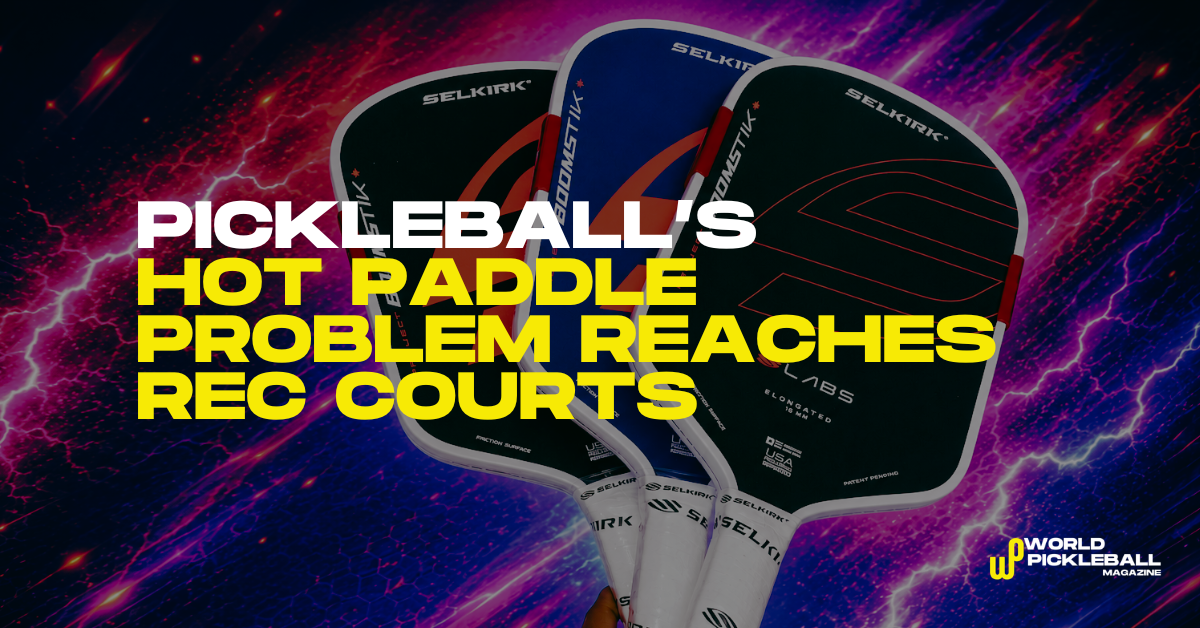
The debate around “hot paddles” is no longer confined to pro pickleball message boards and equipment testers. Following this week’s landmark eye-protection decision at the Coeur d’Alene Classic, attention is increasingly turning toward a more uncomfortable question: has amateur pickleball become significantly faster than the recreational side of the sport is prepared for?
- Concerns around “hot paddles” are increasingly moving beyond fairness debates and into safety conversations at recreational level.
- Many amateur tournaments and clubs lack realistic ways to consistently identify altered, counterfeit, or heavily delaminated paddles.
- The speed of the modern game may now be evolving faster than the volunteer-led infrastructure governing most recreational pickleball.
Before the match had even started, the paddle was already being discussed.
Not the players. Not the scoreline.
The paddle.
One player thought the ball sounded unusually loud during warm-up. Another commented that drives seemed to be jumping off the face faster than expected. By the second game, players from neighbouring courts were quietly watching too.
Scenes like this are becoming increasingly familiar across amateur pickleball.
And after the recent decision by the Coeur d’Alene Classic to mandate protective eyewear for all competitors, conversations around paddle speed and player safety are no longer sitting quietly at the edges of the sport.
They are moving toward the centre of it.
What Is A “Hot Paddle”?
In simple terms, a hot paddle is a paddle that produces more rebound speed and power than expected or allowed, reducing reaction time for opponents and often generating noticeably more “pop” off the paddle face.
Sometimes that happens through illegal modification.
Increasingly, though, the issue is more complicated than straightforward cheating.
Many modern pickleball paddles are built using layered internal structures designed to maximise power and spin. Over time, those layers can separate, weaken, or degrade through repeated impact. That process is commonly referred to as delamination.
When a paddle delaminates, it can start behaving differently.
Players often describe:
- the ball “jumping” unexpectedly off the face
- unusually loud or hollow contact sounds
- increased power with minimal swing effort
- inconsistent rebound speeds
- altered vibration or feel during contact
None of those signs automatically prove a paddle is illegal.
That is precisely why the issue has become so difficult to regulate.
If you’re following how the global game is shifting week by week, the World Pickleball Report breaks this down every day in our morning briefing.
The Enforcement Problem Nobody Has Solved
At the professional level, tours can gradually introduce stricter testing environments, controlled equipment checks, and specialist officiating.
Most recreational pickleball has none of that.
Local tournaments often rely on volunteer referees. Open-play environments usually have no equipment inspection at all. Many clubs simply assume paddles being brought onto courts are legal and safe.
Increasingly, that assumption is becoming harder to guarantee.
Tournament directors say counterfeit versions of premium paddles are becoming easier to purchase online, while heavily worn or damaged paddles may drift into grey areas without players themselves fully understanding what has happened to the equipment.
In many amateur environments, paddle checks are still limited to visual inspection, informal sound testing, or player complaints. Sophisticated testing equipment is rarely available outside elite events.
The challenge is not simply that hot paddles exist.
It is that recreational pickleball may have no realistic way of consistently identifying them.
Professional sports usually evolve governance and enforcement alongside equipment innovation. Recreational pickleball has largely evolved the equipment first.
That gap is becoming increasingly difficult to ignore.
Why Recreational Play May Be More Vulnerable
The irony is that the biggest safety concerns may not emerge first on the professional tour.
They may emerge during open play.
Professional players at least operate inside controlled environments with elite reaction speed, structured officiating, and a clear awareness of the pace of the modern game.
Recreational pickleball looks very different.
Mixed ability levels. Crowded courts. Social atmospheres. Older demographics. Minimal protective equipment. Limited enforcement. Players arriving with paddles purchased online and rarely questioned.
Yet the speed of the ball can still become extreme, particularly at kitchen-line distance.
That matters because many of the most dangerous incidents in pickleball are not full-court exchanges. They are deflections.
A driven ball catching the edge of a partner’s paddle from only a few feet away can redirect toward the face before a player has time to react. Tournament operators increasingly believe those “friendly fire” moments are contributing to a growing number of serious eye injuries around the sport.
The modern pickleball court increasingly asks for professional-level reactions inside an amateur environment.
The Sport’s Culture Is Changing Too
For years, pickleball’s culture was built heavily around trust, informality, and self-regulation.
Equipment checks were rare. Players largely assumed opponents were using legal paddles. Recreational play often felt more social than regulated.
That culture is beginning to strain under the pressure of accelerating equipment technology.
Now players quietly discuss suspicious sounds during warm-ups. Tournament directors field equipment complaints. Referees are increasingly pulled into paddle disputes despite lacking sophisticated testing tools.
The modern paddle debate is no longer simply about performance.
It is about whether the sport still trusts its own equipment environment.
What Happens Next?
Nobody seriously expects paddle innovation to stop.
Nor should it.
Technology evolution exists in every modern racket sport. Manufacturers will continue chasing spin, feel, responsiveness, and power because players demand it.
The bigger question is whether the sport’s governance and recreational infrastructure can evolve quickly enough alongside that technology.
That could eventually mean stronger certification systems, more standardised tournament testing, club-level paddle policies, wider protective eyewear adoption, greater manufacturer scrutiny, and insurance-driven safety requirements.
For now, though, much of amateur pickleball still operates on informal trust inside an increasingly high-speed equipment environment.
The sport still presents itself as social, informal, and accessible. Increasingly, though, the speed of the modern game is forcing local clubs and tournament operators to confront a much more difficult question: what happens when recreational infrastructure is suddenly asked to govern professional-level pace?
Further Reading
- Latest pickleball news from around the world
- Tournament coverage and results
- Rankings and player profiles
- Regional pickleball coverage
For a clearer view of where the sport is heading each month, you can download the latest free issue of World Pickleball Magazine.

Chris Beaumont
Founder and Editor-in-ChiefChris Beaumont is the founder and Editor-in-Chief of World Pickleball Magazine. Chris follows the global game closely, reporting on the latest news, developments, stories and tournaments from all five continents. He also hosts the World Pickleball Podcast, interviewing people at…
View All Articles →