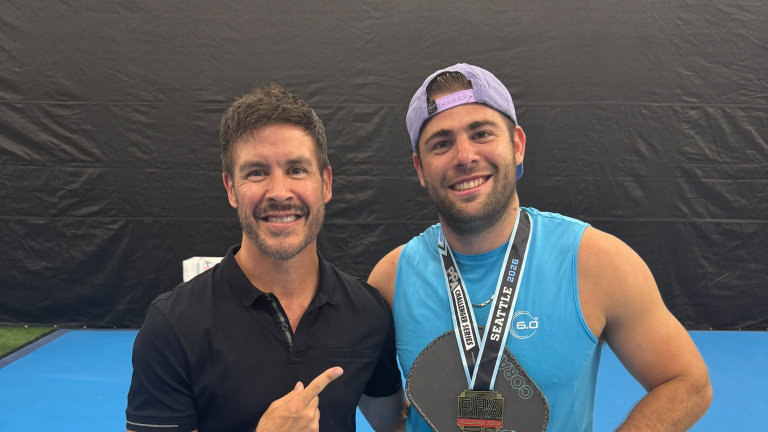

There is a sound James Ignatowich is listening for.
It is lower and heavier than the sharp crack produced by many power paddles. The ball sinks into the face for a fraction longer, then leaves with a thud.
That sound is one of the qualities Ignatowich associates with the new RPM Jade. It comes from a material that changes as it is played, gradually opening up and giving the paddle more power.
For a professional player, that evolution can feel exciting. For the co-founder of a paddle company, it creates a more difficult question.
Can you make thousands of them feel the same?
That is the challenge sitting at the centre of RPM’s next phase. The company has already moved from launch brand to serious industry presence. Now it must turn the instincts of one of pickleball’s most technically curious players into products that arrive consistently, perform legally and survive the scrutiny of reviewers who can measure almost everything.
Jade is the clearest expression yet of that ambition.
According to Ignatowich, RPM received more than 10,000 preorders for the paddle ahead of its planned September 30 release. Its listed price was $269, falling to $229 through an affiliate code.
Those numbers are company figures rather than independently audited sales data, but they reveal the scale RPM believes it is operating at. This is no longer a professional player attaching his name to a small production run.
Ignatowich is trying to build a major paddle business.
Player, Founder, Salesman
Professional athletes have advised equipment companies for years. Some test prototypes. Some lend their names to signature models. Some become prominent marketing faces.
Ignatowich’s involvement with RPM goes much deeper.
He is the company’s co-founder and majority owner. He has described spending six hours a day studying materials science and paddle engineering during RPM’s early development, testing dozens of prototypes and working directly with manufacturers.
More recently, that work has taken him to Shenzhen, China, where he has been involved in RPM’s production operations on the ground.
It places him in an unusual position. He can describe a paddle as the athlete who has to compete with it, the founder responsible for producing it and the salesman asking customers to buy it.
Those interests frequently align. They are not identical.
A professional wants the hottest possible version of a paddle. A manufacturer has to account for tolerances, durability, certification and the possibility that a product’s performance will change after hundreds or thousands of impacts.
The difference between a prototype and a commercial product is repetition.
A prototype needs to feel right once. A product needs to feel right every time somebody opens the box.
If you're following how the global game is shifting week by week, the World Pickleball Report breaks this down every day in our morning briefing.
The Factory as a Competitive Advantage
RPM’s first major product launches exposed the risks of rapid demand. The company struggled with availability as batches sold through and inventory disappeared.

Ignatowich’s answer was to become more closely involved in manufacturing.
He describes RPM as having a factory in China dedicated to its production. That does not necessarily mean RPM owns the building. It means the company says it has secured dedicated manufacturing capacity and a closer working relationship with the people producing its paddles.
That distinction matters.
Much of the pickleball paddle industry depends on Chinese manufacturing. Brands may work with the same general manufacturing regions, material suppliers and construction techniques. Their competitive advantage increasingly comes from specifications, quality control, testing and the strength of their factory relationships.
Ignatowich believes being close to production allows RPM to move faster. A material can be changed, a prototype produced and the result evaluated without the delays created by a long chain of intermediaries.
The arrangement is also intended to improve consistency.
Ignatowich said RPM’s in-factory spin testing had produced results within approximately one per cent of testing conducted using reviewer John Kew’s methodology. That remains a company-reported comparison, but it illustrates what RPM is trying to achieve: factory measurements that anticipate what independent reviewers will find after release.
In the modern paddle market, reviewers are effectively running a second certification system.
A paddle can pass an official standard and still face questions about spin loss, break-in, structural durability or unit-to-unit variation. A few inconsistent samples can quickly become a wider story about an entire model.
The factory, therefore, is more than a production facility. It is part laboratory, part quality-control department and part defence against the internet.
Why Jade Sounds Different
At the centre of Jade is what RPM describes as an MPP core.
Ignatowich contrasts the material with expanded polypropylene, or EPP, which is already familiar in full-foam paddle construction. In his explanation, EPP offers greater consistency but can lose performance as its structure deteriorates. The MPP material used in Jade behaves differently. It changes as it breaks in and, according to RPM, can become more powerful.
That process produces the thud.
It also creates a manufacturing complication. Ignatowich says MPP can vary among suppliers, meaning two materials carrying the same broad description may behave differently once placed inside a paddle.
This is where player feel collides with production engineering.
Ignatowich can identify the response he wants. RPM then has to define that sensation in measurable terms and reproduce it across thousands of units.
It must also ensure that a paddle which gains power through use remains within the applicable performance limits.
Break-in has become one of the most sensitive issues in paddle development. Players want equipment that becomes comfortable and responsive. Regulators and consumers need confidence that its performance will not change beyond acceptable limits.
RPM’s task is to control that evolution rather than eliminate it.

“The ball sinks into the face for a fraction longer, then leaves with a thud. That sound is one of the quickest ways to tell what a paddle is doing.”
James Ignatowich, Professional Athlete & Paddle Innovator
A Surface Designed to Wear
The Jade also introduces what RPM calls Tier 1 durable grit.
Traditional raw carbon-fibre faces generate spin partly through surface texture. That texture wears down through repeated contact with the ball, and a paddle that once produced heavy spin may become noticeably smoother.
RPM’s approach places hard particles within the resin system of the paddle face rather than relying solely on texture at the surface.
As the outermost layer wears, more particles are exposed. In principle, the surface continues to produce friction rather than simply becoming polished.
RPM has used materials including silicon carbide in describing the Jade face. Ignatowich has also discussed other hard particles that can potentially be incorporated into this type of construction.
The broad concept is straightforward. Wear is treated as part of the design.
The harder questions concern how long that performance lasts, how consistently the material is distributed and whether the paddle continues to behave as intended after sustained use. Those answers will come from longer-term independent testing rather than launch-day measurements.
If the construction works as RPM claims, however, it could address one of the most persistent complaints in the premium paddle market.
Players are increasingly unwilling to pay more than $200 for a surface that feels dramatically different after a few months.
Who Controls the Conversation?
A modern paddle launch does not happen through a traditional advertising campaign alone.
It happens through YouTube reviews, podcasts, Instagram clips, Discord groups, affiliate links and spreadsheets maintained by people who test swing weight, spin, power and twist weight with growing precision.
Reviewers have become central to the paddle economy. Their measurements can legitimise a product, while their discount codes can account for a significant portion of its sales.
That creates an unusual relationship.
The reviewer is part critic, part retailer and part media outlet. The brand wants favourable coverage, but it also wants access to the reviewer’s audience. The reviewer wants independence, but may earn money each time a viewer buys the product being discussed.
Ignatowich understands that system because he participates in it constantly. He appears on long-form interviews, talks openly about unreleased products and gives reviewers unusual access to RPM’s development process.
It is effective marketing because it rarely looks like conventional marketing.
The strategy also exposes RPM to greater scrutiny. Every technical explanation becomes a promise. Every predicted release date can be checked. Every prototype mentioned publicly creates an expectation that the finished paddle will eventually appear.
Pickleball’s equipment market now resembles the trainer business more than the traditional racquet industry. Products arrive quickly, colourways matter, scarcity drives attention and online personalities can move inventory in hours.
RPM has chosen to operate inside that noise rather than above it.

The Risks of Being Public
The company’s visibility is amplified by Ignatowich’s willingness to speak directly and by the online activity of co-founder Marwan Abaza.
Ignatowich has described Abaza as a “loose cannon”, a phrase that captures both the energy and the risk of RPM’s public personality. Disputes involving brands, reviewers or competitors can quickly become content, dragging Ignatowich into conversations that have little to do with foam density or paddle construction.
For a young company, attention can be valuable. Uncontrolled attention can also weaken the distinction between a founder’s personality and the quality of the product.
RPM wants to become larger than Ignatowich’s playing career. Doing that will eventually require the brand to be trusted by customers who do not follow every interview, know every professional rivalry or recognise the people behind its social accounts.
The paddle has to carry the story on its own.
What Comes After Jade
Jade is one product in a development pipeline that Ignatowich discusses with unusual openness.
He has outlined a third-generation Strike incorporating the company’s durable-grit technology. He has also discussed a future adjustment to the Q3 core, with December mentioned as a possible target at the time of the interview.
Another concept, the Diesel, is being developed as a heavier widebody paddle. Ignatowich described a target weight of approximately 8.5 to 8.6 ounces and a 4.5-inch handle, with the paddle intended particularly for right-side men’s doubles players who value stability and hand speed over an elongated shape.
Other ideas are moving more slowly.
The Bird has been placed on the back burner. RPM has also explored potential work with Michigan-based materials company Revlin, including experiments involving flax and volcanic rock. Ignatowich has presented that project as exploratory rather than a confirmed commercial release.
The distinction is important. Paddle development produces more ideas than products. Materials that sound compelling in an interview still have to survive prototyping, certification, production economics and consumer testing.
A credible pipeline includes concepts that never reach the market.
The Sound of Consistency
Ignatowich’s greatest asset as a paddle designer may be his sensitivity to small changes.
He can feel when a face is too stiff, when a core holds the ball for the wrong fraction of a second or when a paddle’s response changes after break-in. That sensitivity helped turn RPM from an idea into a legitimate equipment company.
Its next challenge requires a different kind of discipline.
The aim is no longer to make one paddle that produces the right thud. It is to define why it sounds that way, control the materials that create it and build thousands more that behave the same.
That is the real arms race in pickleball equipment.
Power can be measured. Spin can be tested. New materials can be sourced and new surfaces can be promoted.
Consistency is harder.
The winner will be the company that can make every paddle inside every box tell the same story.
For a clearer view of where the sport is heading each week, you can join the World Pickleball Report here.

Chris Beaumont
Founder and Editor-in-ChiefChris Beaumont is the founder and Editor-in-Chief of World Pickleball Magazine. Chris follows the global game closely, reporting on the latest news, developments, stories and tournaments from all five continents. He also hosts the World Pickleball Podcast, interviewing people at…
View All Articles →