
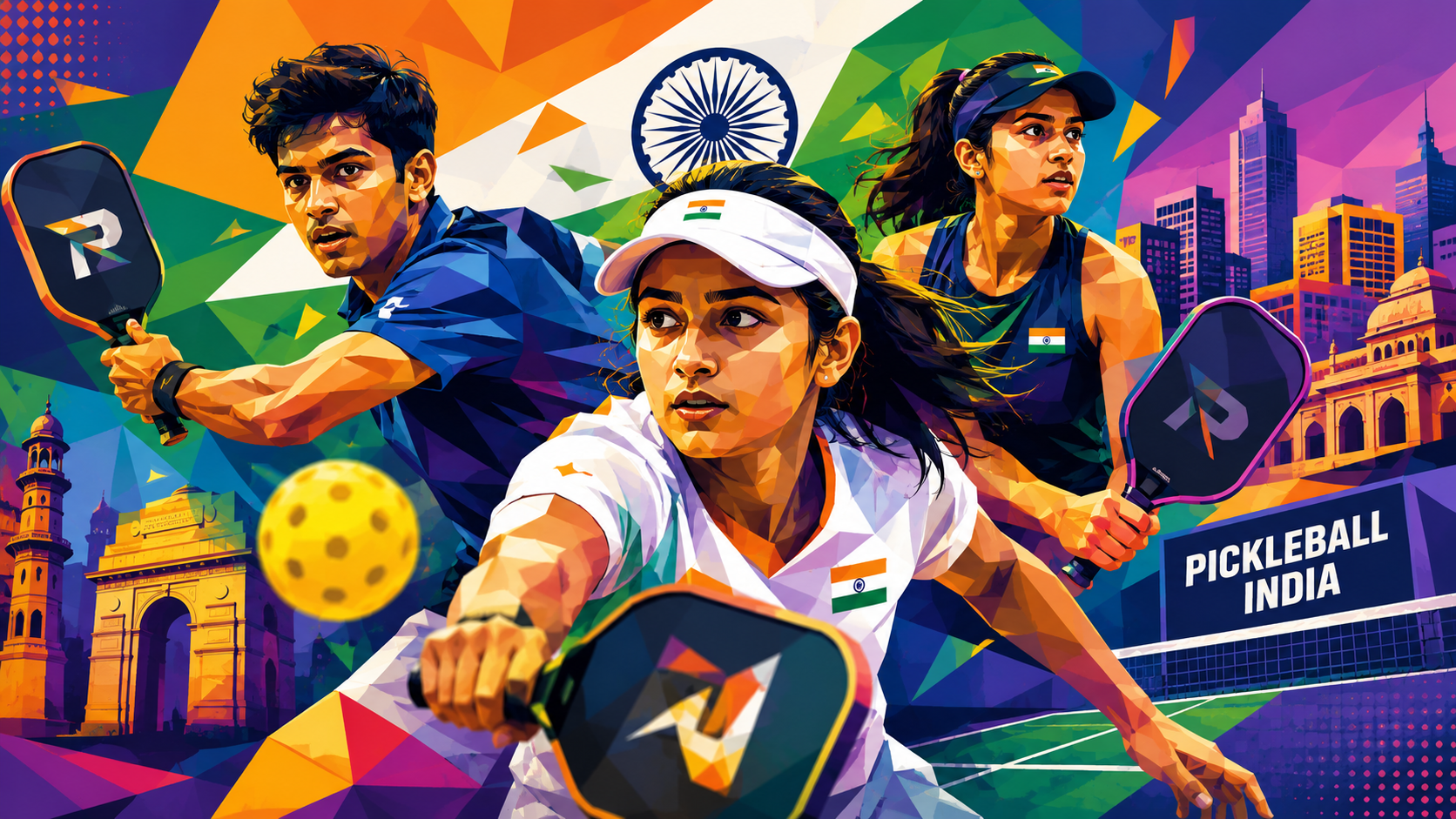
The medal winners from the West Zone Pickleball Championship tell only part of the story. The bigger development may be India’s increasingly structured pathway for producing future elite players and its attempt to build something many emerging pickleball nations still lack: a system.
Key Takeaways
- More than 300 players competed at the inaugural West Zone Pickleball Championship in Pune.
- Athletes emerging from AIPA-backed development programmes continued a trend already seen at regional level.
- India’s zonal structure may prove more important to the country’s long-term pickleball future than any single medal table.
If you’re following how the global game is shifting week by week, the World Pickleball Report breaks this down every day in our morning briefing.
The Most Important Result Wasn’t on the Medal Table
At first glance, the inaugural West Zone Pickleball Championship looked like a straightforward success story.
More than 300 competitors gathered in Pune. Young players collected medals. Coaches celebrated. Organisers pointed to another successful event on an increasingly crowded domestic calendar.
The headline performers were easy to identify.
Anjali captured five medals, including three golds across the Under-18 divisions.
Shreyas Rajaram added another five medals spanning both junior and open competition.
Those achievements deserved attention.
Yet the most important outcome of the championship may not have been who won.
It may have been what the tournament itself represented.
Because while most countries are still trying to grow participation, India is increasingly trying to answer a different question.
What comes after growth?
Most Countries Have Players. Few Have Pathways.
Pickleball’s global expansion has been remarkably fast.
Across Europe, Asia, South America and Africa, new clubs continue to appear. Participation is rising. Courts are being built. Tournaments are becoming more common.
But participation alone does not create elite players.
Pathways do.
The difference is significant.
A pathway provides structure. It creates progression. It allows players to understand where they are, what comes next and how they advance.
Without that framework, talent often develops randomly.
With it, development becomes repeatable.
That is what makes India’s zonal championship structure increasingly interesting.
The West Zone Championship forms part of a wider competitive framework led by the growth of Indian pickleball, where regional events can feed into broader national opportunities.
Viewed individually, each tournament matters.
Viewed collectively, they begin to resemble something more substantial.
They begin to resemble a system.
Building a Ladder Instead of a Tournament Calendar
Many sports organisations can organise tournaments.
Far fewer successfully connect them.
That distinction may ultimately determine whether India becomes a major pickleball nation.
The significance of the zonal championships is not simply that players compete.
It is that players progress.
The strongest performers gain exposure to stronger opposition. Young athletes experience increasingly demanding environments. Coaches gain opportunities to evaluate talent against larger fields.
The result is a competitive ladder rather than a collection of disconnected events.
That matters because sustainable sporting success is rarely built around one exceptional generation.
It is built around a process that continually produces the next one.
The development of player pathways is one of the major questions facing emerging pickleball nations, and India is starting to provide one of the clearer case studies.
The All India Pickleball Association has spent several years investing in that process, with grassroots work sitting at the centre of its development model. The national body lists player development and tournament growth among its core areas of work through the official All India Pickleball Association.
The performances in Pune suggest those investments are beginning to create visible results.
The Evidence Is Beginning to Repeat
One successful championship can be dismissed as a good week.
Two can be viewed as coincidence.
Repeated outcomes become harder to ignore.
The West Zone Championship follows encouraging performances from athletes emerging through the same development structure at the East Zone Championship.
That consistency may be the most encouraging sign of all.
The objective is not to produce one outstanding junior player.
The objective is to produce dozens.
Strong sporting nations are rarely defined by their stars.
They are defined by their depth.
That is why the achievements of players such as Anjali and Shreyas matter beyond their medal counts.
They provide evidence that athletes are beginning to emerge from the pathway itself.
For administrators, that is often the first sign that a development model is functioning.
What Happens If India Gets This Right?
This is where the story expands beyond Pune.
India already possesses advantages that few countries can match.
A vast population.
Growing sporting participation.
Increasing investment in emerging sports.
A large youth demographic.
Those factors alone guarantee nothing.
History is full of countries that possessed potential but lacked organisation.
The real opportunity lies in connecting those advantages to a functioning development structure.
If India succeeds, the country could create one of the deepest pickleball talent pools anywhere in the world.
Not because it has more people.
Because it has more people moving through an organised pathway.
That is a crucial distinction.
The countries that dominate sport are rarely those with the most participants.
They are usually those with the best systems.
The Real Test Is Still Ahead
None of this guarantees future professional stars.
The United States remains the benchmark for elite-level depth and competition.
Other nations continue investing heavily in player development, particularly as Asian pickleball enters a more competitive phase.
India still has significant work ahead.
Pathways must be maintained. Coaching standards must improve. Competition levels must continue rising.
Most importantly, the system must continue producing players year after year.
That is the real test.
The upcoming South Zone Championship will provide another opportunity to assess whether the encouraging signs emerging from the East and West are being replicated across the country.
If they are, the implications become increasingly difficult to ignore.
Why It Matters
The medal table from Pune will eventually be forgotten.
The structure behind it should not be.
Around the world, pickleball organisations are searching for ways to move beyond participation growth and create sustainable player development.
India’s zonal model suggests one possible answer.
The tournament itself was important.
The system taking shape around it may prove far more significant.
Building a pathway is one challenge. Building a pathway that consistently produces elite players is another entirely.
India has not reached that point yet.
But for perhaps the first time, it appears to be building the framework required to try.
Further Reading
- Latest pickleball news from around the world
- Tournament coverage and results
- Rankings and player profiles
- Regional pickleball coverage
For a clearer view of where the sport is heading each month, you can download the latest free issue of World Pickleball Magazine.

Chris Beaumont
Founder and Editor-in-ChiefChris Beaumont is the founder and Editor-in-Chief of World Pickleball Magazine. Chris follows the global game closely, reporting on the latest news, developments, stories and tournaments from all five continents. He also hosts the World Pickleball Podcast, interviewing people at…
View All Articles →