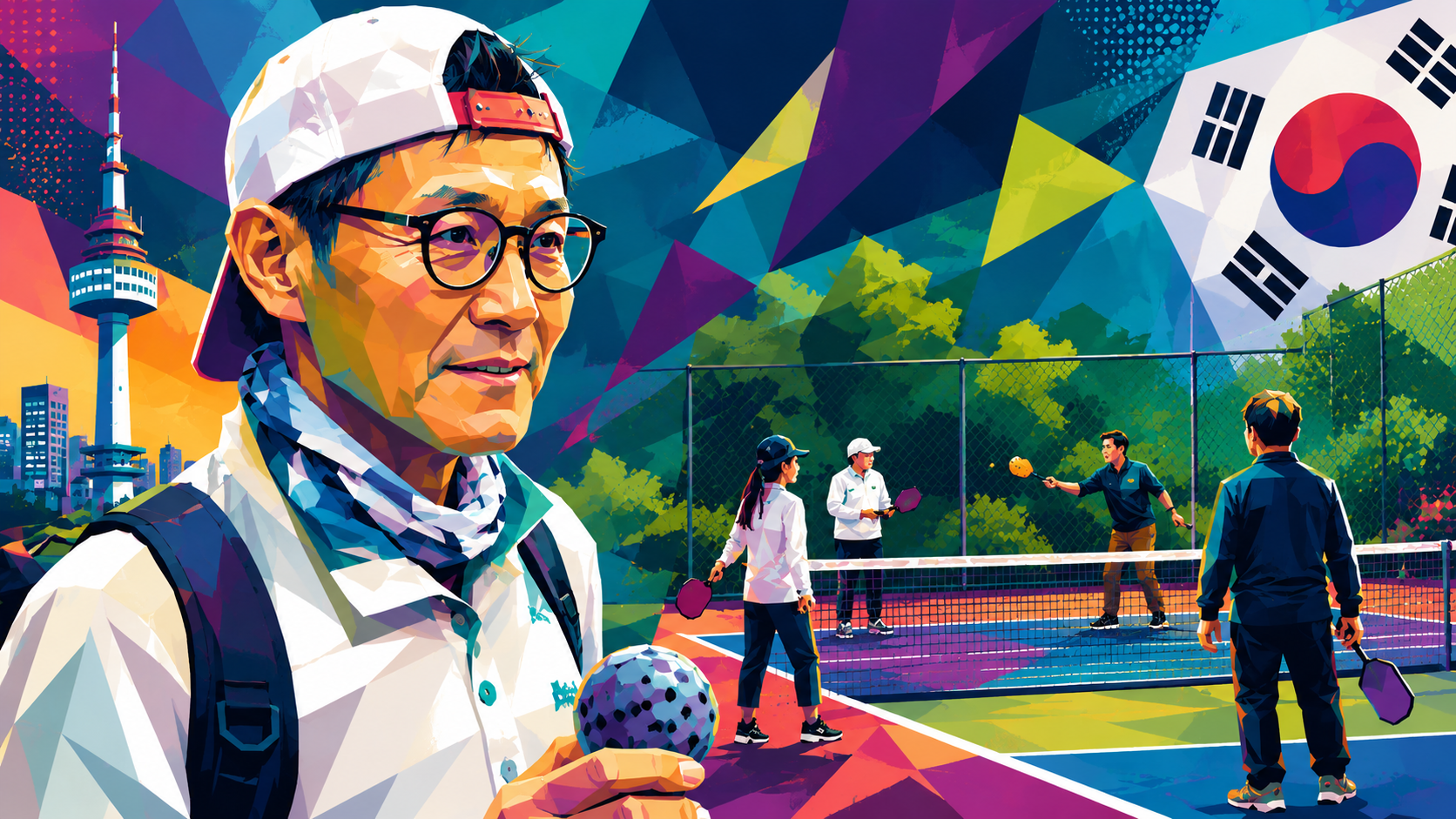
At Seoul’s busiest pickleball venues, finding a court is becoming harder than winning a match. As demand races ahead of infrastructure, South Korea is emerging as a glimpse into what pickleball’s future may look like in densely populated cities around the world.
Key Takeaways
- Seoul opened a new 14-court pickleball complex in April, but demand is already stretching available facilities.
- Existing recreational spaces, including former jokgu courts, are being converted to accommodate growing participation.
- South Korea may offer an early blueprint for how pickleball develops in urban markets where space is limited and competition for facilities is intense.
If you’re following how the global game is shifting week by week, the World Pickleball Report breaks this down every day in our morning briefing.
The New Battle for Space
At Seoul Forest, one of the city’s most popular outdoor recreation areas, the challenge facing pickleball is no longer awareness.
It is access.
Players compete for court time. Clubs coordinate sessions around limited availability. Weekend slots disappear quickly. Demand continues to rise.
For many sports, that would be considered a success story. For pickleball’s global expansion, it has become the next challenge.
South Korea is experiencing one of the fastest pickleball expansions in Asia. What began as a niche activity played largely within expatriate communities and older demographics is now attracting young professionals, students and former tennis players in significant numbers.
The evidence is increasingly visible across Seoul.
On 16 April, the city opened a dedicated 14-court pickleball complex at Gwangnaru Hangang Park. Seoul’s own public information on 2026 city changes said the courts would support up to 500 users per day, with reservations handled through the city’s public service system as part of its wider everyday sports provision.
For most sports, such a facility would represent a substantial investment.
For South Korean pickleball, it may already be insufficient.
The sport’s problem is no longer attracting players. It is finding places for them to play.
Why Pickleball Fits Modern South Korea
Part of pickleball’s appeal comes from how naturally it aligns with contemporary urban lifestyles.
In a country where work schedules are demanding and leisure time is often compressed into evenings and weekends, accessibility matters.
Tennis remains popular, but it asks a great deal of beginners. Developing the skills required to sustain rallies and enjoy competitive play can take months.
Pickleball offers something different.
Players can often enjoy meaningful rallies and competitive games within their first session.
That distinction helps explain why former tennis administrator Cho Min-jung decided to make a dramatic business decision.
Rather than continue operating solely as a tennis facility, she converted her indoor venue into a dedicated pickleball centre known as the Pickle Box.
Her reasoning was practical rather than ideological. People enjoy activities they can participate in immediately.
The shorter learning curve creates a lower barrier to entry and a faster route into the social side of the sport.
That combination is proving attractive to younger players looking for exercise, competition and community without the steep technical demands associated with some traditional racket sports.
Pickleball Isn’t Just Growing. It’s Taking Space.
This is where the story becomes particularly interesting.
Most pickleball coverage focuses on participation. South Korea highlights something different.
What happens when participation begins competing for physical space?
Several facilities that previously hosted jokgu, the Korean foot-volleyball game played across parks and recreation centres throughout the country, have been converted for pickleball use.
On the surface, that appears to be a simple operational decision.
In reality, it reflects a larger shift.
Space is limited. Every court allocated to pickleball is a court that cannot be used for another activity.
That does not mean conflict is inevitable. Recreational habits evolve constantly.
However, it does mean pickleball has reached a stage where municipalities, facility operators and sporting communities are beginning to make choices about priorities.
That is an important milestone.
A sport can only take space when enough people want to play it.
The Communities That Built the Foundation
Before television personalities and celebrities introduced pickleball to wider audiences, the sport’s growth relied heavily on grassroots organisation.
Expatriates and Korean Americans played a significant role in building the early playing community.
With few dedicated facilities available, players created informal networks to identify courts, organise matches and welcome newcomers.
Shared spreadsheets circulated throughout Seoul’s growing pickleball community, helping players locate available venues and coordinate sessions.
Those efforts may not have generated headlines, but they helped establish the foundations on which the current boom has been built.
By the time mainstream attention arrived, a functioning community already existed.
The Celebrity Effect
The rise of pickleball in South Korea cannot be separated entirely from popular culture.
Television figures including Jun Hyun-moo and Choo Sung-hoon have helped increase public visibility through entertainment programming and social media appearances.
More significantly, members of BTS, including Jin, V and RM, have discussed the sport publicly and referenced playing during livestreams and content releases.
Celebrity endorsements alone rarely sustain sporting growth.
What they can do is accelerate awareness.
That appears to have happened in South Korea.
The significance is not that BTS play pickleball. The significance is that pickleball has reached a level of cultural visibility where some of the country’s most recognisable public figures can reference it and expect audiences to understand what they are talking about.
That is a very different position from where the sport stood only a few years ago.
South Korea May Be Showing Pickleball’s Future
The most important lesson from South Korea extends far beyond Seoul.
Many of pickleball’s biggest success stories have emerged in places where space was relatively abundant. Courts could be built first, with participation following behind.
South Korea presents a different model.
Players are arriving faster than infrastructure.
That changes the economics of growth.
Indoor conversions suddenly become attractive business opportunities. Private operators gain incentives to enter the market. Municipal governments face increasing pressure to allocate recreational space.
Existing sports begin competing with pickleball for facilities.
The same questions now emerging in Seoul could easily appear in cities such as Singapore, Hong Kong, Tokyo, London, Paris and Amsterdam if participation continues to accelerate.
That is why South Korea matters.
It is not simply another country embracing pickleball. It may be one of the first countries demonstrating what happens after the initial boom.
Why It Matters
Participation growth has dominated pickleball conversations for years.
South Korea suggests the next phase may be infrastructure.
For facility operators, investors, governing bodies and local clubs, the challenge is no longer convincing people to play.
It is ensuring there is enough room for them when they do.
The packed courts of Seoul Forest are not merely evidence of pickleball’s popularity today. They may be offering a preview of the questions the sport will face tomorrow.
Further Reading
- Latest pickleball news from around the world
- Tournament coverage and results
- Rankings and player profiles
- Regional pickleball coverage
For a clearer view of where the sport is heading each month, you can download the latest free issue of World Pickleball Magazine.

Chris Beaumont
Founder and Editor-in-ChiefChris Beaumont is the founder and Editor-in-Chief of World Pickleball Magazine. Chris follows the global game closely, reporting on the latest news, developments, stories and tournaments from all five continents. He also hosts the World Pickleball Podcast, interviewing people at…
View All Articles →