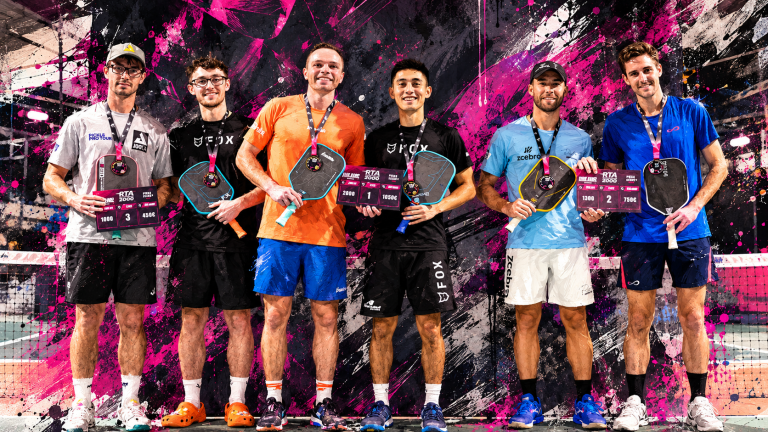
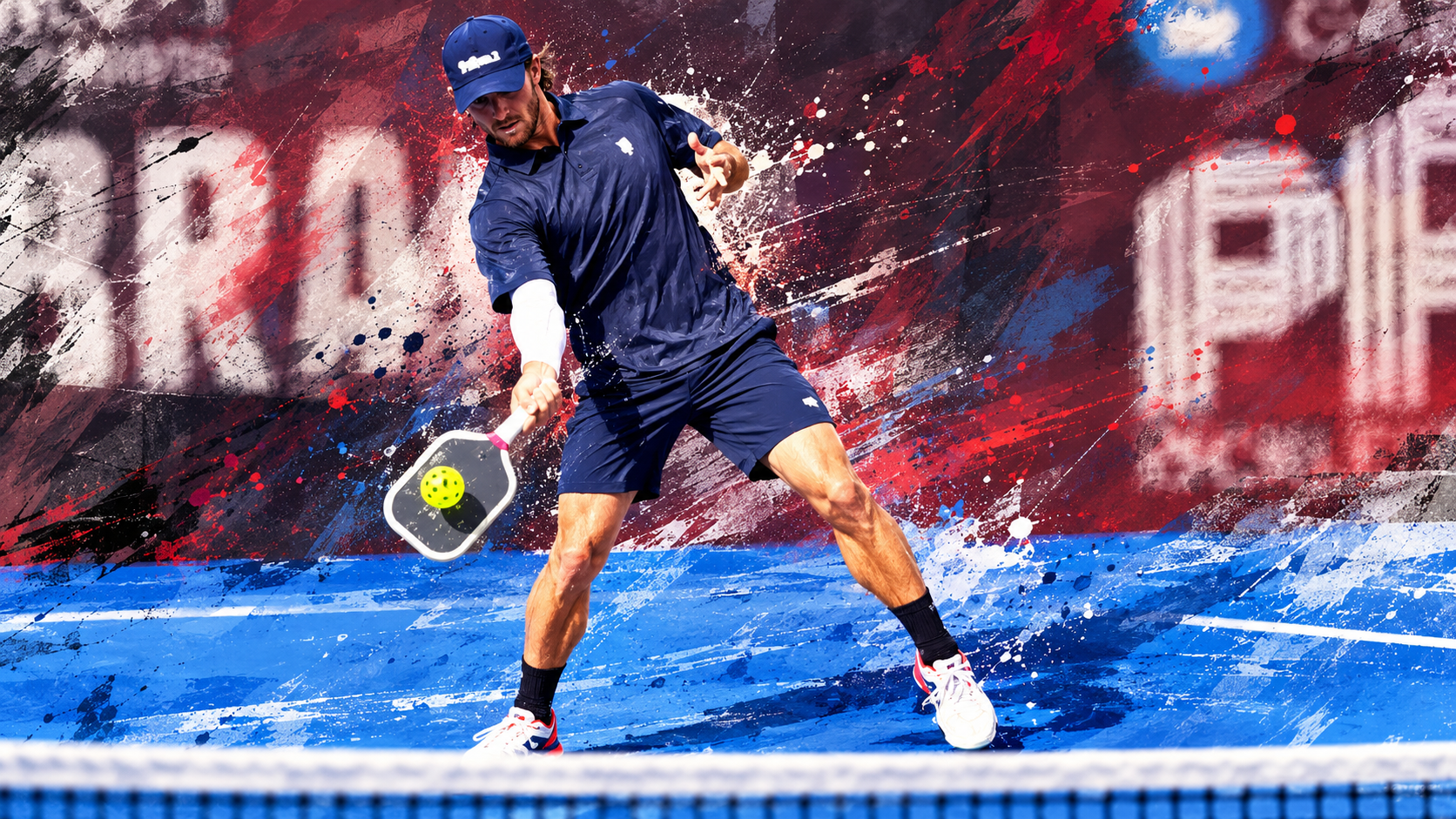
Hunter Johnson has taken out Federico Staksrud to earn a men’s singles final against Ben Johns, while Anna Leigh Waters chases career titles 199 and 200 and Kiora Kunimoto attempts to complete one of the outstanding runs of the Rate Las Vegas Open.
Hunter Johnson arrived at the Rate Las Vegas Open with a draw containing most of the names expected to control the men’s singles title race. By Saturday evening, he had forced his way into the centre of it.
The No. 3 seed recovered from losing the opening game against Federico Staksrud to beat the No. 2 seed 5-11, 11-8, 11-6, setting up a Championship Sunday final against Ben Johns and giving Las Vegas the possibility of one last disruption before the medals are decided.
Key Takeaways
- Hunter Johnson defeated Federico Staksrud 5-11, 11-8, 11-6 and will face Ben Johns for the men’s singles title.
- Kiora Kunimoto’s run continues after following her quarter-final victory over top seed Kate Fahey with a three-game win over Cailyn Campbell.
- Anna Leigh Waters can reach 200 career titles if she wins both the mixed and women’s doubles finals.
- Ben Johns has three opportunities for gold, reaching the men’s singles, mixed doubles and men’s doubles finals.
- Johns and Gabriel Tardio face Christian Alshon and Andrei Daescu in a rematch of the dramatic 2025 Las Vegas men’s doubles final.
Johnson’s victory is the result that changes the complexion of the final day, but it sits within a much broader set of storylines. Kunimoto has followed her quarter-final defeat of top seed Kate Fahey by eliminating Cailyn Campbell. Waters has reached two finals and stands two victories away from a major career milestone. Johns has three gold-medal matches ahead of him across singles, mixed doubles and men’s doubles.
Christian Alshon and Andrei Daescu, meanwhile, have reached a men’s doubles final that carries considerably more history than simply No. 1 against No. 2.
Championship Sunday has plenty of familiar names. The route by which several of them have arrived, however, has been anything but routine.
Johnson Turns the Match Against Staksrud
There was little in the opening game of Saturday’s men’s singles semi-final to suggest Johnson was about to produce the result of the day.
Staksrud won it 11-5 and, given his position as the No. 2 seed, had the opportunity to turn early control into a relatively straightforward passage to the final. Instead, Johnson changed the direction of the contest.
He took the second 11-8 and then won the deciding game 11-6, completing a victory that becomes more significant when placed alongside what Johnson had already done in the draw. His quarter-final against No. 5 Roscoe Bellamy had finished 11-5, 11-4. Staksrud represented a considerable step upwards in opposition, yet Johnson found a way through after falling behind.
It continues the story World Pickleball Magazine identified entering the weekend, when the Las Vegas semi-final field offered several opportunities for the established order to be challenged.
The final now asks a different question.
Beating Staksrud proves Johnson can disrupt the expected order. Beating Staksrud and Johns consecutively would turn an excellent tournament into a defining one.
Johns has had problems of his own to solve. Christian Alshon took the opening game of their quarter-final 11-3 before Johns responded 11-3, 11-6, and John Lucian Goins then pushed him in the second game of Saturday’s semi-final before Johns closed it 11-8, 12-10.
There is an important difference between the two finalists. Johns has spent the latter stages absorbing challenges and finding solutions. Johnson has increasingly been the player creating them.
Singles against Johns usually demands more than simply winning the faster exchanges. Johnson will need to prevent points becoming predictable, resist the temptation to force attacks once Johns has established control of the court and, above all, reproduce the composure he showed after losing the opening game to Staksrud.
The upset has put him in the final. The harder part is turning one upset into two.
Kunimoto Keeps Answering Every Question
Kiora Kunimoto has followed a similar route through the women’s singles draw, although her breakthrough began one round earlier.
The No. 5 seed faced top seed Kate Fahey in Friday’s quarter-final and recovered from losing the second game to win 11-8, 2-11, 11-5. It was one of the defining results of the Las Vegas quarter-finals, but Kunimoto still had to capitalise on it.
Cailyn Campbell made sure that would not be straightforward.
Campbell won Saturday’s semi-final opener 11-8, putting Kunimoto in exactly the sort of position where a player can begin to feel the accumulated weight of a deep tournament run. Instead, Kunimoto responded with an 11-4 second game and then took the decider 11-5.
That distinction matters. One upset can be an exceptional performance. Kunimoto has now repeatedly backed hers up.
Her final opponent, Kaitlyn Christian, represents another escalation. The No. 2 seed has been ruthless through the closing rounds, beating Milan Rane 11-3, 11-0 in the quarter-finals before dismissing Lea Jansen 11-6, 11-5 in Saturday’s semi-final.
Christian therefore reaches the final without having needed a deciding game in either of those matches. Kunimoto arrives having already survived two.
That gives the final its tension. Christian’s route suggests control. Kunimoto’s suggests resilience. If the match becomes uncomfortable, Kunimoto has spent the last two rounds proving she can live there.
Johns Has Three Titles Within Reach
Ben Johns’ Championship Sunday is not limited to trying to stop Johnson.
He will contest three finals.
Alongside Anna Leigh Waters, Johns has reached the mixed doubles gold-medal match without dropping a game. Their semi-final against Tyra Hurricane Black and Gabriel Tardio lasted only two, with the No. 1 seeds winning 11-6, 11-4.
Waiting for them are No. 2 seeds Hayden Patriquin and Anna Bright, who had a much more complicated semi-final against Tina Pisnik and Christian Alshon.
Patriquin and Bright lost the opening game 11-7 before changing the match, winning 11-5, 11-8 to reach the final.
The seedings have therefore delivered the expected final, but the semi-finals revealed two very different experiences. Waters and Johns have been able to impose themselves. Patriquin and Bright have already been required to adjust when a match moved against them.
For the challengers, the tactical problem is finding ways of preventing Waters and Johns from controlling both the pace and geography of rallies. Allow them comfortable progression towards the kitchen and the usable court rapidly becomes smaller. The alternative is to create pressure before their patterns are established without giving away cheap attacking opportunities in the process.
That balance is difficult enough against either player. Against them together, it becomes one of the hardest assignments in professional doubles.
Waters Is Two Wins Away From 200
For Anna Leigh Waters, the final day carries an additional piece of history.
The PPA entered Las Vegas highlighting that Waters could reach 200 career titles by winning both doubles events. She has done everything required to take that possibility all the way to Championship Sunday.
Victory in both finals would take her from 198 to 200.
Her second opportunity comes alongside Anna Bright in women’s doubles, where the top seeds looked overwhelming on Saturday.
Waters and Bright faced Ting Chieh Wei and Meghan Dizon in the semi-final and conceded only three points, winning 11-1, 11-2. Wei and Dizon had reached the last four by beating Isabella Dunlap and Genie Erokhina 11-6, 13-11, yet were given almost no room to establish themselves.
Tyra Hurricane Black and Catherine Parenteau now have to find an answer.
They booked their place in the final with an 11-7, 11-4 victory over Lacy Schneemann and Kate Fahey, having earlier beaten Sofia Sewing and Tina Pisnik 11-2, 11-1 in the quarter-finals.
That creates an intriguing subplot for Black, who gets two opportunities to stop Waters on the same day. The first comes in mixed doubles alongside Gabriel Tardio. The second comes with Parenteau against Waters and Bright.
Neither assignment is easy, but Black’s presence in both finals means she will have more influence than most over whether Waters leaves Las Vegas having reached one of the biggest statistical milestones of her career.
Johns-Tardio Against Alshon-Daescu, Again
The men’s doubles final carries perhaps the strongest historical context of the five gold-medal matches.
Christian Alshon and Andrei Daescu have reached the final from the No. 2 position after beating Hayden Patriquin and Federico Staksrud 11-7, 11-8 in Saturday’s semi-final.
Waiting for them are Gabriel Tardio and Ben Johns, who defeated Jaume Martinez Vich and Nicolas Acevedo 11-5, 11-6.
The match is not simply the top two seeds meeting for the title.
Johns and Tardio arrived in Las Vegas with a perfect record as a partnership during 2026, while Alshon and Daescu won the recent Arizona Open. More importantly, the same two partnerships contested the Las Vegas final a year ago.
That match became one of the longest in PPA history. Johns and Tardio eventually won the fifth game 12-10 after two hours and 28 minutes.
The PPA’s official Las Vegas tournament preview identified that history before the tournament began. Championship Sunday has now delivered the rematch.
For Alshon and Daescu, reaching another final establishes consistency. Beating the partnership at the top of the draw would establish something more, particularly after their Arizona title.
They have the physical tools to make the court uncomfortable, with reach, pace and the ability to accelerate quickly when an attack presents itself. Against Johns and Tardio, however, the issue will be whether those weapons can be used without allowing the match to become a sequence of increasingly low-percentage speed-ups.
If Alshon and Daescu can stay disciplined long enough to create attacks rather than search for them, the men’s doubles final could become one of Sunday’s most revealing matches.
Championship Sunday Is Also a Test of Workload
There is another element connecting the final programme.
Johns is scheduled to play for gold three times. Waters twice. Black twice. Bright twice.
That matters because Championship Sunday is not simply five independent matches. For the players appearing repeatedly, each final becomes part of the conditions for the next one.
Physical fatigue is the obvious consideration, particularly if matches extend into deciding games, but the mental demand may be equally important. A difficult defeat has to be processed quickly. A significant victory cannot become a distraction. Partners change, tactical responsibilities change and the opponent across the net may be somebody who was standing alongside you earlier in the day.
Johns’ schedule illustrates it best. He has Johnson waiting in singles, Waters alongside him in mixed and Tardio alongside him in men’s doubles. Each requires a different version of his game and each carries its own significance.
The same is true for Waters. Her mixed partnership with Johns is built around a different set of patterns from her women’s partnership with Bright, yet the expectation attached to both remains the same.
Las Vegas Still Has Room for One More Disruption
The final day therefore arrives with a curious mixture of order and instability.
The No. 1 seeds have reached the mixed doubles, women’s doubles and men’s doubles finals. Johns and Waters remain positioned to collect multiple titles. The established hierarchy has hardly disappeared.
Yet around it, the tournament has repeatedly produced resistance.
Kunimoto removed the women’s No. 1 seed and then came from behind against Campbell. Johnson removed the men’s No. 2 seed after dropping the opening game. Alshon and Daescu have reached the men’s doubles final and bring the confidence of their Arizona victory. Black has put herself into two finals and now gets two chances to interfere with Waters’ pursuit of 200 career titles.
Most of all, Johnson has changed what the men’s singles final represents.
Staksrud entered Las Vegas as the defending champion. Johnson has removed him.
Now comes the difficult distinction between reaching a final and changing the hierarchy.
He has beaten Staksrud.
Ben Johns is next.
Further Reading
- Rate Las Vegas Open: Kunimoto and Campbell Head Into Semi-Final Saturday
- Rate Las Vegas Open Quarter-Finals: The Stories That Shaped the Weekend
- Rate Las Vegas Open 2026 Preview

Chris Beaumont
Founder and Editor-in-ChiefChris Beaumont is the founder and Editor-in-Chief of World Pickleball Magazine. Chris follows the global game closely, reporting on the latest news, developments, stories and tournaments from all five continents. He also hosts the World Pickleball Podcast, interviewing people at…
View All Articles →