
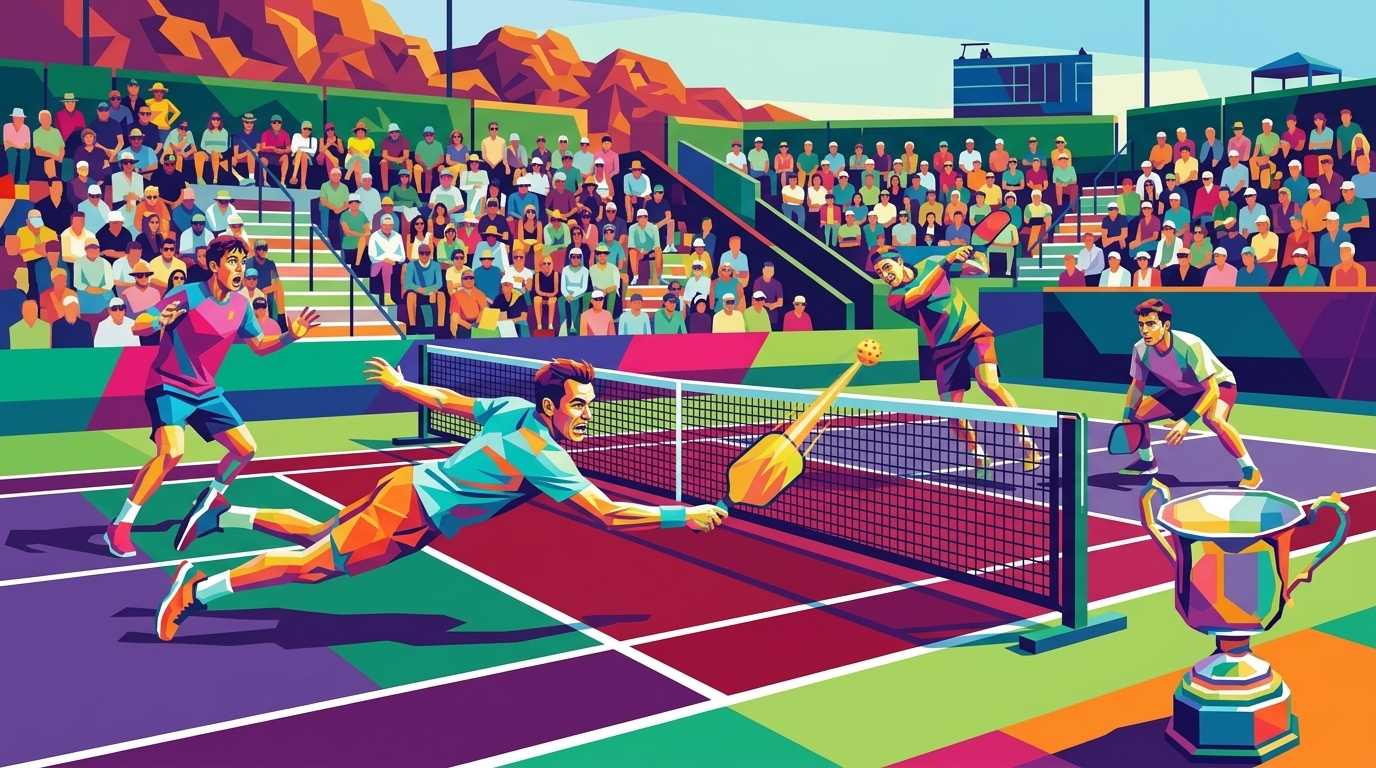
Jay Devilliers did not need to hit James Ignatowich.
By his own account, he came close. The ball missed by centimetres after Devilliers sent it towards him as hard as he could during a Major League Pickleball match.
Yet accuracy was not really the point.
Ignatowich had already struck Devilliers several times and had also targeted his Utah Black Diamonds partner, Tyler Loong. Devilliers believed those shots were intended less to win rallies than to hit the men standing across the net.
Eventually, he answered.
“I was just tired of getting hit every time,” he recalled during an appearance on the Pickleballers Podcast. “I’m like, ‘If you want to play like that, I can too.’”
When asked whether he had managed to catch Ignatowich, Devilliers explained why the miss had still achieved its purpose.
“It was to send a message.”
That is the point at which a body shot becomes something more than shot selection.
Professional pickleball permits players to attack an opponent’s body. Often, it is the correct tactical decision. The chest, dominant shoulder and paddle-side hip can be difficult to defend at kitchen-line speed. A well-directed ball jams the swing, removes reaction time and may create uncertainty between partners.
The rulebook does not distinguish between a ball struck into open court and one which wins the rally by hitting an opponent.
Pickleball’s culture does.
Players raise a paddle in apology after contact. They debate whether the shot was necessary. They remember who has hit whom and respond differently according to the person on the other side of the net. A tactically legitimate play can still cause offence, begin an argument or demand retaliation.
The professional game therefore has an unusual problem.
It has accepted the body shot as part of elite competition without agreeing upon the behaviour that surrounds it.
The Manners of Another Game
Pickleball’s conventions were not created for televised team matches involving professional contracts, prize money and public rivalries.
They developed through a social game.
Many players learned pickleball in clubs and community groups where the same people met every week. Partners changed. Standards varied. Preserving the atmosphere mattered because today’s opponent might be tomorrow’s teammate.
In that setting, restraint serves a purpose.
Repeatedly driving the ball at a weaker or less mobile player might be legal, but it could make the game unpleasant for everybody. A quick apology after hitting someone helped separate the tactical act from personal aggression. Winning mattered, although it was rarely the only reason people were there.
Professional pickleball has retained much of that language and etiquette.
The conditions around it have changed.
A professional is supposed to exploit an opponent’s weak backhand, movement, positioning and decision-making. Nobody expects an apology after a player is repeatedly drawn into the same losing dink pattern. Targeting the body, however, can still be treated as a breach of sporting manners, even when it exposes a weakness just as effectively.
That difference is partly physical. A ball directed into the body feels personal because the opponent, rather than the court, becomes the destination.
It is also cultural.
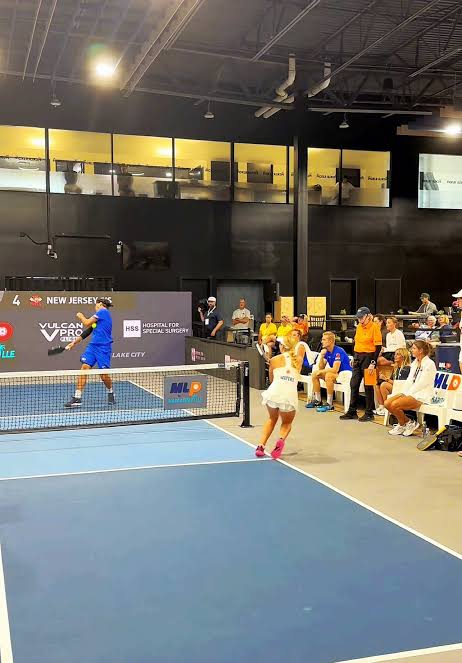
Pickleball wants the intensity of professional sport while preserving the friendliness through which many people first encountered it. The body-shot argument is one of the places where those ambitions meet.
When the Match Changes
Devilliers does not present himself as an enthusiastic body hunter. His position depends upon the atmosphere.
“I’m not necessarily pro body bag,” he said. “I feel like there are bags that are more okay than others.”
In an ordinary match, with no hostility between the players, he sees little reason to seek one out. If the contest becomes intense and the players begin “chirping” at one another, he believes the terms change.
“Then I feel it’s free game.”
That is an understandable player’s code. It is also almost impossible to apply consistently.
There is no official moment at which a pleasant match becomes hostile enough to permit harder treatment. One player may think a body shot has changed the terms. The person who played it may consider it an obvious tactical choice. A retaliatory ball, intended to restore balance, can then be received as the first genuine act of aggression.
The rally carries everything that happened before it, but the players may remember that history differently.
This helps explain another incident involving Devilliers and Nico Acevedo during MLP competition in Austin.
Acevedo had caught Devilliers with body shots during earlier rallies. Devilliers later struck Acevedo and celebrated with a forceful “vamos”. Acevedo appeared to accept the contact. His Texas Ranchers partner, Lea Jansen, did not.
Jansen called Devilliers “a joke”, refused the customary paddle tap and continued the confrontation after the match. She later indicated that her reaction involved a separate social-media grievance, making it difficult to treat the body shot as the sole cause of the dispute.
It was, however, the moment through which the wider tension became visible.
The shot could be explained tactically. It could also be read as retaliation. The celebration encouraged the second interpretation because it suggested that hitting Acevedo meant more to Devilliers than merely winning the rally.
Once again, the rules settled the point but could not settle the meaning.
The Apology Problem
The reflexive apology after a body shot captures pickleball’s uncertainty rather neatly.
At professional level, the player may have aimed exactly where the ball landed. Both sides know it. The raised paddle does not deny the intention. It says that the striker wanted the tactical benefit without giving personal offence.
That is not necessarily hypocrisy.
Hard sports often develop gestures that allow competition and respect to coexist. A boxer touches gloves. A bowler checks on a batter after striking them. A footballer may acknowledge an accidental collision even when the challenge itself was legitimate.
Pickleball should not lose that consideration simply because money has entered the sport.
However, an apology cannot make every choice equivalent.
A ball driven into an exposed chest during a rapid exchange is different from repeatedly trying to hit somebody when a better route to the point is available. A controlled attack below the shoulders is different from a reckless shot towards the face. Targeting an elite rival who has already raised the temperature is different from intimidating somebody who cannot defend themselves adequately.
Professionalisation should move the boundary of acceptable aggression. It should not remove the boundary altogether.
The more useful distinction is not between hitting the body and avoiding it. It is between attacking an opponent’s defence and attacking the opponent.
Devilliers’ shot towards Ignatowich crossed that distinction by his own description. It was meant to communicate displeasure. Contact, had it occurred, would have delivered the warning physically.
That does not automatically make the response indefensible. Ignatowich had, in Devilliers’ view, already turned the match into that kind of contest.
It does mean the shot cannot be justified solely as normal tactics.
Equal Competition, Unequal Instincts
Anna Leigh Waters exposed another weakness in the unwritten code when she body-bagged Devilliers during MLP play.
If you're following how the global game is shifting week by week, the World Pickleball Report breaks this down every day in our morning briefing.
He regularly attacked male opponents but said he had never deliberately done the same to a woman. Waters’ shot left him uncertain because his usual instinct to retaliate collided with his belief that she should be treated differently.
“I didn’t know how to react,” he admitted.
Devilliers became passive and retreated towards the baseline while considering what he was supposed to do. Had a man hit him, he believed he would have answered. With Waters, he did not want to.
He later called it the best body bag he had ever received.
The moment raises a question professional mixed doubles has not resolved. Does equal competition require players to make the same shots against men and women, or can safety and differences in physical power justify different boundaries?
There is no completely satisfying answer.
A male player launching a full-power ball high at a female opponent may create a legitimate safety concern. The same concern should exist when any stronger player recklessly targets the head or face of somebody with less pace or reaction time.
Yet refusing to attack a woman’s body under any circumstances creates another problem. It treats a professional opponent as somebody who must be protected from the competitive demands of the match.
Waters did not ask Devilliers for that protection. She chose the available target and played the point.
His hesitation showed that the convention belonged to him.
Professional mixed doubles asks women to withstand pace, cover the court and accept sustained tactical pressure. It cannot offer equality only until a particular shot feels socially uncomfortable. At the same time, equality does not excuse a player from exercising control.
The standard has to be based upon tactical purpose, proportion and safety, rather than gender alone.
What Professional Pickleball Owes Its Past
The simple answer is to declare that professionals are paid to compete and anything legal should therefore be accepted.
There is some force to that argument.
A player cannot demand the advantages of professional status and then expect opponents to ignore an effective target. As paddle technology, hand speed and tactical aggression advance, the body will remain part of the available court. Professionals will need to defend it.
But sport is never governed by its written rules alone.
Footballers object to opponents continuing to attack when a player is injured. Cricket has long debated actions which are legal but considered contrary to the spirit of the game. Baseball possesses its own disputed codes concerning retaliation and respect.
Professional pickleball will develop conventions of its own. The mistake would be to assume that the recreational code can simply be preserved unchanged, or that becoming professional requires abandoning it entirely.
The social game offers something worth keeping. An opponent remains a person, even when their body presents the best target. Control matters. Safety matters. The acknowledgement after contact matters.
What changes at professional level is the expectation of protection.
A professional player should not expect an opponent to surrender a legitimate tactical advantage merely because the ball may hit them. Courtesy can govern the manner in which the shot is played and received. It cannot make the target unavailable.
That produces a clearer code than the one players are currently negotiating rally by rally:
Attack the body when it offers a genuine competitive advantage.
Keep the ball away from the head and use control where disparities in power create an obvious risk.
Do not pretend a retaliatory shot is merely tactical.
Do not turn accidental or necessary contact into humiliation through celebration.
Do not demand an apology for being beaten by a legal, proportionate shot.
Most importantly, judge the play by its purpose and danger, not simply by whether the opponent is male or female.
The Message Behind the Ball
Jay Devilliers’ stories do not supply a universal answer. They show why one is needed.
Against Ignatowich, he tried to enforce his own boundary after deciding that repeated targeting had become excessive.
Against Acevedo, a legal shot became part of a wider personal confrontation.
Against Waters, the code he applied to male opponents suddenly seemed unusable.
In each case, the body shot exposed something already present in the match: hostility, grievance, uncertainty or unequal expectations.
That is why the debate will not disappear by declaring the shot legal.
Professional pickleball is separating itself from the social game in speed, money and consequence. Its culture is taking longer to catch up. Players are still borrowing the manners of recreational courts while testing how much aggression elite competition should permit.
The answer is not to remove civility from the sport.
It is to stop confusing civility with immunity.
A professional opponent’s body is a legitimate tactical target. Their safety and dignity remain a player’s responsibility.
The difference lies in what the shot is trying to accomplish.
One ball attacks the defence.
The other, as Devilliers freely acknowledged, is sent to make the person understand.
That is when the point ends and the argument begins.
Primary source: Jay Devilliers speaking on the Pickleballers Podcast. Additional reporting: Pickleball.com and NML Pickleball.
For a clearer view of where the sport is heading each week, you can join the World Pickleball Report here.

Chris Beaumont
Founder and Editor-in-ChiefChris Beaumont is the founder and Editor-in-Chief of World Pickleball Magazine. Chris follows the global game closely, reporting on the latest news, developments, stories and tournaments from all five continents. He also hosts the World Pickleball Podcast, interviewing people at…
View All Articles →

