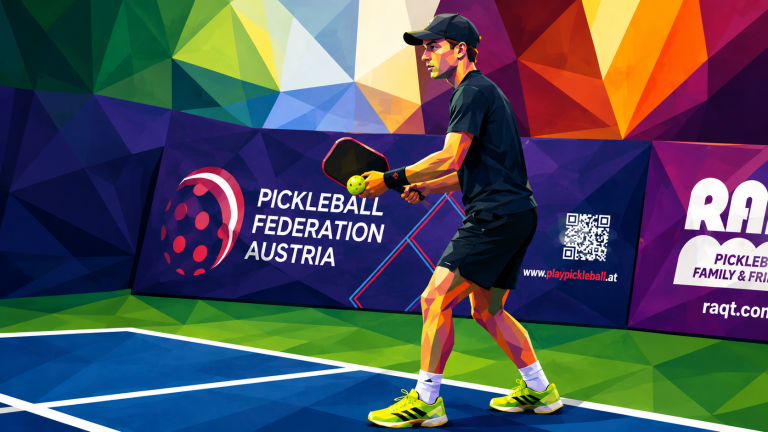

The latest World Pickleball Podcast goes beyond results and into something more important: what happens when a sport expands faster than its competitive depth, and how returning international players can reset standards in Europe.
- PPA Australia’s Moreton Bay event exposed real questions around depth, participation, and player prioritisation.
- Chris Beaumont and Gordon Watson argue that rising costs and a crowded global calendar are starting to shape who enters which events.
- Louis Laville returning to Europe and winning immediately shows what higher-level exposure can do to a player, and to a region.
Moreton Bay mattered for what it revealed
The latest episode of the World Pickleball Podcast starts in Australia, but not with a simple recap of winners and losers.
Chris Beaumont and Gordon Watson use the PPA Australia event in Moreton Bay to ask a sharper question. What does it mean when a pro event feels thin?
On paper, there were still good players in the draw. In reality, the lack of depth was hard to ignore, especially in the women’s events. That matters because a tournament is not judged only by the quality of its winners. It is judged by the pressure of the field, the number of credible challengers, and the sense that a title had to be earned through a full competitive route.
That pressure did not feel as strong here as it has at other recent events across Australia and Asia.
This is not just about one quiet draw
Watson’s explanation is practical rather than dramatic. Fuel costs in Australia have surged. Travel is expensive. Daily life is more expensive. And when the global calendar keeps expanding, players start making harder choices.
That is where this becomes a structural story rather than a local one.
As Beaumont points out in the episode, a lower-tier event should still offer opportunity. If the very top names are absent, the next group should step in, gain experience, and build momentum. But that only works if players actually enter. If they do not, a tournament loses both its star power and its developmental value.
That is the tension at the centre of the current Australian picture.
There are more pathways than before, which is good. But there is also more fragmentation than before, which is harder to manage. Tours are no longer competing only with other events in the same country. They are competing with a genuinely international calendar, and with the points, prize money, and prestige that come with it. The official PPA Tour structure now sits inside a much wider and more crowded global ecosystem.
If you’re following how the global game is shifting week by week, the World Pickleball Report breaks this down every Wednesday.
PPA Asia is not just growing, it is changing behaviour
One of the strongest threads in the conversation is the idea that regional pickleball coverage now has to be read in context. PPA Asia’s rise is not just a good-news story about expansion. It is also changing how players plan their seasons.
That matters in Australia more than most places because the top of the player pool is still relatively concentrated. If a few names choose a different route, the effect on a draw is immediate. Suddenly, an event that should feel strong feels lighter than expected. That is not a long-term verdict on Australian pickleball, but it is a clear warning sign about the pressures created by a spreading schedule.
The next few events will tell us more. Beaumont and Watson both hint at that in the episode. If bigger points events still struggle for depth, the concern becomes sharper. If they recover, then Moreton Bay may prove to be more of a transition moment than a trend.
Louis Laville’s return shows the opposite effect
The second half of the discussion shifts to Europe, and the contrast is telling.
Laville, after time away competing internationally, has returned to the European circuit and gone straight back to winning. Double gold in Stockholm is not just a nice comeback story. It is evidence of what exposure can do.
Players who spend time in stronger, faster, more varied environments do not come back the same. They return with better instincts, cleaner decision-making, and a wider understanding of what top-level pickleball demands.
That matters individually, of course. But it also matters collectively.
When a player comes back with more tools, the entire region is forced to respond. Standards rise because expectations rise. The level required to win changes. Europe has already seen that through the dominance of leading partnerships, but Laville’s return suggests the next jump may come through circulation, not just local improvement.
The real issue is not talent, it is repetition
One of the smartest parts of the podcast is where the conversation widens beyond named players and named events.
Beaumont makes the point that this challenge exists at every level of the game. A player can show flashes of quality. The harder task is sustaining that level point after point, match after match, tournament after tournament.
That is where repetition matters.
Elite standards are not built only through coaching or intention. They are built through regular exposure to elite opposition. If that exposure weakens, even temporarily, the floor can drop. Not because players suddenly become poor, but because they are no longer being dragged upward often enough.
That may be the most important line running through this episode. Australia’s issue is not a shortage of good players. Europe’s advantage is not simply that its best players are talented. The gap is shaped by how often top-level intensity is repeated.
Why this episode matters
This is a strong World Pickleball Podcast episode because it does not settle for recap. It uses one tournament and one returning player to get at a much bigger question.
How does pickleball keep raising its level as it grows wider?
That is the real issue now. Not whether the sport is expanding. It clearly is. The harder question is whether every part of the system can keep pace with that expansion, from Australia to Europe and beyond.
The regions that solve that first will not just produce winners. They will shape the next phase of the sport.
For a clearer view of where the sport is heading each week, you can join the World Pickleball Report here.
Further Reading
- Latest pickleball news from around the world
- Tournament coverage and results
- Rankings and player profiles
- Regional pickleball coverage

Chris Beaumont
Founder and Editor-in-ChiefChris Beaumont is the founder and Editor-in-Chief of World Pickleball Magazine. Chris follows the global game closely, reporting on the latest news, developments, stories and tournaments from all five continents. He also hosts the World Pickleball Podcast, interviewing people at…
View All Articles →