
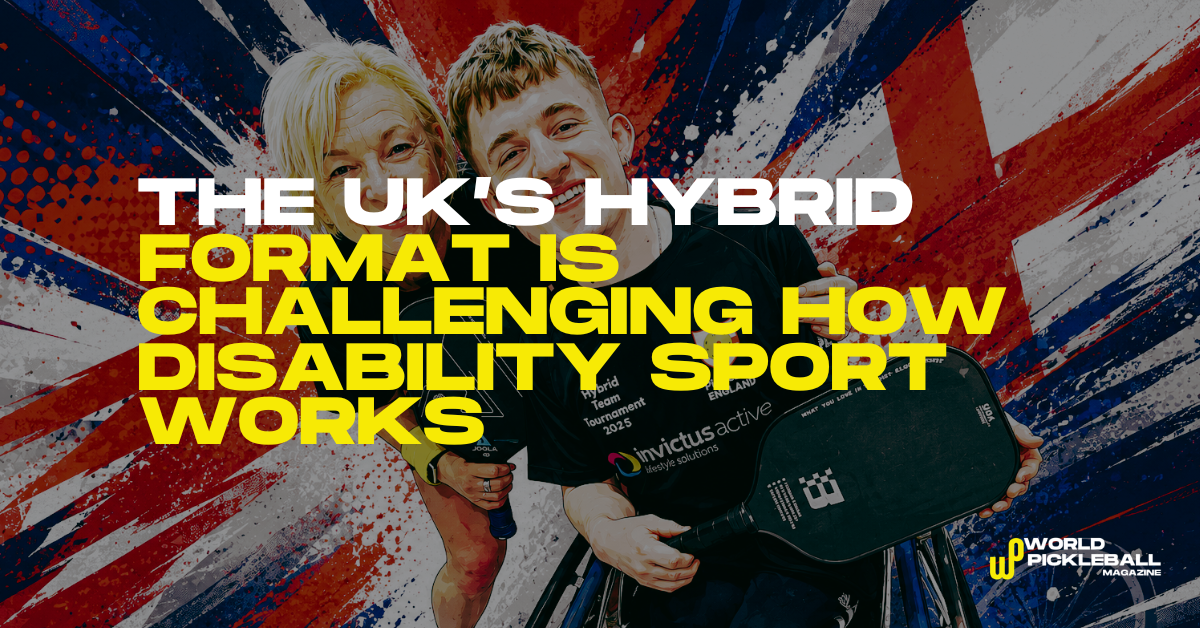
The inclusive pickleball weekend taking place in Stourbridge next month is attracting attention not simply because it is accessible, but because the format itself appears to work competitively.
- Courtside in Stourbridge will host its second hybrid pickleball event on 6–7 June
- The format combines para and non-disabled athletes inside the same competitive teams
- Similar adaptive structures are beginning to emerge internationally as governing bodies update official rules around para play
The first assumption usually arrives before the first rally.
Mark Fosbrook sees it almost every time he walks onto court.
Opponents glance across the net at the double below-knee amputee standing opposite them and quietly adjust their expectations.
Then the match starts.
“I often get people thinking I cannot play,” Fosbrook said. “When I get on court and show what I can do, they soon realise that a disability does not need to stop you from being a good player.”
That reaction sits at the centre of the inclusive pickleball weekend being staged at Courtside in Stourbridge on 6–7 June.
Because the event is not built around sympathy or symbolic participation.
It is built around competition.
A Format Built Around Real Matches
Saturday’s schedule begins with a Para Standing Come and Try session for athletes with physical impairments, including amputees, players with cerebral palsy and athletes with dwarfism.
Sunday then moves into the second Hybrid Team Pickleball Tournament, where teams are made up of two para players and two non-disabled players competing across para doubles, non-disabled doubles and hybrid pairings.
That structure matters.
Most disability sport still operates through separation. Different categories. Different tournaments. Different environments.
The Stourbridge format asks a more uncomfortable question: what if the structure itself is the problem?
Why Hybrid Competition Feels Different
What makes the event genuinely interesting is that the hybrid format appears competitively legitimate rather than merely well-intentioned.
The matches work.
That sounds obvious. In adaptive sport, it often is not.
Players contribute meaningfully. Team balance matters. Tactical adjustments matter. Communication matters. The format creates real competition rather than staged inclusion.
Importantly, this is no longer just a theoretical idea.
Courtside already staged an earlier hybrid tournament in March, described by organisers as the world’s first event pairing para and non-disabled pickleball athletes inside the same competitive team structure. The June event is effectively a second edition rather than a one-off experiment.
If you’re following how the global game is shifting week by week, the World Pickleball Report breaks this down every day in our morning briefing.
Why Pickleball Suits Integrated Play
That distinction is important because many adaptive sports initiatives struggle once they move beyond introductory sessions and awareness campaigns. Long-term sustainability usually depends on whether participants genuinely want to keep competing inside the format itself.
So far, the signs are encouraging.
Pickleball may also be unusually well-suited to this kind of integrated structure.
The smaller court dimensions reduce physical disadvantage compared to many traditional racket sports. Tactical intelligence, positioning and teamwork carry enormous weight. Hybrid pairings force teams to think carefully about movement, shot selection and court coverage rather than relying purely on athleticism.
In other words, the format changes how matches are played rather than simply who is allowed to participate.
The Wider Sport Is Moving Too
The wider sport is beginning to move in the same direction too.
USA Pickleball’s official rulebook already includes wheelchair and hybrid competition provisions, including adaptive bounce allowances and recognised standing-versus-wheelchair competition formats.
Similar hybrid and adaptive events are also beginning to appear more regularly across North America as organisers experiment with integrated competition structures.
The UK has quietly become one of the more progressive countries in this area of the sport. Earlier hybrid events allowed mixed-ability families and teams to compete together in ways rarely seen elsewhere in racket sports, while the LimbPower Games will continue introducing adaptive formats to new participants.
Making Integrated Competition Feel Normal
The most interesting thing about the Stourbridge weekend is not that it makes pickleball more accessible.
It is that it may slowly make integrated competition feel normal.
For a clearer view of where the sport is heading each month, you can download the latest free issue of World Pickleball Magazine.
Further Reading
- Latest pickleball news from around the world
- Tournament coverage and results
- Rankings and player profiles
- Regional pickleball coverage

Chris Beaumont
Founder and Editor-in-ChiefChris Beaumont is the founder and Editor-in-Chief of World Pickleball Magazine. Chris follows the global game closely, reporting on the latest news, developments, stories and tournaments from all five continents. He also hosts the World Pickleball Podcast, interviewing people at…
View All Articles →