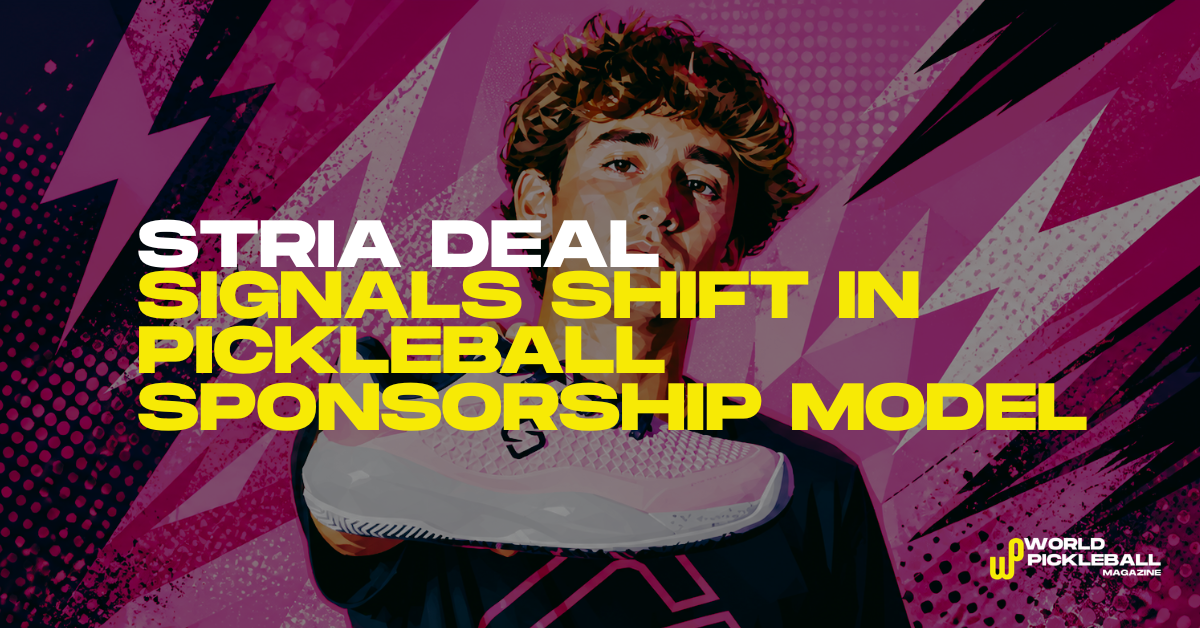
Stria’s deal with Gabe Tardio is not just a product launch. It introduces a different kind of relationship between player and brand, one that could reshape how value is shared across the sport.
- Tardio’s deal ties earnings to product performance rather than fixed sponsorship fees
- The move signals a shift toward athletes as commercial partners, not just ambassadors
- Basketball-style design and investment models are beginning to influence pickleball
A different kind of deal
For most of pickleball’s rise, a sponsorship deal meant wearing a logo and taking a fixed cheque. No upside. No stake. No real involvement.
Stria’s agreement with Gabe Tardio is one of the clearest signs yet that the model is starting to change.
Not in scale yet. But in structure.
The Chicago-based basketball footwear brand has entered the market with the G1 Pro, alongside a signature deal that links Tardio’s earnings directly to the shoe’s commercial performance.
In simple terms, this is the difference between being paid to wear something and being paid when it works.
Tardio is not simply endorsing the product. He is tied to it. If it succeeds, he benefits. If it does not, he shares in that outcome as well. That structure has long existed in basketball. In pickleball, it represents a break from how things have been done.
From visibility to ownership
Until now, the balance has been one-sided. Brands controlled the product, the messaging, and the upside. Players provided visibility in return for fixed compensation.
Even at the top of the PPA Tour, that relationship has remained relatively simple.
A royalty model changes that balance. It introduces alignment. It introduces risk. And it introduces the idea that athletes are not just part of the marketing, but part of the business itself.
Once players start sharing in product success, it becomes very difficult to return to fixed deals.
Rethinking the product itself
Stria’s approach is not limited to contract structure.
The G1 Pro has been designed around movement patterns more commonly associated with basketball than tennis. A wider base, stronger lateral stability, and impact protection built for outdoor surfaces reflect how the game is actually played.
That shift matters because the equipment has lagged behind the sport.
Much of pickleball footwear has been adapted from tennis. Yet player behaviour has already started to move elsewhere. A growing number of players have turned to alternatives, including basketball shoes, in search of better support for the game’s stop-start, side-to-side demands.
Stria has not adjusted to that trend. It has built directly into it.
Tardio’s involvement reinforces that change. He has contributed throughout the process, from early design through testing. This is not a name added at the end. It is input from the beginning.
If you’re following how the global game is shifting week by week, the World Pickleball Report breaks this down every Wednesday.
Cross-sport influence is becoming real
The second layer sits off the court.
Two-time NBA All-Star Andre Drummond has joined Stria as an investor and Creative Director.
This is not passive investment. It is a transfer of a commercial model that has already been proven elsewhere.
In basketball, athletes shape products and share in their success. That approach is now beginning to appear in pickleball, not as a concept, but as something being put into practice.
What this means
If royalty-based deals take hold, the current sponsorship model will not survive unchanged.
Players will expect more than guaranteed income. Brands will need to offer more than exposure. And the idea of an athlete as a passive ambassador will begin to feel outdated.
At the same time, product design may start to move away from tennis as its default reference point. If basketball-influenced footwear proves more effective for the way the sport is played, others will follow.
Structural change rarely begins at scale. It begins when the underlying assumptions start to shift.
Closing thought
Pickleball has spent the last few years proving it can attract attention. The next phase will be proving it can distribute value.
This is where that shift starts to become real.
For a clearer view of where the sport is heading each week, you can join the World Pickleball Report here.
Further Reading
- Latest pickleball news from around the world
- Tournament coverage and results
- Rankings and player profiles
- Regional pickleball coverage

Chris Beaumont
Founder and Editor-in-ChiefChris Beaumont is the founder and Editor-in-Chief of World Pickleball Magazine. Chris follows the global game closely, reporting on the latest news, developments, stories and tournaments from all five continents. He also hosts the World Pickleball Podcast, interviewing people at…
View All Articles →