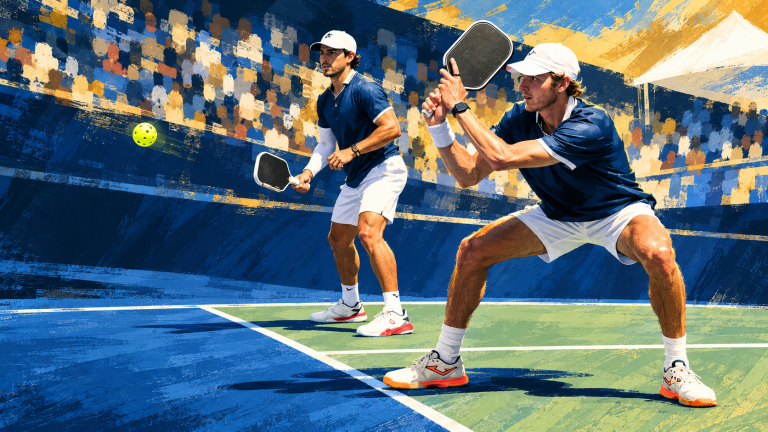

An amateur upset produced the headline result at the PPA Australia Moreton Bay 125, but the wider story ran through the whole weekend. Singles proved unstable. Doubles did not.
- Isabella Papazyan beat Sahra Dennehy in the women’s singles quarter-finals
- Andie Dikosavljevic won women’s singles, while Danni-Elle Townsend and Joseph Wild took double gold
- Moreton Bay showed how quickly singles can open up, even as doubles order remains far more secure
The biggest result came before the final
At Moreton Bay, the match that changed the tournament did not decide a title. It changed the shape of the draw.
Papazyan, playing as an amateur, knocked out Dennehy in the women’s singles quarter-finals, recovering from a first-game deficit to win 7-11, 11-6, 11-7.
It was not a loose, chaotic upset. It was a composed one. Papazyan settled into the match, adjusted her tempo, and forced one of the field’s biggest names to play from behind.
That result immediately altered the event, but it did not produce the eventual champion. Papazyan then lost in the semi-finals to Kaitlynn Hart before falling narrowly to Townsend in the bronze-medal match.
The women’s singles title instead went to Dikosavljevic, who beat Hart in the final and once again underlined her ability to come through turbulent draws.
Singles opened up. Doubles closed down.
If women’s singles delivered the shock, the doubles draws restored order.
Townsend and Dennehy regrouped immediately to take the women’s doubles title without dropping a game, a result that reinforced the form line already visible in earlier Australian events and in WPM’s own coverage of the country’s rising MLP prospects.
In the men’s doubles, Wild and George Wall came through in three games against Mitch Hargreaves and Ryan Henry to win gold. Wild then added mixed doubles gold alongside Townsend, beating Dikosavljevic and Lucas Pascoe to complete one of the strongest weekends in the field.
By the end of the tournament, the winners across the five pro events were clear: Dikosavljevic in women’s singles, men’s singles going elsewhere in the draw, Townsend and Dennehy in women’s doubles, Wild and Wall in men’s doubles, and Townsend and Wild in mixed doubles.
The pattern mattered more than the medal list alone. Singles had room for disruption. Doubles largely did not.
If you’re following how the global game is shifting week by week, the World Pickleball Report breaks this down every Wednesday.
This is where the Australian picture gets more interesting
Moreton Bay drew more than 250 players to Focus Pickleball Redcliffe, part of a PPA Australia calendar that is becoming denser and more consequential. The event’s place on the 2026 schedule was part of a wider sanctioned structure already listed by Pickleball Australia, but the competitive lesson sat inside the results themselves.
Singles remains the looser discipline. Rankings matter, but they do not protect players in the same way. A strong week, a tactical adjustment, or one uncomfortable match-up can change everything.
Doubles is different. Structure matters more. Repetition matters more. Partnerships impose themselves over time, which is why the top combinations looked far more secure than the singles seeds did.
That split is becoming one of the clearest ways to read the Australian pro scene. For broader results context, WPM’s tournament coverage and recent APAC tour reporting show the same region producing both depth and hierarchy at once.
Moreton Bay did not flatten the hierarchy. It clarified it.
Papazyan’s win over Dennehy was real and significant. It said something important about how open singles can be, and how much danger still lives beneath the surface of the draw.
But the full weekend told a more precise story than “anything can happen”.
In singles, the draw could still be broken. In doubles, the strongest players and pairings still took control of the podium.
That is not a contradiction. It is the state of the circuit.
For a clearer view of where the sport is heading each week, you can join the World Pickleball Report here.
Further Reading
- Latest pickleball news from around the world
- Tournament coverage and results
- Rankings and player profiles
- Regional pickleball coverage

Chris Beaumont
Founder and Editor-in-ChiefChris Beaumont is the founder and Editor-in-Chief of World Pickleball Magazine. Chris follows the global game closely, reporting on the latest news, developments, stories and tournaments from all five continents. He also hosts the World Pickleball Podcast, interviewing people at…
View All Articles →