Louis Laville’s double gold in Stockholm was not just a strong weekend on the RTA Tour. It exposed how quickly Europe’s apparent order can be broken when a player arrives sharper than the circuit around him.
For a tour that has recently begun to look more settled at the top, that matters. Laville did not simply collect medals in Sweden. He altered the shape of the event and, with it, the way the European men’s doubles picture now has to be read.
- Louis Laville returned from Australia and immediately won double gold in Stockholm
- The result disrupted the sense of stability around Europe’s leading men’s doubles pairings
- External competition now looks like a real advantage, not just background context
He did not rebuild momentum. He arrived with it.
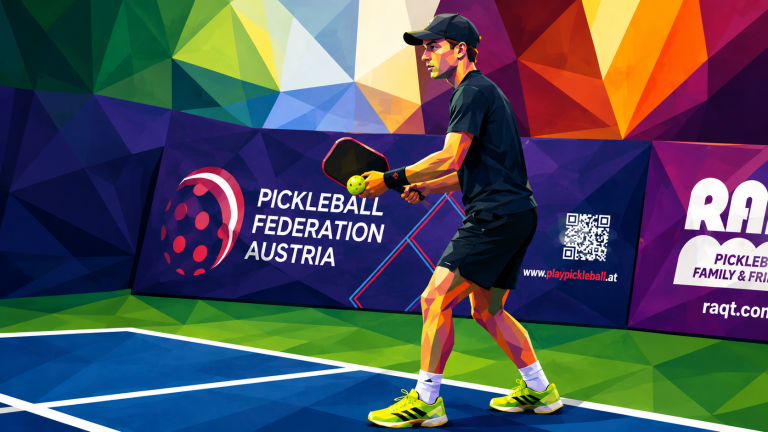
At the RTA 2000 in Stockholm, Louis Laville stepped straight back into the European circuit and won men’s doubles gold with Mauro García, adding mixed doubles gold alongside Domenika Turkovic.
There was no slow return, no visible rust, no sense of a player needing a weekend to settle back into the rhythm of the tour. He came in sharp, and the difference showed immediately.
That is what gives the weekend its weight. Form is not supposed to travel this cleanly across continents. Yet Laville’s transition from Australia back into Europe looked almost frictionless, and the result was immediate control. WPM’s own Stockholm coverage captured the result. The bigger point is what sat underneath it.
Stockholm challenged the idea that the top was settled
The top end of European pickleball has recently begun to feel more familiar. The same names have kept appearing in the closing stages of tournaments. Certain pairings have started to carry the authority that comes from repetition, not just talent.
That has been especially true in men’s doubles, where Ben Cawston and Théo Platel had built an unbeaten record together and come to represent the most stable version of the current European hierarchy.
Stockholm did not follow that script.
Laville’s return introduced a different pressure into the field. He was not merely another strong player in the draw. He was a player arriving from outside the immediate European cycle, already sharpened by recent competition and able to impose himself from the start.
The effect was obvious by the end of the weekend. The order that had looked increasingly firm suddenly looked conditional. Even the broader official RTA rankings tell only part of that story. Rankings reflect accumulation. Stockholm exposed instability.
If you’re following how the global game is shifting week by week, the World Pickleball Report breaks this down every Wednesday.
This was bigger than one player winning two titles
The easy read is that Laville had an excellent weekend. The better read is that Stockholm exposed how vulnerable a closed circuit can look once outside form enters it.
When the same players compete within the same ecosystem week after week, hierarchy starts to harden. Rankings begin to feel definitive. Partnerships begin to feel safer than they really are.
Then a weekend like this cuts through that certainty.
Laville did not just beat opponents. He disturbed assumptions. He showed that recent European order may have owed as much to the limits of the environment as to any untouchable level at the top.
That should matter to anyone following the sport beyond a single result. It affects how we interpret the men’s doubles picture, how we judge established pairings, and how seriously we take external experience as a competitive edge. That wider context sits inside WPM’s rankings and player coverage.
Europe now looks more open than it did a week ago
This is not a story about Europe falling behind. It is a story about Europe becoming harder to read.
That is healthier, more interesting, and more demanding for the players trying to stay on top.
It also gives the circuit a sharper competitive edge. If established pairs can be unsettled this quickly, then the tour is no longer moving toward quiet predictability. It is moving toward real pressure, and that is exactly the kind of shift that should shape future tournament coverage.
Laville did not just come back and win in Stockholm. He showed how fast the order can come apart.
For a clearer view of where the sport is heading each week, you can join the World Pickleball Report here.
Further Reading
- Latest pickleball news from around the world
- Tournament coverage and results
- Rankings and player profiles
- Regional pickleball coverage

Chris Beaumont
Founder and Editor-in-ChiefChris Beaumont is the founder and Editor-in-Chief of World Pickleball Magazine. Chris follows the global game closely, reporting on the latest news, developments, stories and tournaments from all five continents. He also hosts the World Pickleball Podcast, interviewing people at…
View All Articles →