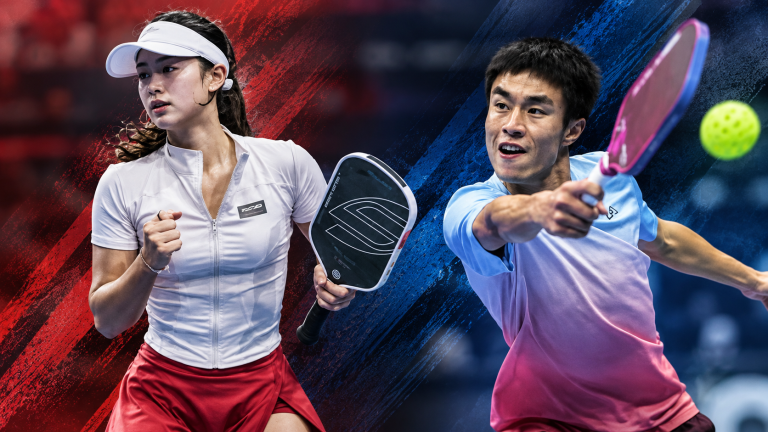

India’s pickleball strategy has moved beyond participation and into power. With a national system forming and a clear push towards the 2030 Commonwealth Games, the country is positioning itself to shape how the sport fits into global competition.
Key Takeaways
- India is targeting Commonwealth Games inclusion as a decisive step towards global sporting legitimacy.
- A national pathway is forming, from school programmes to high-performance centres and international competition.
- This is not a growth story — it is a structural play that could accelerate pickleball’s Olympic trajectory.
Most countries are still working out how to grow pickleball.
India is trying to decide where it belongs in global sport.
That difference matters.
The shift became clear in a recent interview with Indian Pickleball Association president Suryaveer Singh Bhullar, who outlined the country’s long-term strategy in a widely circulated podcast appearance.
Bhullar described a system that goes well beyond participation — one built around structured pathways, international competition, and a clear ambition to position pickleball for inclusion in the 2030 Commonwealth Games.
India is not simply building courts. It is building a case.
From participation to pathway
The Indian Pickleball Association has expanded rapidly across 26 states, with more than 10,000 serious players now operating within a structured system.
But those numbers are no longer the headline.
The real story is what sits underneath them.
A national pathway is taking shape. School integration is being rolled out alongside an inter-school championship. At the elite level, a 150-player high-performance centre in Ahmedabad is already operational under national coach Dhiren Patel, with further centres planned.
This is not informal growth.
It is system design.
The Commonwealth Games play
India will host the 2030 Commonwealth Games. As host nation, it has the power to introduce new sports.
Pickleball is being positioned to take one of those places.
That is the strategic shift.
As Bhullar explained, the aim is not just domestic expansion, but to demonstrate that pickleball can meet the structural demands of a multi-sport event.
The Indian Pickleball Association is working with other nations to establish qualifying frameworks while launching an 18-country Asia Cup to strengthen international credibility.
This is not about exposure.
It is about legitimacy.
If pickleball meets the criteria for Commonwealth inclusion, it moves from a tour-led sport into one backed by federations, funding structures, and government recognition.
If you’re following how the global game is shifting week by week, the World Pickleball Report breaks this down every Wednesday.
Why India’s approach is different
In most regions, pickleball has grown from the ground up.
Local courts. Recreational players. Then competition.
India is building both ends at the same time.
Grassroots expansion through schools is running in parallel with elite development, international competition, and national system planning.
This dual-track approach is unusual.
It is also deliberate.
In North America, the sport has largely developed through private tours and commercial investment. India is moving towards a federation-led model, closer to how Olympic sports are structured.
That difference matters.
What this means for the sport
If pickleball enters the Commonwealth Games, the impact is immediate.
National federations gain leverage. Government funding becomes viable. Athlete pathways become clearer, particularly outside the United States.
It also strengthens the sport’s Olympic case.
Pickleball will not reach that level through participation alone. It requires structure, governance, and international alignment.
India is attempting to build all three at once.
This is not about catching up.
It is about shaping what comes next.
From adoption to influence
Pickleball’s global story has largely been told through growth.
More players. More courts. More countries.
India is shifting that narrative.
The question is no longer how quickly the sport can expand there.
It is whether India will help define where the sport goes next.
Further Reading
- Latest pickleball news from around the world
- Tournament coverage and results
- Rankings and player profiles
- Regional pickleball coverage

Chris Beaumont
Founder and Editor-in-ChiefChris Beaumont is the founder and Editor-in-Chief of World Pickleball Magazine. Chris follows the global game closely, reporting on the latest news, developments, stories and tournaments from all five continents. He also hosts the World Pickleball Podcast, interviewing people at…
View All Articles →