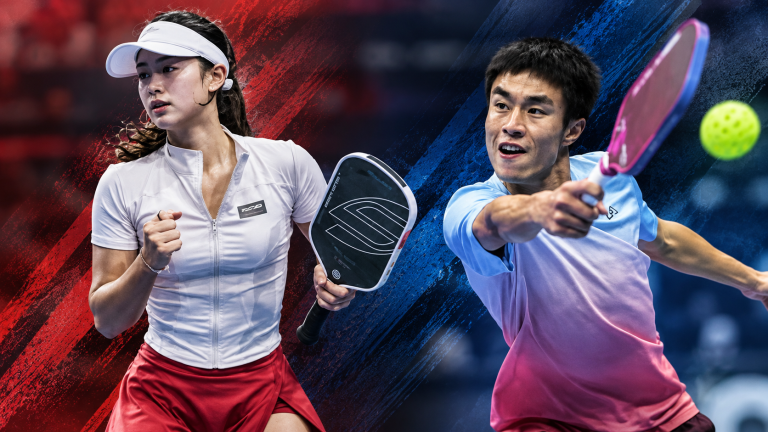
Zane Navratil has challenged the reaction to a controversial match-point call in Hanoi, pointing to a deeper issue: the sport still cannot reliably judge its own biggest moments.
- Navratil warns standard broadcast angles distort line calls
- Points to a past “hooking” accusation where replay proved misleading
- Raises wider concerns about consistency and scrutiny across the tour
The verdict arrived before the evidence did.
One replay angle. One line call. A conclusion that spread faster than the match itself.
When Ly Hoang Nam closed out his win over Christian Alshon at the MB Hanoi Cup, the final call was immediately picked apart online. From the broadcast view, the ball looked in. That was enough.
Zane Navratil is not convinced it should have been.
His argument is not that the call was right. It is that the replay people are relying on cannot prove it was wrong.
The standard broadcast angle in pickleball sits low and behind the baseline. It flattens depth. It compresses distance. Balls that land out can appear to clip the line. Without a sideline view, the image becomes suggestive rather than reliable.
Navratil has lived that gap between perception and reality.
In Da Nang, he was accused of “hooking” a ball on match point. From the main broadcast angle, it looked like a clear miss-call. The reaction followed quickly. Only later did a separate sideline angle emerge.
The ball was not close. It was clearly out.
The problem was not the call. It was the camera.
That example cuts through the current debate in Hanoi.
Because what is being judged online is not the call itself. It is a single angle that has already been shown, in similar situations, to be misleading.
Navratil also pointed to something less technical, but just as revealing.
Alshon disputed the decision, but his reaction never crossed into the kind of confrontation that usually follows a call a player knows is definitively wrong. That does not settle the debate. But it does weaken the certainty of it.
Then comes the broader issue.
Controversial calls are not new. They happen regularly across the professional game. What is less consistent is the reaction. Some moments pass. Others escalate.
Navratil’s point is not just about one match. It is about how the sport chooses which moments to scrutinise and which to ignore.
Pickleball’s growth has outpaced its infrastructure.
The sport now operates across tours, continents and broadcast environments. But officiating has not evolved at the same speed. Most matches still rely on limited camera coverage, often from a single angle that was never intended to function as a review system.
That gap is no longer theoretical. It is visible.
This is not about whether one ball was in or out.
It is about a sport that cannot yet prove the answer when it matters most.
As coverage expands and scrutiny increases, these moments will not disappear. They will multiply.
And until multi-angle replay becomes standard, the sport will continue asking imperfect images to deliver definitive answers.
That is a problem.
Right now, pickleball is arguing over angles instead of outcomes. Until the sport fixes how it sees, it will keep questioning what it knows.
For more global pickleball reporting and the stories that matter across the sport, you can sign up to the World Pickleball Report.
Further Reading
- Latest pickleball news from around the world
- Tournament coverage and results
- Rankings and player profiles
- Regional pickleball coverage

Chris Beaumont
Founder and Editor-in-ChiefChris Beaumont is the founder and Editor-in-Chief of World Pickleball Magazine. Chris follows the global game closely, reporting on the latest news, developments, stories and tournaments from all five continents. He also hosts the World Pickleball Podcast, interviewing people at…
View All Articles →