A lot of players are losing points with paddles they think are helping them. At amateur level, extra power can feel like an upgrade until it starts turning routine balls into missed margins.
- Power paddles can increase unforced errors for players who cannot consistently control the added rebound
- Control paddles often improve drops, resets and kitchen exchanges by giving players more margin
- Ball type, indoor or outdoor play, and temperature can all change how much power a paddle really gives you
More power is not always more pressure
The logic is easy to understand.
If a paddle gives you more pace, you should be able to put opponents under more pressure. Drives should feel heavier. Counters should feel sharper. Speed-ups should carry more threat.
That is true, up to a point.
For many 4.0 to 5.0 players, though, the same power that creates pressure also removes control. The ball comes off the face faster than expected. A drive misses long by a foot. A counter off the body sails past the baseline. A reset that should die into the kitchen sits up instead.
Those are not dramatic errors. They are small losses of margin.
But at competitive amateur level, that is often where matches are decided.
The test that tells the story
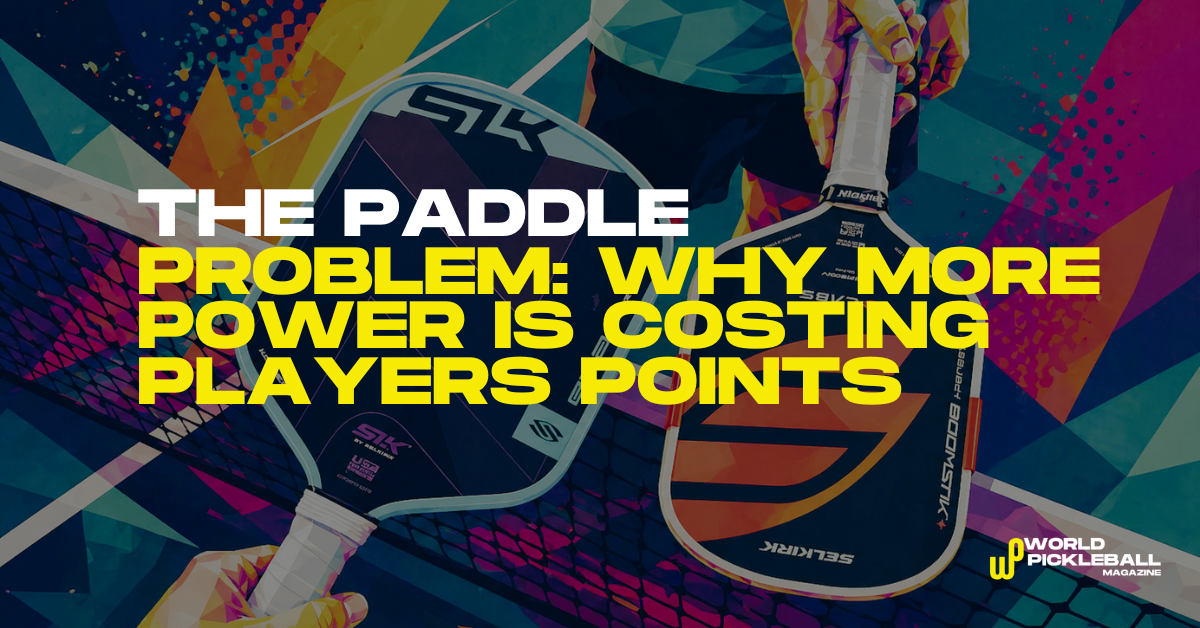
The clearest example came from a 5.0-level player testing two very different paddles in match conditions: the control-focused Vatic Pro Prism and the more power-heavy Boomstick.
With the control paddle, the soft game became more repeatable. Third-shot drops settled earlier. Resets stayed lower. Hand battles felt calmer because the player did not have to take as much pace out of the ball.
With the power paddle, the same strokes created different outcomes. Drives carried. Counters needed finer timing. Balls that looked playable off the paddle finished just long.
That is the uncomfortable part for many players. The mistake does not always feel like a paddle problem. It feels like a swing problem.
Sometimes it is. But often, the paddle has simply reduced the margin for the player using it.
The result was still there. The control was not
The same player still reached the podium in mixed doubles while using the more powerful paddle.
That matters because this is not a simple argument that power paddles are bad. They are not. In the right hands, they are dangerous.
The issue is stability.
A player can still win matches with a power paddle and be less consistent while doing it. The ceiling may stay high, but the floor drops. One rally looks unplayable. The next ends with a drive long, a counter rushed, or a reset sitting too high.
Over a full match, that gap matters.
If you’re following how the global game is shifting week by week, the World Pickleball Report breaks this down every Wednesday.
Where the points start leaking
The problem shows up most clearly in the shots that require touch under pressure.
On third-shot drops, extra rebound narrows the landing window. A ball that would have dipped into the kitchen with a control paddle can drift deep enough to invite an attack.
On resets, the player has less time and less forgiveness. Instead of absorbing pace, the paddle adds a little back. That is how neutral balls become pop-ups.
At the kitchen line, the same issue appears in hand exchanges. Power can help if the player stays compact. But if the paddle encourages a bigger swing, the exchange quickly gets away from them.
Most players do not lose those points because they lack aggression.
They lose them because they cannot keep the aggression inside the court.
The ball changes the equation
This is where the conversation becomes more interesting than a simple power versus control argument.
The same paddle does not behave the same way with every ball.
With a harder outdoor ball, the margin disappears faster. The ball already travels more quickly and comes off the paddle with more urgency. Add a powerful paddle and the player has to be much cleaner with contact, shape and depth.
With a softer indoor ball, the same paddle can feel easier to manage. The pace drops slightly. The ball sits on the face a little longer. The player has more room to work.
That does not remove the issue. It delays it.
Temperature matters too. In hotter conditions, the ball tends to feel livelier. A paddle that feels controlled in cooler weather can become much harder to manage when the court speeds up.
For many players, the real question is not simply, “Is this paddle too powerful?”
It is: “Is this paddle too powerful for this ball, in these conditions, with my current level of control?”
Why professionals get away with it
At professional level, power is not the problem.
The difference is that elite players can hold the same pace inside smaller margins. They are not just hitting harder. They are missing less while hitting harder.
That is why the comparison between amateur and professional paddle choice can be misleading.
A pro can use added power to finish points because their hands, footwork and contact discipline keep the ball under control. A 4.0 player using the same type of paddle may simply give themselves less room to miss.
That does not make the paddle wrong.
It makes the fit wrong.
What players should actually look for
The warning signs are usually clear.
If you are missing long more often than into the net, your paddle may be adding more pace than you can manage.
If your drops keep floating deep, you may not need more power. You may need more dwell, softness and control.
If your hand battles feel rushed, the answer is not always faster hands. It may be a paddle that lets you stay shorter and quieter through contact.
That is the real performance check.
A good paddle is not the one that feels most explosive in warm-up. It is the one that lets you repeat your best shots under pressure.
Why it matters
Power sells because it is easy to feel.
Control wins because it is easier to repeat.
For amateur players, that difference is bigger than many realise. A paddle that adds pace can be useful, but only if the player can still drop, reset, block and counter without giving points away.
Power only helps if you can keep it inside the court.
For a clearer view of where the sport is heading each week, you can join the World Pickleball Report here.
Further Reading
- Latest pickleball news from around the world
- Tournament coverage and results
- Rankings and player profiles
- Regional pickleball coverage

Chris Beaumont
Founder and Editor-in-ChiefChris Beaumont is the founder and Editor-in-Chief of World Pickleball Magazine. Chris follows the global game closely, reporting on the latest news, developments, stories and tournaments from all five continents. He also hosts the World Pickleball Podcast, interviewing people at…
View All Articles →