
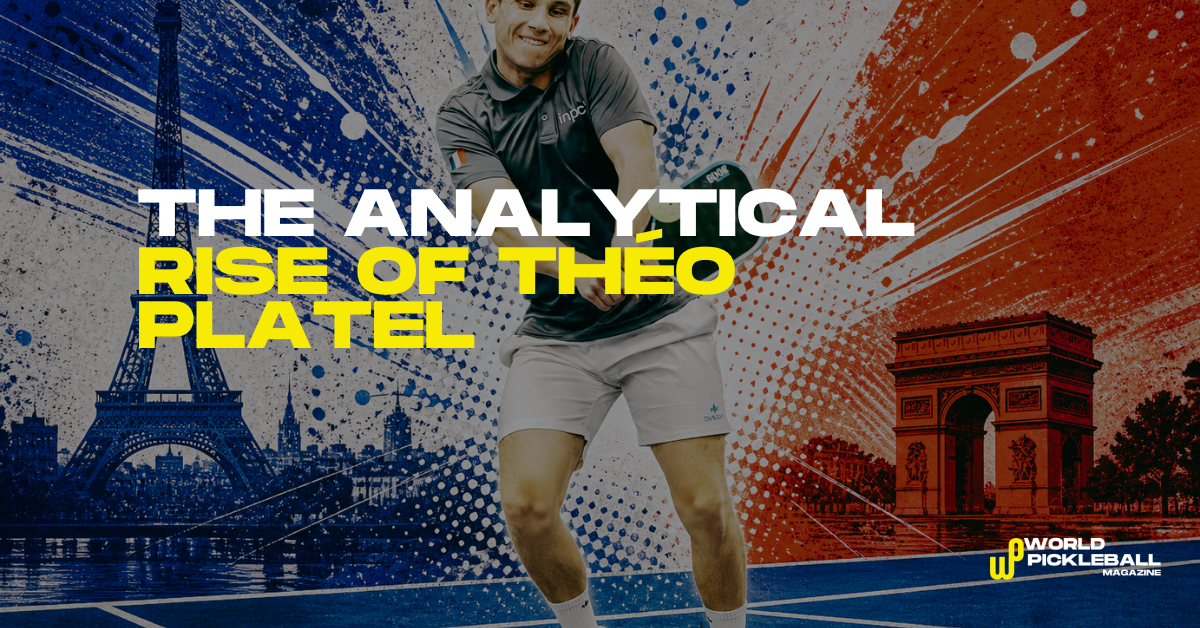
It is late April 2026, and Théo Platel is looking at the numbers.
The 24-year-old Frenchman has already collected 12 titles from his first 10 tournaments of the year, a staggering hit rate that has pushed him to the top of the European RTA Tour men’s doubles rankings. The RTA Tour rankings reflect this shift, with European players climbing steadily. For a player who naturally leans towards analysis, these are the kind of figures that matter.
Key Takeaways
- Théo Platel has collected 12 titles from his first 10 tournaments of 2026, making him the dominant force in European men’s doubles
- The 24-year-old French accountant brings a data-driven, analytical approach to pickleball that sets him apart from intuitive players
- Platel’s partnership strategy is built on mathematical precision rather than raw athleticism, redefining what European elite play looks like
This article features in the May 2026 issue of World Pickleball Magazine. For the full collection of features, interviews, coaching insights and global coverage, download the complete magazine here.
But the numbers alone don’t explain why Platel has become the defining face of French pickleball.
To understand that, you have to look at how he sees the game.
From Tennis Prodigy to a Humbling Education
Platel’s racket-sport pedigree was forged early. By the age of 13, he had achieved a 15/1 tennis classification, placing him among the top 10 juniors in the South of France. It provided a strong technical foundation, but as Platel is quick to point out, a tennis background doesn’t automatically translate.
His introduction to pickleball arrived by chance in the summer of 2021. After a padel session with his older brother, Julien, a local initiation session changed the trajectory of his sporting life.
What followed was a familiar experience for many crossover athletes: a quick lesson in humility.
“We played 60-year-old people,” Platel recalls. “I was like, ‘Okay, I should beat this guy just by looking at him.’ And it’s not good to do that. They beat me easy.”
That moment stayed with him.
“I had to understand this game… to understand how he beat me and how I can beat him later. That’s why I really love pickleball. Tactic is really a big part of the sport.”
The Data-Driven Professional
Platel’s edge comes from how he processes the game.
“I was working as an accountant,” he says, laughing at the correction after initially calling himself a scientist. “For me, analysis is easy. When I see a game on YouTube… I really want to understand why this guy played this type of shot and what it brings to him.”
Rather than copying what top American players do, he breaks it down.
When he wanted to add a backhand flick, he didn’t just replicate the movement. He watched the same matches multiple times, isolating when the shot was used and why it worked. Only then did he take it onto the court, repeating the pattern again and again until it became reliable.
It is a demanding approach.
A typical day in Nice can include two hours in the gym followed by two hours of structured drilling. With limited high-level match play available locally, much of his development has come through repetition rather than competition.
That discipline shows in his consistency.
The Math of a Championship Partnership
For three years, Théo’s rise was closely linked to his brother Julien, who was both partner and sounding board. The combination worked, culminating in an appearance for Team France, but the intensity of competing alongside a sibling eventually led to a change.
By 2025, Julien had stepped into a full-time coaching role, allowing Théo to explore new partnerships.
His thinking around doubles is, unsurprisingly, methodical.
“If you play with someone and you’re a really good left-side player… but you make [your partner] play on the right side, maybe they are at 50 percent,” Platel explains. “Together you’re like 150 percent. But imagine if you play right side where you’re not too bad, and your partner feels good on the left side. It will be 80 percent and 80 percent—which is 160 percent.”
He found that balance with Great Britain’s Ben Cawston.
Platel dictates from the front of the court, while Cawston—one of the quickest hands in Europe—anchors the defence and counter-attacks. Off the court, their friendship allows for direct, honest feedback. On it, the partnership has become one of the most reliable combinations on the tour.
If you’re following how the global game is shifting week by week, the World Pickleball Report breaks this down every Wednesday.
The Mental Rebuild
The rise to the top of the rankings has not been straightforward.
Platel admits that 2024 was a difficult year. Expectations rose quickly, and so did the pressure that came with them. Funding his own travel, often at a cost of around 800 euros per tournament, added another layer of stress.
“Before that, I was like, ‘Okay, I’m number one, I cannot lose any matches,’ which is impossible,” he says.
That mindset became a problem.
To move forward, he had to reset.
“If I lose, it’s just a match. He was better. I will practice 10 times harder and I will be better to beat him.”
It sounds simple, but it marked a shift from protecting his position to improving it.
That shift showed.
The “American Dream” and the Future of French Pickleball
Platel is now looking beyond Europe.
He has launched a crowdfunding initiative to spend six months competing on the PPA and APP tours in the United States, where the depth of competition remains unmatched.
Back home, the landscape is changing as well. In January 2026, the French Tennis Federation (FFT) officially took over the governance of pickleball, giving the sport institutional backing and a clearer pathway for growth.
As France’s top-ranked player, Platel is working closely with the federation, aware that rapid growth needs structure to sustain it.
When asked what advice he would give to a 4.0-level player trying to improve, he returns to his core principle.
“People play the point in a way that they want to win the point… they try to do something big and take some risk,” he says. “Just put the ball maybe twice in, maybe three times, and then your opponent is going to pop up the ball. Work on your consistency.”
Chasing the Margins
Looking ahead, Platel’s goals are clear.
He wants the double crown on the European Pro Tour. A strong showing at the French Nationals. And a chance to test himself consistently against the best in the world.
But more than that, he is chasing refinement.
Because for all the numbers, all the titles, and all the progress, his view of the game hasn’t changed.
It’s still something to be solved.
Not through one big shot.
But through a series of better decisions.
And right now, that’s a calculation he’s getting right more often than anyone else in Europe.
For a clearer view of where the sport is heading each week, you can join the World Pickleball Report here.
Further Reading
- Latest pickleball news from around the world
- Tournament coverage and results
- Rankings and player profiles
- Regional pickleball coverage
Chris Beaumont is the founder and Editor-in-Chief of World Pickleball Magazine. Chris follows the global game closely, reporting on the latest news, developments, stories and tournaments from all five continents. He also hosts the World Pickleball Podcast, interviewing people at all levels of pickleball. Chris is also an avid player, currently struggling to make the breakthrough from 4.0 to 4.5.