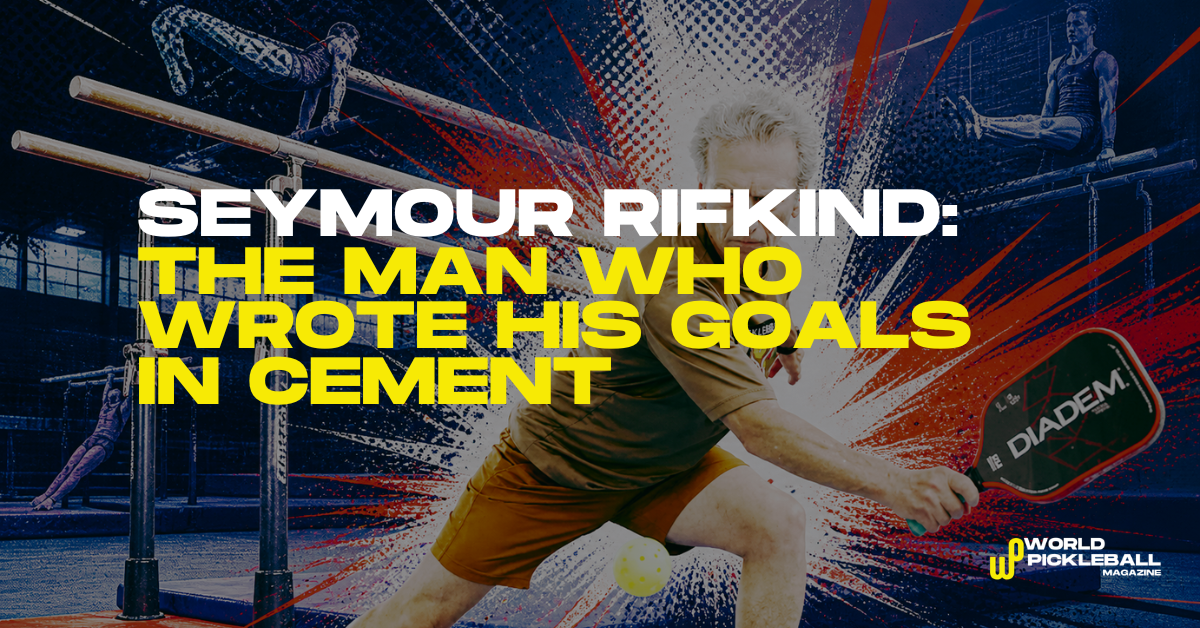
Seymour Rifkind learned early that goals become harder to abandon once other people can see them.
As a teenager in Illinois, he built a set of parallel bars in his backyard with his father. Two oars from a rowboat. Pipes. Holes dug into the ground. Cement poured to hold the whole thing in place.
Key Takeaways
- Seymour Rifkind’s approach to pickleball mirrors his life philosophy: write your goals where others can see them and make them impossible to abandon
- His story spans decades of athletic commitment, from gymnastics to marathons to competitive pickleball in his later years
- Rifkind’s competitive drive and systematic goal-setting offer a model for how age-group players can approach the sport with professional intensity
This article features in the May 2026 issue of World Pickleball Magazine. For the full collection of features, interviews, coaching insights and global coverage, download the complete magazine here.
Before the cement dried, he wrote into it what he intended to become.
The 1969 Illinois state parallel bar champion.
The 1969 state all-around champion.
One of those goals was plausible. The other was not. At that point, Rifkind had barely begun working the other events.
That was the point.
Once it was in the cement, it could not quietly disappear.
“When I got sick, when I wasn’t feeling well, I’d see that written in the cement,” he says. “Or sometimes a friend would say, ‘What do you mean you’re not going to work out? I thought you said you were going to be state champion.’”
The lesson stayed with him.
A goal kept privately can be negotiated with. A goal made visible starts to own you.
That is the thread running through Rifkind’s life, from gymnastics to coaching, from ultra-endurance to pickleball.
He does not just imagine systems.
He tries to build them.
Rifkind’s drive did not arrive from nowhere.
He grew up as the son of a Holocaust survivor. His father spoke about what had happened, not occasionally, but constantly. There were stories of deprivation, loss and survival. Stories a child might not have been ready to hear, but heard anyway.
His father, Rifkind says, carried guilt because he survived when others did not. His older brother, described as the smartest, did not. His younger brother, described as the sweetest, did not. His father called himself the troublemaker.
The troublemaker survived.
Rifkind was named after the younger brother.
That history became more than family memory. It became pressure. It became purpose. It became a need to make his father proud, to give some meaning to survival that had never quite made sense to the man who lived through it.
“I took it upon myself,” Rifkind says, “to do everything I could to make him feel proud.”
That sentence explains more about his career than any title does.
The Hall of Fame. The teaching organisation. The World Pickleball Federation. The schools project. The Olympic ambition.
They are not separate achievements.
They are expressions of the same instinct.
Make the goal visible. Build the structure. Refuse to let it drift.
When Rifkind first started talking seriously about pickleball’s future, most people laughed.
In 2015, he told athletes that pickleball could become the most popular sport in the world and that his goal was to see it in the Olympics.
“I got a bunch of giggles,” he says. “Nobody took it seriously.”
He understood why.
At the time, pickleball was still viewed by many as a recreational game, closer in perception to horseshoes than to a serious global sport. Dedicated courts were scarce. In some places, there were probably more backyard courts in the Pacific Northwest than formal pickleball courts anywhere else.
But Rifkind saw something others did not.
Not just popularity.
Goals Written in Cement
Possibility.
Today, he says the sport is in around 90 countries, and he has personally introduced it to more than 40.
That matters. But it is not the most interesting part of his story.
The more interesting part is what he thinks pickleball still lacks.
For Rifkind, the sport’s future is not secured by participation numbers.
It depends on teaching, standards, facilities, equipment control, player pathways and governance.
That may sound dry until you hear how he talks about coaching.
His background in gymnastics shaped everything. In gymnastics, he says, nothing is natural. To teach it properly, you have to understand anatomy, physiology, kinesiology and how the body moves. If you get it wrong, people get hurt.
He brought that thinking into pickleball.
Not because pickleball is dangerous in the same way.
Because bad teaching creates bad habits, and bad habits become the foundation of a sport if nobody stops them early.
His teaching curriculum was built around stroke development, efficiency and evidence, not just the opinions of great players. That distinction matters to him. A great player is not automatically a great coach.
“People equate a great player being a great coach,” he says. “That’s the furthest thing from the truth.”
That is one of Rifkind’s sharpest points.
Pickleball cannot rely on charisma and playing level alone. It needs people who can teach, explain, adapt and correct.
It needs education, not just demonstration.
That is why his organisation overhauled its level one curriculum. What was once four hours in a classroom and four hours on court became 12 hours online and four hours on court. The reason was simple: consistency.
The material is now available in 20 languages. Everyone gets the same message. Instructors can study before they arrive on court. The classroom part no longer depends on whether a particular tutor happens to be a strong public speaker.
For Rifkind, that is not administration.
It is infrastructure.
The kind people do not notice until it is missing.
He is especially proud that higher education has started to take the curriculum seriously. He says European University is basing a graduate-level pickleball major on IPTPA’s curriculum, with other university partnerships also developing.
That is where his vision becomes clear.
He does not want pickleball merely played everywhere.
He wants it taught properly everywhere.
The challenge is that the game itself keeps moving.
At beginner level, the fundamentals remain. But at the top, pickleball is changing fast. New athletes. New shots. New equipment. New patterns.
Rifkind sees the sport entering another phase.
First came the early pickleball players. Then came athletes from tennis and other sports, players who already understood training, pressure, nutrition and competition. Now, he believes, the next generation is arriving.
Pickleball natives.
Players trained in the sport from childhood, without needing to unlearn tennis mechanics.
If you’re following how the global game is shifting week by week, the World Pickleball Report breaks this down every Wednesday.
If you're following how the global game is shifting week by week, the World Pickleball Report breaks this down every day in our morning briefing.
A Lifetime of Competition
That is where Asia enters the conversation.
Rifkind is convinced that countries such as China, Vietnam, Malaysia and India will soon produce players capable of standing with the best in the world. His reasoning is not vague. He has seen the training culture up close.
In China, he has watched five-year-olds at table tennis centres hitting thousands of balls a day. He is careful about the methods, and says some of it would be considered unacceptable in the western world. But the discipline and repetition are undeniable.
At a PCL Rising Stars event in Hainan, he watched 14 to 18-year-olds from across Asia and was stunned.
“I was blown away by how good these kids were,” he says. “Every single one of these kids had every single skill.”
Some, he says, were already 5.0 players. They had positioning, pressure management, sportsmanship and joy.
That combination caught his eye.
Not just skill.
Readiness.
The next step is more formal still.
Rifkind says IPTPA is working with partners in Asia on what he describes as the first full residential pickleball academy in the world, aimed at players aged 14 to 18. Coaching, nutrition, off-court training, recovery areas, ice baths, saunas, treatment rooms.
A proper high-performance environment.
If it works, he wants academies on every continent so players do not have to move to the United States to get better.
That is not a small idea.
It is the same cement again.
A goal made visible.
But Rifkind is not romantic about where the sport stands.
He sees problems everywhere.
Ratings. Equipment. Governance. Illegal paddles. Counterfeit approvals. Line calls. Safety. Too many people arriving too quickly without enough structure underneath them.
His concern about paddles is especially sharp.
At professional level, an illegal paddle creates an advantage. At recreational level, it can change someone’s first experience of the sport entirely.
He describes a beginner being told to move up to the kitchen line, only to face someone with an overpowered paddle trying to smash the ball at them.
“They’re thinking, ‘I don’t want to get up to that net. This isn’t fun. This is intimidating.’”
That, for Rifkind, is not a small issue.
It cuts directly into what makes pickleball work.
If equipment turns the sport away from play and towards intimidation, the game loses something important.
The same applies tactically.
Rifkind rejects the idea that dinking is dead. He has heard that argument from people in Asia who claim the sport has become a power game. His answer is simple.
Watch Ben Johns.
If the highest-level doubles matches still produce long dink rallies, then the chess match has not disappeared.
It has changed.
The Pickleball Chapter
He believes equipment has added speed and spin, but the best players still understand how to take away what opponents want to do. That is why, in his view, Johns remains the standard.
Other players may have quicker hands or more explosive athleticism.
But pickleball, at its best, is still a game of counters, adjustments and control.
That is why Rifkind’s view of the sport is more complicated than simple evangelism.
He wants growth, but not chaos.
He wants professionalism, but not at the expense of play.
He wants global expansion, but not without teaching standards.
He wants the Olympics, but knows the sport cannot get there while governance remains fractured.
At one point, he says plainly that people at the highest levels of the Olympic movement love pickleball and want to see it there. But the first requirement is one international federation. That, he argues, has been the central governance problem.
This is the uncomfortable truth in the middle of his optimism.
Pickleball is not being held back by lack of interest.
It is being tested by its own speed.
And yet, for all the systems talk, Rifkind keeps returning to something softer.
Play.
He has seen professional players finish matches and then coach the players who beat them. He says that does not happen in tennis. The culture is different.
“The secret sauce to pickleball will always be there,” he says. “The community. The friendships that develop, the laughs, the giggles.”
Then he says the line that explains why he still believes in the sport.
“It’s playtime.”
Not childish. Not unserious.
Playtime.
A word adults often lose, then spend the rest of their lives trying to recover.
That is why the systems matter. Not to make pickleball colder, more bureaucratic or more controlled.
To protect the thing that made it powerful in the first place.
Seymour Rifkind once wrote a goal into wet cement because he understood, even then, that ambition needs form.
Decades later, he is still doing the same thing.
Only now the cement is different.
Curriculums. Federations. Academies. Coaching standards. Global pathways. Olympic ambitions.
The scale has changed.
The instinct has not.
Make the goal visible.
Then build until the world has to take it seriously.
For a clearer view of where the sport is heading each week, you can join the World Pickleball Report here.
Further Reading
- Latest pickleball news from around the world
- Tournament coverage and results
- Rankings and player profiles
- Regional pickleball coverage

Chris Beaumont
Founder and Editor-in-ChiefChris Beaumont is the founder and Editor-in-Chief of World Pickleball Magazine, published by World Pickleball Media Ltd. He follows the global game closely, reporting on news, developments, stories and tournaments from all five continents. He also hosts the World Pickleball…
View All Articles →