
The Belgian Blueprint: How Estee Widdershoven is Redefining the European Pickleball Pathway
By Chris Beaumont, Editor-in-Chief
Download the full March 2026 World Pickleball Magazine for free
There is a precise moment in the trajectory of every elite athlete when the abstract dream of professional sports suddenly crystallises into an undeniable reality. For Estee Widdershoven, the newly minted face of Belgian pickleball, that epiphany arrived not on the familiar baseline of a tennis court, but in the heart of Palm Springs during the 2024 PPA Masters.
Just months into her competitive pickleball journey, Widdershoven and her mixed doubles partner found themselves across the net from an established sibling duo. The Campbells were seasoned. They were known commodities on the tour. But as the match progressed, Widdershoven overheard a courtside conversation that changed everything. The Campbells’ coach—their father—was being told point-blank by his players that they were out of answers. They had no game plan to counter the relentless, multifaceted attack coming from the other side of the net.
“I think at that moment on we were like, ‘Okay, we’re going to have to take this serious,’” Widdershoven recalls. “‘We are playing against top players that are already known in the tour, and we beat them pretty easy.’ We were half a year in”.
That sweeping victory in the desert wasn’t just a fleeting upset; it was the genesis of a meteoric rise. Now, holding a DUPR rating well north of 5.5, Widdershoven stands at the vanguard of a new wave of athleticism crashing into professional pickleball. Hailing from Maaseik, Belgium, and polished in the United States as a standout tennis player for Valdosta State University (VSU), she is rewriting the script on how European talent can seamlessly transition to the top tiers of the sport.
From the Baseline to the Kitchen: The Tennis Translation
To understand Widdershoven’s rapid ascent is to understand the tactical foundation built during her years as a collegiate tennis player. Unlike many tennis converts who stubbornly cling to heavy topspin baseline drives, Widdershoven possessed a nuanced tennis game that perfectly translated to the 20-by-44-foot pickleball court.
“When I was a tennis player, I had a lot of variation,” she explains. “I like to come to the net a lot, which for women’s tennis, it’s a big plus to have that you have a lot of touch and can come into the net, and that really translated well into pickleball”.
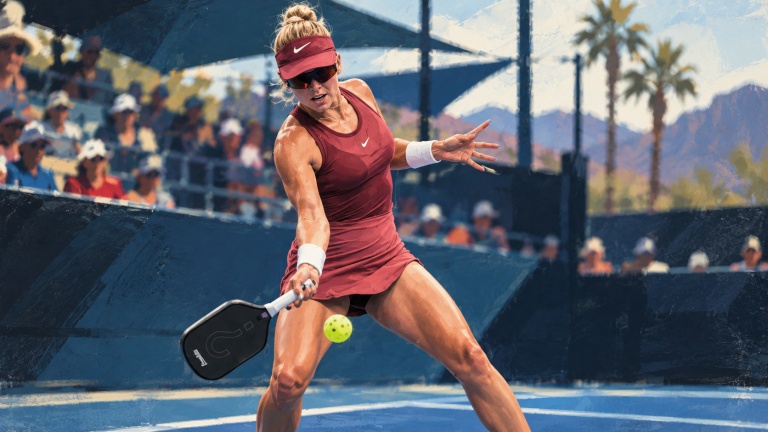
Her physical tools are undeniable. Standing at 5-foot-10 with a sprawling wingspan, she presents a formidable wall at the non-volley zone. In a sport where inches dictate the difference between a reset and a put-away, her reach allows her to exert constant pressure. “I think it scares some people,” she admits. “If you’re playing against kind of two giants, it’s pretty intimidating”.
Yet, the transition wasn’t entirely frictionless. The mechanics of pickleball require a delicate unlearning of deeply ingrained tennis muscle memory. For Widdershoven, the most frustrating hurdle was mastering the drop shot—a stroke that demands an agonisingly soft touch that has no true equivalent in power tennis.
“It’s so not tennis related,” Widdershoven says. “Driving was easy because it’s like a ground stroke in tennis. But to drop, you don’t really push a ball in tennis”.
Rather than shy away from her weakness, she attacked it with the meticulous discipline of a collegiate athlete. She drilled the drop shot relentlessly until the most difficult stroke in her repertoire transformed into her most reliable weapon. “Right now it’s my favourite shot,” she says. “The resets and the drops, I think I feel the most comfortable in it because I’ve drilled it so many times”.
If you're following how the global game is shifting week by week, the World Pickleball Report breaks this down every day in our morning briefing.
The Mind of a Coach on Centre Court
Widdershoven’s development is uniquely supplemented by her day job. She currently serves as the assistant coach for the VSU women’s tennis team, a role that forces her to constantly analyse mechanics, dissect opposing strategies, and maintain absolute emotional equilibrium.
In a sport as volatile as professional pickleball, where momentum swings wildly and the physical proximity of opponents can amplify tensions, maintaining composure is a distinct competitive advantage. “As a coach, you have to stay calm,” Widdershoven notes. “You cannot go crazy because the player will feel it as well. So just stay calm and collected on the pickleball court, because sometimes it can be really intense. You feel almost like you’re on top of each other. So when you scream, it’s super intense. I have to keep that neutral”.
This analytical coaching mindset allows her to rapidly identify and exploit the structural weaknesses in an opponent’s game. When you play against Widdershoven, you aren’t just playing an elite athlete; you are playing a tactical scout actively deconstructing your tendencies in real-time.
A Historic Milestone: Signing with the PPA
Her relentless work ethic and tactical brilliance recently culminated in a historic milestone: Estee Widdershoven became the very first Belgian player to sign a professional contract with the PPA Tour.
While she keeps the specific financial details of the agreement closely guarded, the structural impact the contract has on her 2026 season is profound. Prior to signing, Widdershoven was entrenched in the gruelling reality of the qualifier grind—a demanding gauntlet where players must survive up to seven matches in a single day against hungry, desperate competition just to earn the right to play the main draw the following morning.
The PPA contract immediately removes her from that physical and mental meatgrinder. She now enjoys direct entry into the main draws, allowing her to travel later, rest properly, and peak when the stakes are highest. Beyond the physical relief, the contract offers a new level of professional validation. “It’s small little things,” she explains. “You can go into the pro lounge, eat the snacks, sit in the shade, just relax a little bit in between your matches… I felt really more at ease and like not that I had to prove myself anymore. I felt comfortable in the environment”.
Singles Dimensions and Centre Court Showdowns
With her PPA tour status solidified, Widdershoven is aggressively expanding her competitive footprint. Initially hesitant about professional singles, she has recently fully embraced the discipline, leveraging her tennis background to dominate the full court.
Her fearless approach was put to the ultimate test when she squared off against Catherine Parenteau on center court in Atlanta. Instead of shrinking from the spotlight, Widdershoven viewed the heavily favoured Parenteau and the raucous crowd as a necessary crucible for her growth. “My goal was really to be comfortable in the uncomfortable,” she says. “I knew there were going to be a bunch of people watching and rooting for Catherine… I gave her a match”.
During that match, Widdershoven utilised a devastating forehand slice, a tactical anomaly in modern pickleball that disrupts the rhythm of players accustomed to standard topspin drives. “It was the same in tennis,” she observes. “People don’t like to see different speeds coming at them or different spins”.
Widdershoven is also keenly watching the ongoing trials regarding the reduction of the singles court size. While she acknowledges that a skinnier court might favour the “cat-and-mouse” mastery of players like Ben Johns, she remains highly sceptical of its long-term viability. The logistical nightmare of forcing global facilities to re-tape or repaint double lines on acrylic courts makes widespread adoption unlikely in her eyes. “If you would ask me a yes or no answer, I think it will actually be no, just because of the accommodations,” she predicts.
The Global Stage: Belgium’s Figurehead and Asian Innovations
While her professional career is anchored in the United States, Widdershoven’s heart remains tethered to her homeland. She proudly represents a nation that is just beginning to fully adopt the sport, serving as a beacon for European players who dream of crossing the Atlantic.
That international pride peaked late last year when she represented Belgium at the World Cup in Fort Lauderdale. The experience of wearing her nation’s colours reignited the same fires she felt playing Junior Olympics for tennis over a decade ago. “It’s the best feeling as an athlete that you can have,” she says. “You don’t play for yourself, you’re playing for your whole country”.
Belgium’s performance was spectacular. They stunned the heavily favoured United States in the women’s doubles pre-tournament final on centre court. They then navigated a treacherous pool, defeating Ecuador, Nicaragua, and surviving a thrilling Dream Breaker against China before besting Italy in the main draw.
The World Cup also served as a masterclass in global pickleball styles. Widdershoven was particularly captivated by the Asian teams, noting the stark differences in their tactical approach. “The Asians have so, so good hands,” she observed. “And also their dinks are just so on point. They don’t leave anything up really. You’re really going to have to create a pop-up from them”. She marvelled at the militant discipline of teams like Hong Kong, watching them drill exclusively at the kitchen line, dinking relentlessly for half an hour straight between matches.
The Blueprint for 2026
As the 2026 season unfurls, Widdershoven is meticulously architecting her path to the apex of the sport. Her mixed doubles partnership with Luca Mack—a former German tennis All-American whom she met at Valdosta State in 2020—provides a bedrock of consistency and deep mutual trust. The pair, currently residing in Georgia, are planning a strategic relocation to Florida (targeting hot spots like Boca Raton or Tampa) to immerse themselves in the highest density of elite practice games.
She enters the year as a highly coveted free agent in the paddle market, having recently concluded her contract with Selkirk. For manufacturers listening, her demands are clear: she wants the touch of a 16mm control paddle, but requires enough inherent pop to complement her aggressive, power-heavy singles game. “I have a lot of power myself,” she notes. “I also need some power in my paddle, but still having control at the same time for doubles”.
The ultimate measuring stick for her 2026 campaign will be the upcoming Major League Pickleball (MLP) draft. Earning a coveted roster spot is her primary objective. But true to her coaching mentality, Widdershoven has a contingency plan perfectly mapped out. If the draft doesn’t call her name, she will pivot seamlessly to the PPA Challenger circuit over the summer, relentlessly hunting ranking points to secure better seeding for the back half of the year.
“It can’t go wrong,” she says with the quiet confidence of an athlete who knows exactly where she is heading.
Estee Widdershoven is no longer just a qualifier looking for an opening. She is a contracted professional, an international flag-bearer, and a tactical tactician ready to leave an indelible mark on the sport. For Belgium, and for the global pickleball community, the rise of Estee Widdershoven is no longer a localised phenomenon—it is a worldwide warning.
For a clearer view of where the sport is heading each week, you can join the World Pickleball Report here.

Chris Beaumont
Founder and Editor-in-ChiefChris Beaumont is the founder and Editor-in-Chief of World Pickleball Magazine. Chris follows the global game closely, reporting on the latest news, developments, stories and tournaments from all five continents. He also hosts the World Pickleball Podcast, interviewing people at…
View All Articles →