
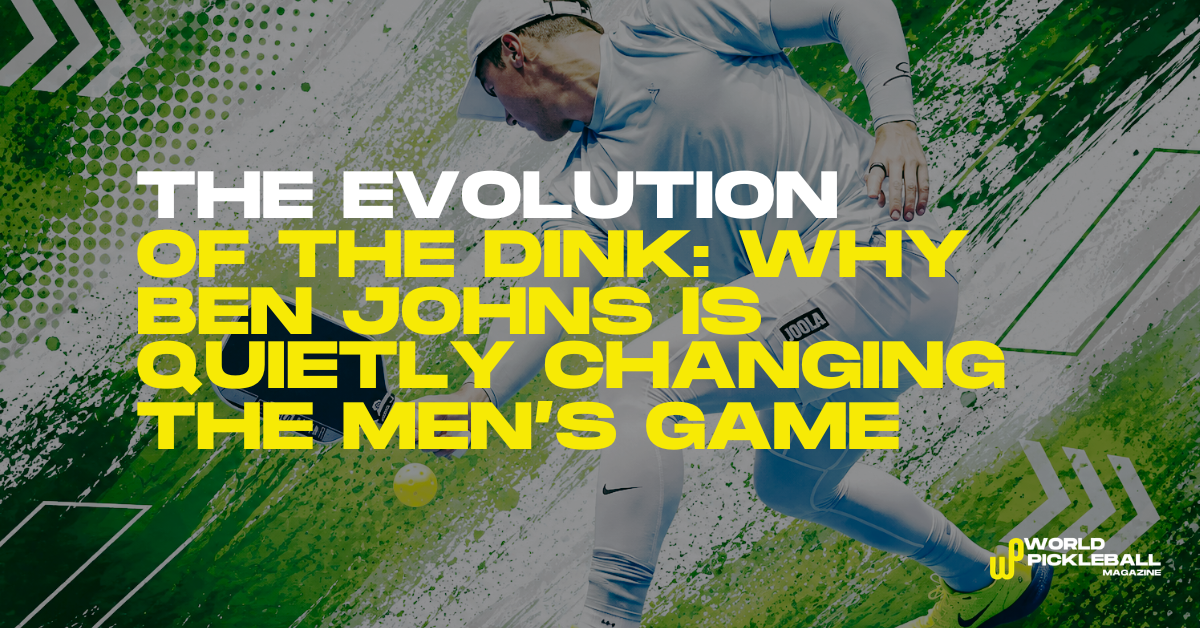
Ben Johns has introduced a noticeably different two-handed dink technique, and the adjustment may say more about the future of professional pickleball than any result from the PPA Finals. The modern men’s game is no longer rewarding obvious aggression. It is rewarding disguise.
- Ben Johns has shifted towards a shorter, more compact two-handed dink motion
- Elite defensive standards are forcing professionals away from predictable speed-ups
- Younger players such as Tama Shimabukuro are beginning to influence the tactical direction of the sport
At first, it barely looked different.
Ben Johns stood at the kitchen line during the PPA Finals with the same calm posture he has carried for years. Same balance. Same stillness. Same unreadable expression.
But the paddle was lower.
The follow-through was shorter. The exaggerated roll motion that once defined so much of the modern men’s game had largely disappeared. Instead of attacking the ball with a sweeping scoop across his body, Johns appeared to cushion it forward with a compact brushing motion, the paddle tip staying down and out in front almost the entire time.
To casual viewers, it was insignificant.
To serious players, it was fascinating.
Why Compact Mechanics Suddenly Matter
Because elite pickleball is no longer about who attacks first. It is becoming about who reveals their intentions last.
Coach and analyst Ryan Dawidjan was among the first to publicly highlight the change, describing Johns’ new two-handed dink as more of a controlled “bunt” than the larger, more explosive mechanics that have dominated recent professional play.
That detail matters far beyond one player’s technique.
For the last several years, the men’s professional game has chased speed relentlessly. Bigger drives. Faster counters. More aggressive hand battles. Players increasingly looked to create pressure through raw acceleration, particularly from below the net.
Then the defenders adapted.
The top professionals now reset with absurd consistency. They absorb pace comfortably. They counterattack from positions that previously looked defensive. What once felt overwhelming has become manageable at the elite level.
Power forced the evolution of defence. Defence is now forcing the evolution of deception.
If you’re following how the global game is shifting week by week, the World Pickleball Report breaks this down every day in our morning briefing.
The Tactical Shift Happening at the Kitchen Line
Johns’ new mechanics appear built around keeping options alive for as long as possible. By reducing backswing and keeping the paddle neutral in front of the body, he can disguise direction far later into contact.
The same preparation can produce a crosscourt dink, a down-the-line redirect, a sudden topspin roll or a soft reset.
The opponent receives less information.
At professional speed, that is everything.
Large swings and exaggerated loading patterns now create problems at the kitchen line. They expose intention early. They slightly widen recovery paths. They can pull the shoulders off-centre for a fraction too long. Against elite counterpunchers, those tiny windows are enough to lose control of a rally.
The modern kitchen line is starting to resemble chess played at sprint speed.
What makes this tactical shift even more interesting is where some of the influence may be coming from.
How Tama Shimabukuro Fits Into the Story
The compact mechanics increasingly appearing in Johns’ game bear similarities to the style used by Tama Shimabukuro. The 15-year-old prodigy’s kitchen play relies heavily on balance, short preparation and late decision-making rather than exaggerated movement.
His paddle often remains in almost identical positions regardless of whether he is rolling crosscourt, redirecting pace or applying pressure through spin.
That matters because sporting evolution rarely moves in one direction forever.
Sometimes the dominant veterans shape the next generation. Sometimes the next generation quietly forces the veterans to adapt.
This may be one of those moments.
For years, the men’s game rewarded players who could impose themselves physically at the kitchen line. The tactical priority was often straightforward: attack first, speed up early and win the firefight.
Now the environment looks different.
Elite defenders have become too stable. Too compact. Too comfortable under pressure.
What This Means for the Future of Pro Pickleball
As a result, the players gaining edges are increasingly the ones creating hesitation rather than simply creating pace.
That changes what coaches teach.
It changes what young players copy.
It may eventually even influence paddle development itself, with touch, hand speed and face manipulation becoming more important than maximum power generation.
And because Johns remains the sport’s clearest tactical reference point, these adjustments rarely stay isolated for long.
That is how stylistic eras change in professional sport. Quietly at first. Almost invisibly. One small adjustment from the best player in the world eventually becomes the new normal six months later.
The important thing is not that Ben Johns changed his dink.
It is why he felt he had to.
Because if the best player in the world believes modern pickleball now demands more disguise, less wasted movement and later decision-making, the rest of the sport is probably heading there too.
For broader context around the professional game’s ongoing tactical evolution, the official PPA Tour continues to showcase how rapidly elite standards are changing across the men’s division.
For a clearer view of where the sport is heading each month, you can download the latest free issue of World Pickleball Magazine.
Further Reading
- Latest pickleball news from around the world
- Tournament coverage and results
- Rankings and player profiles
- Regional pickleball coverage
Chris Beaumont is the founder and Editor-in-Chief of World Pickleball Magazine. Chris follows the global game closely, reporting on the latest news, developments, stories and tournaments from all five continents. He also hosts the World Pickleball Podcast, interviewing people at all levels of pickleball. Chris is also an avid player, currently struggling to make the breakthrough from 4.0 to 4.5.