
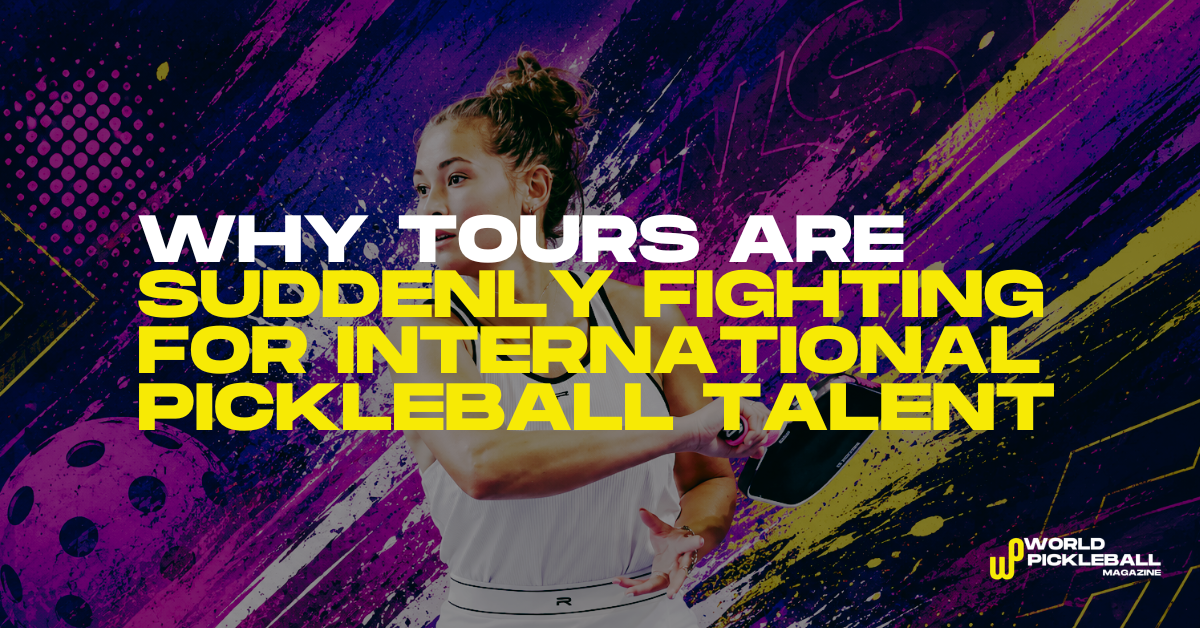
The APP Tour’s latest signing wave was not simply another batch of contracts. It was a revealing look at where the business of professional pickleball is heading next, with international players increasingly becoming central to how tours build audiences, identity, and long-term relevance.
- The APP Tour’s newest signings heavily feature international players from Europe, Asia, and Australia
- Professional tours are increasingly competing for global reach, not just American dominance
- International recruitment is becoming part of the commercial and structural battle between tours
For most of professional pickleball’s modern existence, international players were useful for optics but rarely central to the business of the sport.
The stars, audiences, broadcasts, sponsors, and storylines remained overwhelmingly American. International players existed, but often as occasional breakout stories orbiting a US-centred professional scene.
That balance is beginning to shift.
The APP Tour’s latest round of multi-year signings may initially read like another standard roster announcement. Established names such as Megan Fudge and Simone Jardim remain important pillars of the tour. Rising American players including Sofia Sewing and Jack Munro continue to feature prominently.
But the most revealing part of the announcement sits elsewhere.
International Players Are Becoming Strategic Assets
England’s Louis Laville. Vietnam’s Quang Duong. India’s Harsh Mehta. Poland’s Patrick Kawka. Dutch player Roos Van Reek. Spain’s Glauka Carvajal-Lane.
Then there is the Australian group. Former professional tennis player Seone Mendez joins alongside Emilia Schmidt and 18-year-old junior standout Nicola Schoeman.
The pattern is now too deliberate to ignore.
This is no longer international representation added around the edges of an American tour. Increasingly, tours appear to view international players as strategically essential to their future.
That raises the more interesting question behind the announcement itself.
Why are tours suddenly prioritising international recruitment so aggressively?
Part of the answer is straightforward. Professional pickleball wants legitimacy as a global sport, and no tour can realistically claim global status while relying almost entirely on American player visibility.
But the deeper answer is commercial.
Tours are beginning to realise that international players do not simply bring competitive depth. They bring access to entirely different markets.
A player like Duong immediately creates stronger relevance in Vietnam and across parts of Southeast Asia, where pickleball participation is accelerating rapidly. Laville strengthens visibility in the UK and wider European scene. Mehta matters because India already possesses major racket-sport infrastructure and a huge potential participation base.
The Australian signings connect the APP to another mature sporting market with deep tennis roots and increasing pickleball investment.
That changes sponsorship conversations.
It changes audience development.
It changes streaming value.
And eventually, it may change where the sport’s biggest events are staged.
A year ago, an international signing often felt like an interesting addition to a roster. Now it increasingly feels like infrastructure.
If you’re following how the global game is shifting week by week, the World Pickleball Report breaks this down every day in our morning briefing.
The APP Is Also Building Pathways
The APP also appears increasingly focused on building visible player pathways alongside international recruitment.
Players such as Aidan Schenk, Ronan Camron, and Schmidt have progressed through the APP Next system into larger professional opportunities. That matters because the sport is becoming easier to understand from the outside.
The professional game once felt fragmented and improvised. Now there are clearer routes, clearer systems, and clearer incentives for younger players to commit earlier.
That combination matters.
A tour with international visibility, developmental pathways, recognisable personalities, and long-term player security begins to look less like a collection of tournaments and more like a functioning sporting ecosystem.
And ecosystems are harder to replace.
The Battle Between Tours Is Changing
This does not mean the APP suddenly controls the professional landscape. The PPA still carries enormous influence, star power, and mainstream visibility. Major League Pickleball still possesses strong commercial backing and franchise appeal.
But the APP’s latest signing strategy suggests the battle between tours may increasingly be fought through global positioning as much as domestic dominance.
That feels important.
Because the next phase of professional pickleball may not simply belong to the tour with the biggest American stars.
It may belong to the tour that convinces the rest of the world the sport belongs to them too.
For a clearer view of where the sport is heading each month, you can download the latest free issue of World Pickleball Magazine.
Further Reading
- Latest pickleball news from around the world
- Tournament coverage and results
- Rankings and player profiles
- Regional pickleball coverage

Chris Beaumont is the founder and Editor-in-Chief of World Pickleball Magazine. Chris follows the global game closely, reporting on the latest news, developments, stories and tournaments from all five continents. He also hosts the World Pickleball Podcast, interviewing people at all levels of pickleball. Chris is also an avid player, currently struggling to make the breakthrough from 4.0 to 4.5.