
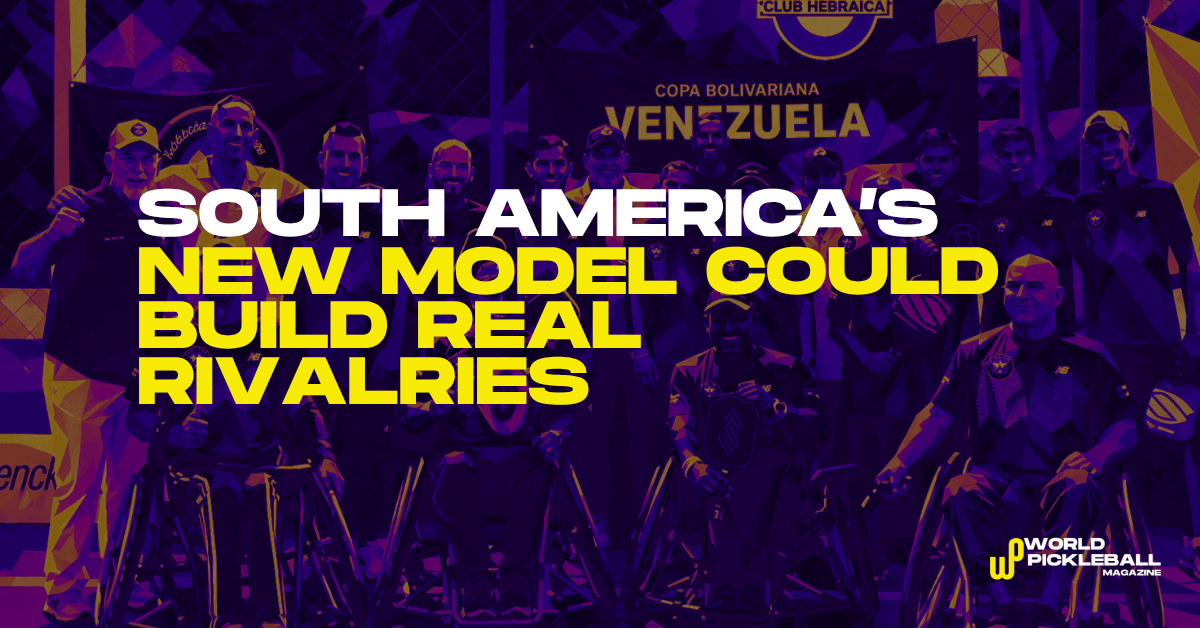
A new bi-national competition between Venezuela and Trinidad & Tobago will not transform pickleball overnight. It does not need to. What matters is the model behind it. In South America and the wider Americas, federations are beginning to shape international competition on their own terms rather than waiting for access to global tours.
- The Pickleball Federation of the Americas has sanctioned a new bi-national event between Venezuela and Trinidad & Tobago
- The format offers a lower-cost, more controllable way to build international competition in the region
- Other sports show that small, repeatable international formats can become some of the most meaningful fixtures in the calendar
This is not about scale yet
The simplest way to misread this story is to judge it by size.
There is no major global field here, no sprawling multi-country draw, no huge commercial package attached to it. On the surface, it is a straightforward international fixture between two nations.
That simplicity is exactly why it matters.
For federations across South America and the wider Americas, access to large international events can be limited by travel costs, scheduling, and the simple fact that the sport’s biggest structures are still being shaped elsewhere. A smaller bilateral format offers something different. It gives federations control.
They can decide the fixture. They can decide the timing. They can decide how often their players compete internationally.
Why this model works in other sports
This is not some strange or improvised idea. Sport is full of examples where repeat international formats have become more meaningful than their modest structure first suggested.
In cricket, the Ashes is the clearest example. England versus Australia is not a global tournament. It is a recurring contest between two nations. What gives it weight is repetition, history, and the certainty that it means something every time it returns.
Football’s old Home Nations tournament worked in a similar way. It did not need the whole world involved to matter. It built rivalry and identity through familiarity, not scale.
Golf’s Ryder Cup shows the same principle from a different angle. It sits outside the normal weekly tour rhythm, but because the format is clear and the sides are fixed, the contest carries a significance far beyond its size.
What about rugby, and the Six Nations which happens every season?
The lesson is straightforward. Small international formats can become big occasions if they are repeated, owned properly, and given room to build memory.
If you’re following how the global game is shifting week by week, the World Pickleball Report breaks this down every Wednesday.
What this could mean for pickleball in the region
For pickleball, that opens a useful possibility.
Instead of waiting for major tours or distant championship events to create international meaning, federations can start building it themselves. Not through imitation for the sake of it, but by borrowing structures that other sports have already proved can work.
A South American or Americas-based sequence of recurring fixtures would lower the barrier to entry for international play. It would create more opportunities for national representation. Most importantly, it could begin to build rivalries that feel real rather than occasional.
That matters in a developing sport. Players do not just need tournaments. They need contexts that give matches meaning.
Control is the real story
The important shift here is not growth. It is control.
South American and regional federations are beginning to explore what happens when they do not wait for the sport’s biggest structures to decide everything for them. They can create their own layer of international competition, one that fits their geography, budgets, and stage of development.
That does not replace global tours. It gives the region something underneath them.
For now, this is one fixture. Nothing more should be claimed than that.
But it is a serious first step, because it points towards a version of international pickleball that is more regular, more regional, and more self-directed.
For federation context and regional governance, the Pickleball Federation of the Americas provides the clearest reference point.
A small event can still signal a bigger change
Not every important development arrives as a major championship.
Sometimes it starts with a format that looks modest, but makes more sense for the region than anything larger currently on offer.
That is the opportunity here. Not to pretend this event is already huge, but to recognise that it may point to a more sustainable international model for South American pickleball and beyond.
For a clearer view of where the sport is heading each week, you can join the World Pickleball Report here.
Further Reading
- Latest pickleball news from around the world
- Tournament coverage and results
- Rankings and player profiles
- Regional pickleball coverage

Chris Beaumont is the founder and Editor-in-Chief of World Pickleball Magazine. Chris follows the global game closely, reporting on the latest news, developments, stories and tournaments from all five continents. He also hosts the World Pickleball Podcast, interviewing people at all levels of pickleball. Chris is also an avid player, currently struggling to make the breakthrough from 4.0 to 4.5.