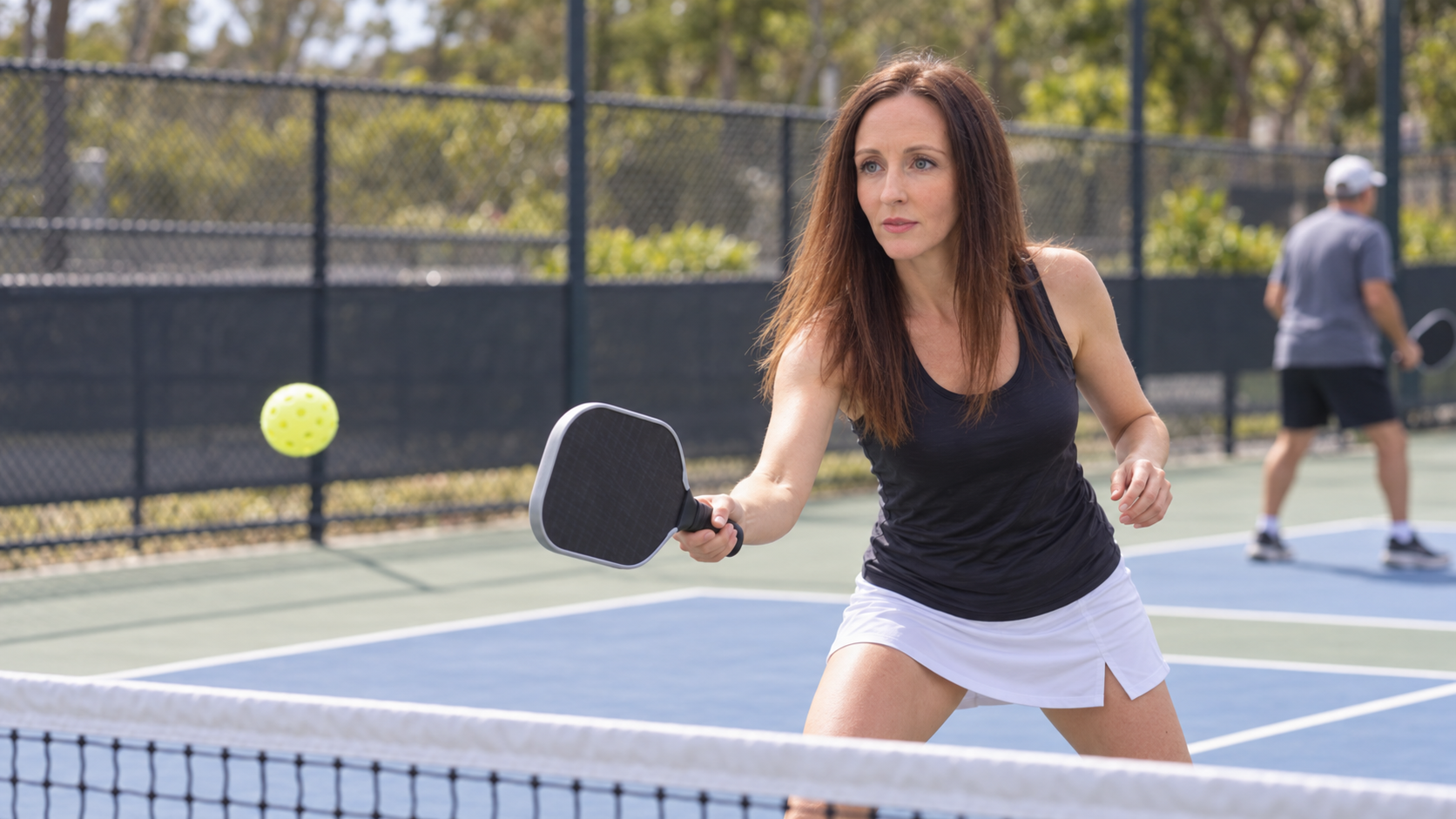
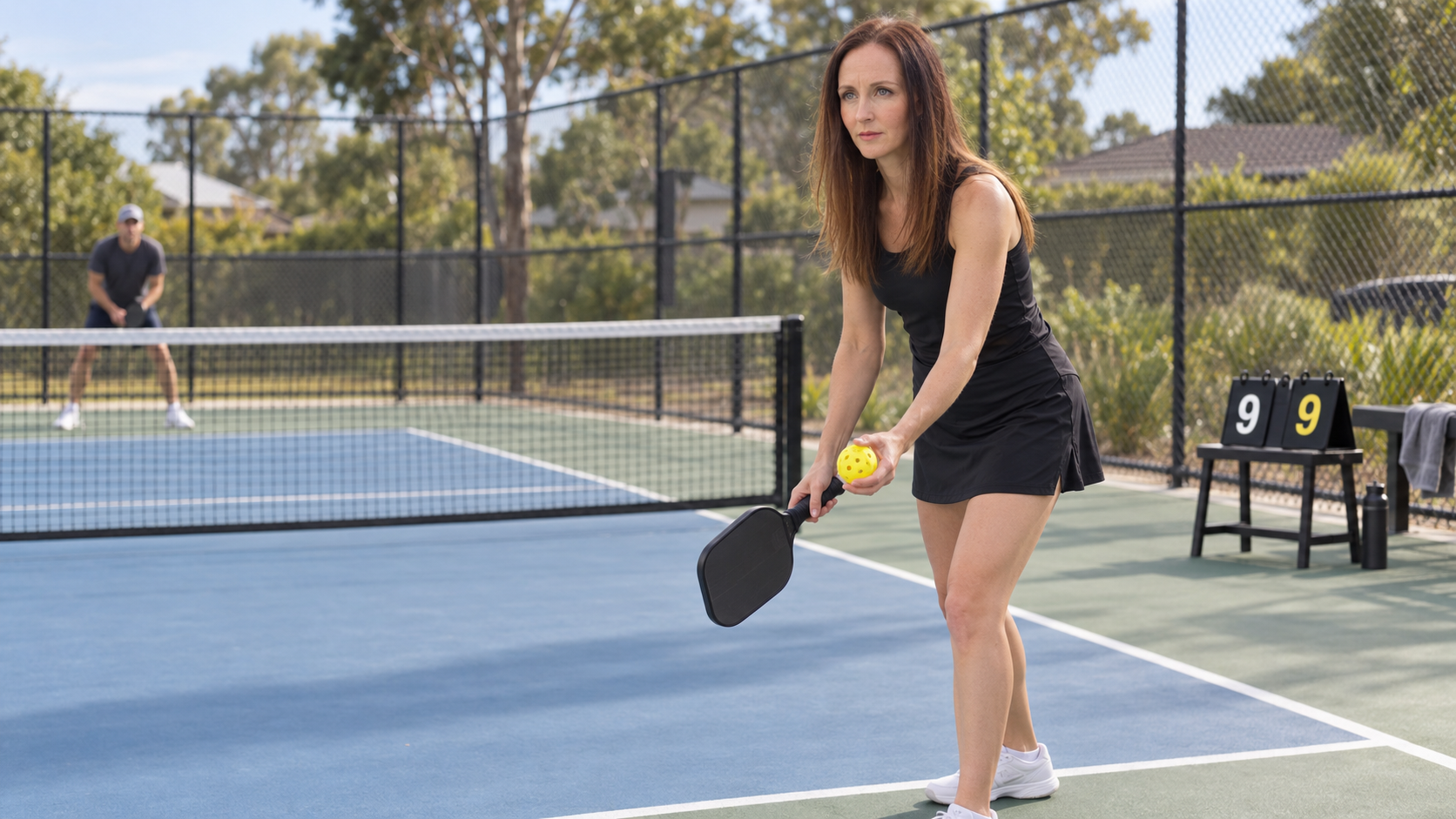
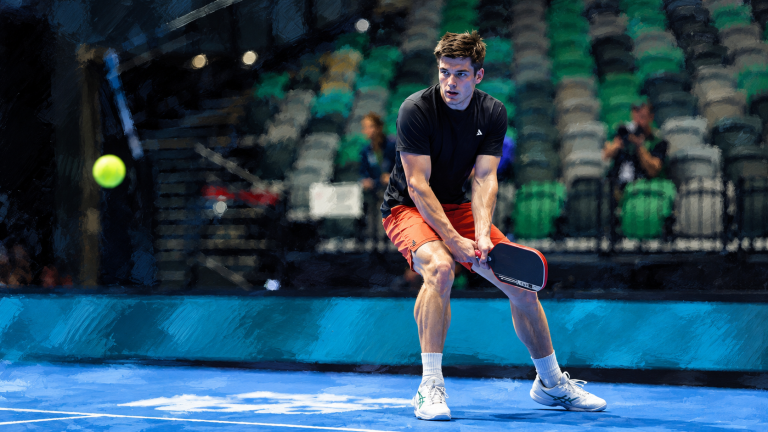
At 9–9 in the deciding game, players rarely lose because of mechanical flaws. They lose because anxiety tricks them into attempting shots they haven’t mastered, instead of trusting the simple, repeatable ball they already know.
At 9–9, the court can become a crowded place.
The ball is still there. So are the opponents, the boundaries and the partner standing a few feet away. Yet they are suddenly joined by everything that has already happened and everything that might happen next.
The return you missed three points ago. The lead you allowed to disappear. The match waiting on the next two rallies. The possibility that your partner is growing frustrated.
Somewhere inside all that noise is the shot you already know how to hit.
Inside This Masterclass
The Pressure Trap: Why clutch moments tempt competitors into abandoning their core strengths for low-percentage heroics.
Access Under Stress: Understanding how psychological panic restricts access to motor memory and shot variety.
The Repeatable Ball: Why champions win close matches by doing ordinary things with extraordinary consistency.
Dr Deirdre Timlin is interested in why it can become so difficult to find.
Timlin is an AHPRA-registered health psychologist and board-approved supervisor with a PhD and a background in behavioural science. She is also a passionate pickleball player who understands from experience how quickly a few mistakes can change the way a person thinks, moves and competes.
Through her Instagram channel, @thepickleballpsychologist, she has begun examining an area of the sport that receives far less deliberate practice than drops, dinks and resets: what happens to our attention when the score begins to matter.
The subject is finding an audience, with some of Timlin’s early posts attracting tens of thousands of views. Many players clearly recognise the problem.
They have learned the shot. They can execute it in practice. Then pressure arrives and access to it seems to close.
When the Psychologist Got Inside Her Own Head
I have known Deirdre through the pickleball community. She is warm, thoughtful and a genuinely lovely human being. Her professional background did not make her immune to the emotional difficulties of learning a new sport.
Timlin discovered pickleball around two and a half years ago in Queensland, Australia. Catherine Boreham introduced her to the game, while David Lapere, she jokes, “basically harassed me until I finally went along”.
She arrived without a racquet-sport background and was soon hooked. Enjoyment, however, became mixed with a growing anxiety about how quickly she was improving.
“I felt I was progressing slowly, became nervous playing and developed a negative mindset around my ability,” Timlin says.
“I could miss a few shots and suddenly decide I couldn’t play pickleball.”
That conclusion will be familiar to players at every level. One missed return becomes a judgement about the serve. Two failed drops become evidence that the shot cannot be trusted. A poor game starts to feel like a verdict on the player rather than a short, imperfect sequence of points.
Timlin began to notice what was happening inside her own game.
As her nerves rose, her attention moved away from the information that could help her play. She stopped watching the ball as closely. Targets became less clear. Reading her opponents gave way to replaying previous mistakes, thinking about the score and questioning her ability.
DISCIPLINE Under maximum pressure, mechanical simplicity protects players from catastrophic unforced errors.
Then there was the person standing beside her.
A partner’s glance or change in body language could alter Timlin’s emotional state, even when that person had not intended to express frustration. Once she began wondering what her partner was thinking, another part of her attention was no longer available for the rally in front of her.
The psychologist in Timlin became curious about the player. She began investigating research into attention, pressure, self-belief and partner dynamics, then applying those ideas to her own pickleball.
The Pickleball Psychologist grew out of that process.
9–9
The psychological boiling point of a tournament match, where shot discipline and emotional composure outweigh raw athletic talent.
If you're following how the global game is shifting week by week, the World Pickleball Report breaks this down every day in our morning briefing.
Losing Access
“Sometimes you haven’t lost your skill,” Timlin says. “You’ve lost access to your skill.”
Consider two technically equal players at 9–9.
One is thinking: Don’t miss. We need these next two points.
The other is thinking: Where am I sending this ball?
The first player’s attention has travelled into the future. It is occupied by the possible outcome and the consequences of failure. The second remains attached to the task directly ahead.
Their ability and circumstances are the same. Their attention is not.
“On game day, you already have the skills you’ve developed in training,” Timlin says. “Psychology can influence how effectively you access those skills under pressure.”
Pressure does not always cause a dramatic collapse. Its effects can be smaller and harder to detect. A player watches the score rather than the ball. The grip tightens slightly. Decision-making becomes cautious. Someone who is normally assertive begins guiding shots into the court instead of completing the stroke.
The body may still be capable of performing the action while the mind issues competing instructions.
The idea has a long history in performance psychology. In The Inner Game of Tennis, Timothy Gallwey described the conflict between the part of a player performing the skill and the internal voice attempting to judge and control it.
Pickleball gives that conflict its own conditions. The court is compact, the exchanges are rapid and mistakes are difficult to escape. Doubles adds another layer because every error is witnessed at close quarters by someone who shares its consequence.
Timlin does not believe the solution is to eliminate nerves. The useful question is whether a player can continue making clear decisions while nervous.
She now tries to interpret difficult matches as challenges rather than threats. Sometimes she tells herself: “I’m ready.”
The feeling may remain. Its meaning has changed.
TRUST Trusting the reliable drop rather than pressing for an impossible winner at crucial junctures.
“One player is thinking: Don’t miss. The other is thinking: Where am I sending this ball? That subtle distinction determines the champion.”
Sports Psychology & Performance Masterclass
Practising the Score
Most pickleball practice is built around technical repetition. Players hit dozens of drops or resets from the same position, often without a score, consequence or opponent trying to expose the shot.
Then they enter a tournament and expect the stroke to behave exactly as it did in the drill.
Timlin believes players should train their attention as deliberately as they train technique.
When the mind begins drifting towards mistakes and consequences, she suggests giving it a specific job:
Pick your target. Trust your shot.
She also advocates building pressure into practice. Players can begin a game at 8–8, make the final ball in a drill worth more or create a small consequence for losing an exercise. The stakes do not need to be severe. They need only to make the player care about what happens.
“You’re not practising how not to feel nervous,” Timlin says. “You’re practising how to play while nervous.”
The physical shot may be identical. The conditions surrounding it are no longer comfortable.
A player who has rehearsed a stroke only in calm conditions has practised only part of the task. Tournament pickleball requires the same stroke to survive a changing score, a missed opportunity and the tightening that follows an important error.
Pressure training gives the player a chance to recognise those reactions before the match depends on them.
What Does Your Partner Need?
The most distinctly pickleball part of Timlin’s work concerns psychological safety between doubles partners.
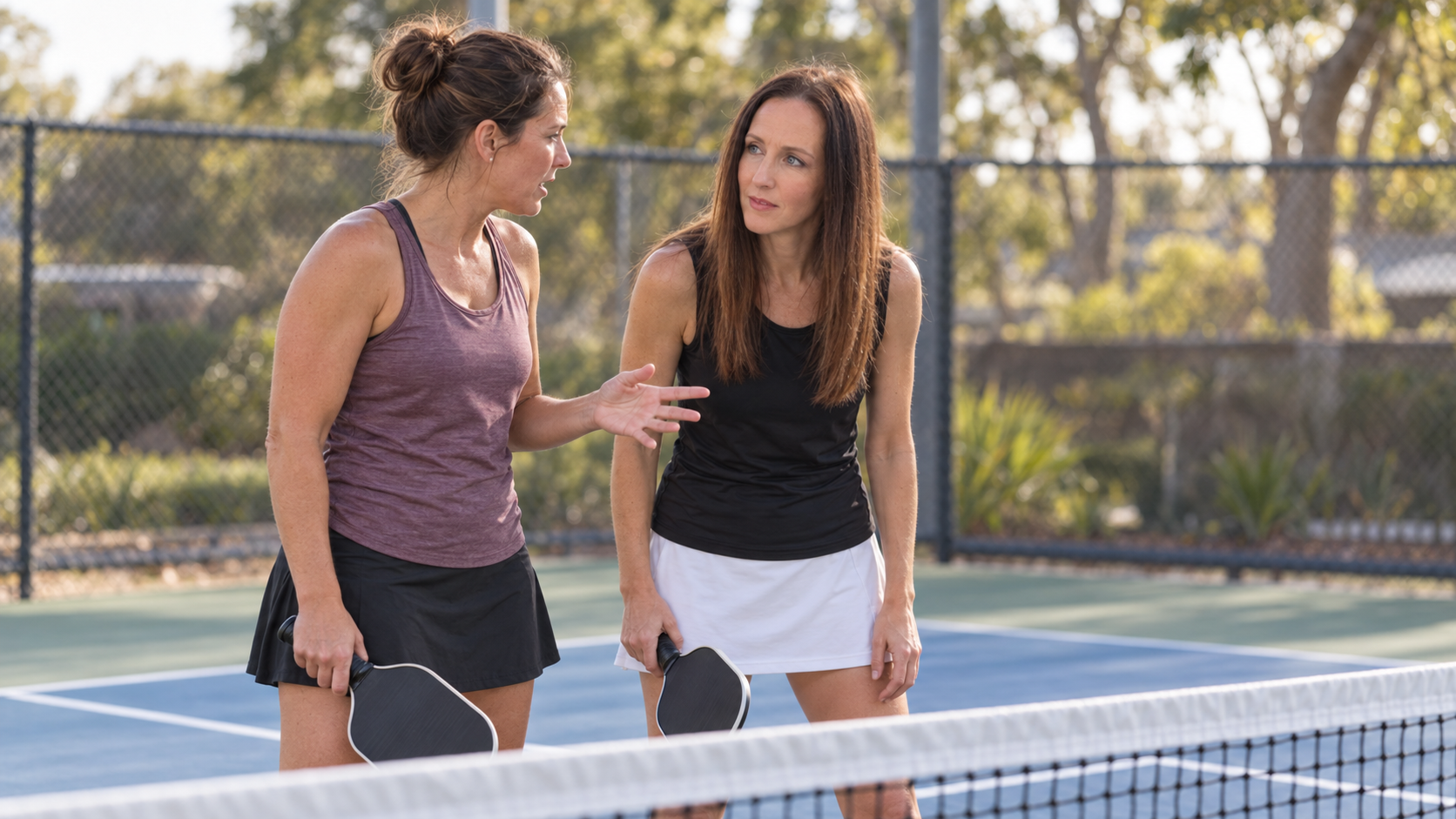
Players spend hours discussing which partner should take the middle and whether two playing styles are tactically compatible. They may never discuss what either person needs after making a mistake.
Timlin discovered the importance of that conversation while playing a tournament with Ngaire, a fiercely competitive partner who remained consistently encouraging.
“I never felt judged when I made a mistake,” Timlin says. “I realised how much easier it was to stay focused when I felt psychologically safe with my partner.”
That safety did not reduce their competitive expectations. It allowed mistakes to pass without acquiring additional meaning.
“You can have high expectations and still make your partner feel safe enough to make a mistake,” she says.
Timlin recommends asking a new partner a simple question before playing:
“When things aren’t going well, what helps you reset? Encouragement, space or a tactical cue?”
FOCUS Mental rehearsal and breathing routines between points maintain access to motor skills.
The answer can prevent two well-intentioned players from making each other’s match more difficult.
One player may want reassurance. Another may prefer silence. Someone else may recover most quickly when the partnership agrees on a tactical response for the next point.
Problems arise when each assumes that their own preference is universal.
Repeated encouragement can overwhelm a partner who needs space. Silence can feel like anger to somebody seeking reassurance. A technical instruction may be intended as help but received as blame.
The conversation before a match takes only a few seconds. It establishes how the partnership will handle the moments when playing well becomes difficult.
In a sport built around doubles, that is part of preparation.
Between One Point and the Next
Timlin is not trying to teach players how to hit a third-shot drop. Pickleball already has plenty of coaches who can explain the mechanics.
“I’m interested in what determines whether you can access that third-shot drop when it actually matters,” she says.
That may depend on where a player’s attention goes after an error. It may involve the meaning attached to nervousness, the quality of their pressure training or the reaction of the person beside them.
Usually, several things are happening at once.
Technical instruction remains essential. Players need sound mechanics, repetition and tactical understanding. Yet there comes a point when another lesson on the stroke cannot explain why it works comfortably on Tuesday evening and disappears during Saturday’s tournament.
Timlin’s work begins in that gap.
The score reaches 9–9. The grip tightens. A thought arrives before the ball does.
Don’t miss.
The skill is still there.
The next task is learning how to reach it.
Follow Dr Deirdre Timlin on Instagram: @thepickleballpsychologist
Chris Beaumont is the founder and Editor-in-Chief of World Pickleball Magazine. Chris follows the global game closely, reporting on the latest news, developments, stories and tournaments from all five continents. He also hosts the World Pickleball Podcast, interviewing people at…