
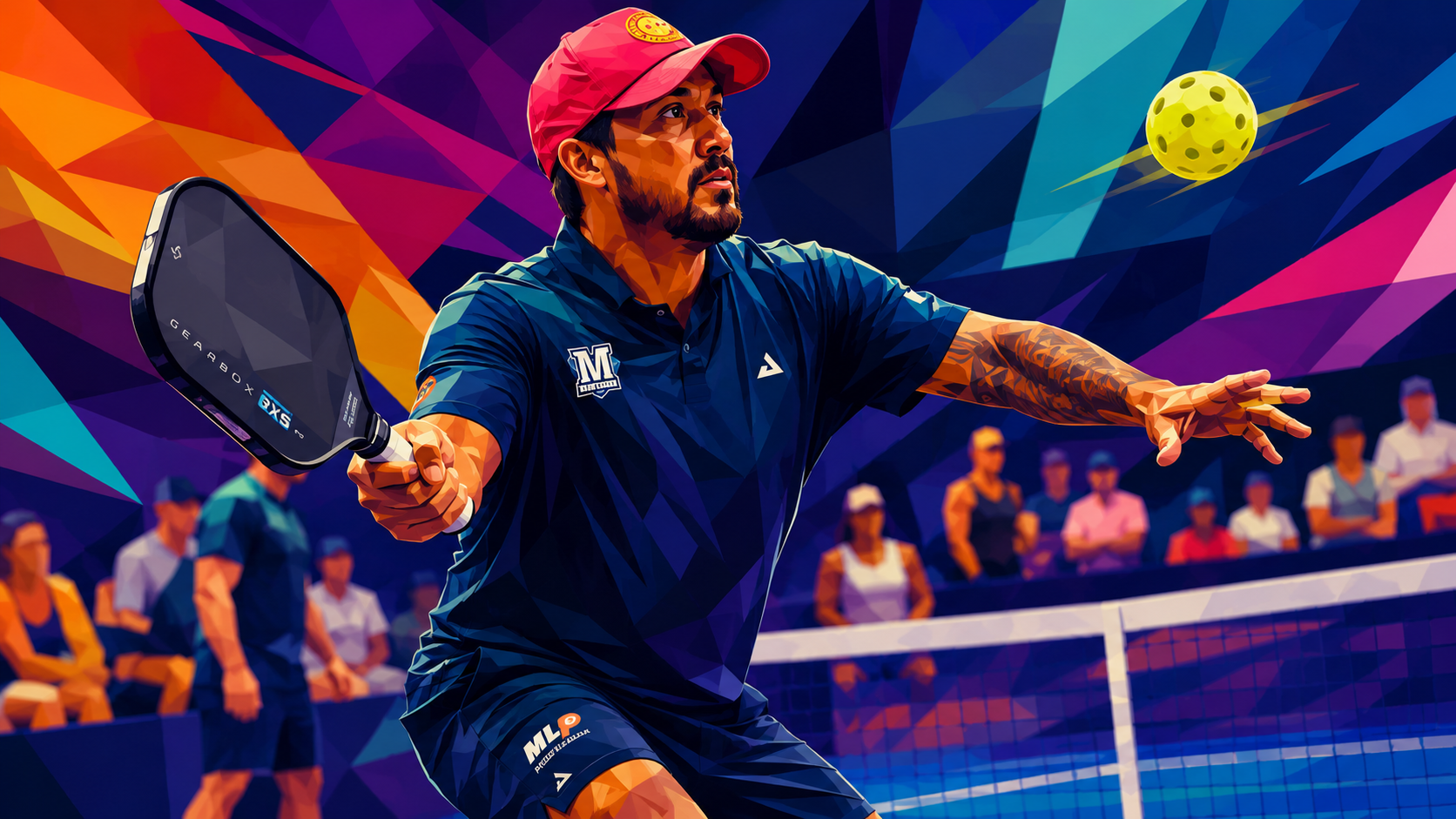
Ask most players how to improve and they will usually talk about technique. A better backhand. A more reliable third-shot drop. Faster hands at the kitchen. Joey Farias sees the game differently. After competing among the world’s best and coaching multiple top professionals, he believes elite pickleball is won less by superior strokes than by superior decision-making. The world’s best players are not simply reacting to rallies. They are quietly designing them.
Key Takeaways
- Joey Farias believes professional pickleball is built around recognising patterns rather than simply executing individual shots.
- Elite players create sequences that increase the probability of winning the next ball instead of trying to finish every point immediately.
- The strongest competitors use their own strengths against an opponent’s weakness rather than matching weakness against weakness.
- Every shot changes the value of the one that follows, making anticipation and manipulation as important as execution.
- Recreational players often spend too much time correcting weaknesses and too little time making their strengths even more dangerous.
Joey Farias does not believe the world’s best pickleball players win simply because they hit better shots.
He believes they win because they are solving problems their opponents have not even recognised yet.
The speed of the professional game is the part everyone notices first.
Hands appear impossibly quick. Volleys arrive before defenders seem ready. Points can be decided in fractions of a second.
According to Farias, however, that is not what truly separates elite players from everyone else.
The speed is merely the visible part.
The invisible part — the part most recreational players never notice — is that the world’s best competitors have already made many of their most important decisions before the rally reaches its fastest moments.
That idea runs through almost everything Farias teaches.
He rarely begins by talking about forehands or backhands.
Instead, he talks about probabilities.
About tendencies.
About options.
About recognising patterns before they become obvious.
Most importantly, he talks about understanding that no shot exists in isolation.
Elite pickleball, he argues, is a game of sequences.
Stop Trying to Win Every Attack
One sentence from Farias completely reframes how attacking pickleball should be understood.
“Usually the first attack in pickleball is the setup and the second ball that gets put back is the one we’re looking to put away.”
Most developing players attack because they believe they have found a winner.
Professionals often attack because they know what the reply is likely to be.
That distinction changes everything.
Rather than viewing a speed-up as the end of the rally, Farias treats it as the beginning of a sequence.
The first attack narrows the defender’s options.
The reply becomes more predictable.
Only then does the truly aggressive opportunity appear.
It is less like throwing a knockout punch than forcing an opponent into a position where the knockout becomes increasingly difficult to avoid.
The first attack does not necessarily win the rally.
It decides how the rally is likely to be won.
Professional pickleball, viewed through that lens, becomes a sport of preparation rather than impatience.
Probability Beats Perfection
One word repeatedly appears within Farias’ explanations.
Probability.
Elite players are not trying to guarantee outcomes. They are trying to increase the likelihood of favourable ones.
That is why so many of his tactical discussions revolve around return locations, paddle positions, contact points and court geometry rather than the technical construction of a stroke.
Place the return in one area and the fourth ball becomes more likely to arrive somewhere useful.
Attack from another position and the defender’s block will usually travel into a narrower range of locations.
Recognise where an opponent makes contact with the ball and their possible responses become easier to anticipate.
Farias studies how players hold the paddle, whether contact happens in front of the body or slightly behind it, and which direction the ball tends to travel when they are placed under pressure.
What spectators interpret as extraordinary reactions is often something more sophisticated.
Elite players have already reduced the number of possible outcomes before the ball reaches them.
They are not guessing.
They are repeatedly stacking probabilities in their favour.
Your Strength Matters More Than Their Weakness
One of Farias’ strongest criticisms is directed at a mistake made throughout competitive amateur pickleball.
Players identify an opponent’s weakness.
Then immediately abandon their own strengths in order to attack it.
His example is simple.
Imagine an opponent has a weak backhand dink.
Unfortunately, your own backhand dink is also the least reliable part of your game.
Many players will willingly enter a backhand-to-backhand exchange because they believe attacking the opponent’s weakness must automatically give them the advantage.
Farias believes the calculation is wrong.
He would rather find a way to use his stronger forehand against that backhand, even when doing so requires additional footwork, different positioning or greater patience.
The question should not simply be:
Where is my opponent weakest?
It should be:
How do I create a rally in which my greatest strength repeatedly meets their biggest weakness?
That shift changes shot selection.
It changes positioning.
It changes the type of rally a player is willing to construct.
The objective is no longer merely to expose the opponent.
It is to expose them on your own terms.
The Return Is Already Controlling the Fourth Ball
Few recreational players think deeply about where they place their return of serve.
Good depth often feels sufficient.
Farias sees something far more consequential.
The return is already influencing which opponent will receive the fourth ball, whether that ball is more likely to be driven or dropped, and how much court each player will be able to cover afterwards.
His explanation came from a match played in New Zealand.
Farias and his partner were facing a team that wanted one player to drive the third while the aggressive left-side player crashed the kitchen behind it.
Rather than simply returning deep, they began placing the ball into a narrow channel just left of centre.
The location encouraged the right-side player to run around his backhand and strike a forehand drive.
That movement forced his partner to move wider to create space, changing the angle from which he could crash the net and reducing the pressure he could apply through the middle.
The return itself did not win the rally.
It changed the geometry of everything that followed.
Farias also explained that players can use the return to influence which partner is most likely to receive a drive.
A third-shot drive is generally more likely to travel towards the returner positioned directly in front of the striker. A drop is often more likely to travel crosscourt, where there is more space and a longer distance in which the ball can fall.
That means the returning team can place the return in front of the player who handles pace most comfortably.
Their partner can then move forward expecting that they are more likely to receive the slower drop.
By the time the serve has been returned, the team has already begun shaping the fourth shot.
That is elite pickleball thinking.
Every Shot Makes the Opposite Shot Better
Perhaps the most revealing idea in the conversation arrived almost in passing.
“Every shot, whether it’s a speed-up or a dink, makes the opposite shot that much better.”
Show opponents that you are willing to speed up off the bounce and they may begin standing slightly deeper.
Suddenly your dink becomes more dangerous because they can no longer reach forward and cut it off as aggressively.
Spend several rallies dinking patiently and opponents begin leaning towards the kitchen, expecting another soft ball.
Now the surprise speed-up becomes more effective.
The value of each shot is therefore partly created by the threat of its opposite.
Elite players constantly manage those relationships.
Sometimes they attack because it will make their dinking more effective later.
Sometimes they dink because patience will create hesitation before the next attack.
The immediate outcome matters.
The future consequence may matter even more.
The Threat Can Be More Valuable Than the Winner
Professionals frequently play shots that are not expected to win the rally immediately.
A speed-up up the line.
An attack through the middle.
A drive towards a player’s forehand rather than the supposedly weaker backhand.
The value can be psychological as well as tactical.
Farias described how an aggressive left-side player can dominate the middle when the opponent positioned across from them never threatens the line.
Without that threat, the left-side player can cheat towards the centre, intercept balls and protect their partner’s weaknesses without hesitation.
Attack the line once, however, and the calculation changes.
The aggressive player must remain responsible for more court.
They may hesitate before poaching.
They may stand slightly deeper.
They may leave their partner more exposed.
The attacking team might even lose the first rally in which it attempts the shot.
That does not necessarily make it a poor decision.
The effect may only become visible several points later.
“It’s almost like a little bit of smoke and mirrors. You show it once or twice, even though it might not necessarily be your best shot. Now that threat is there and we have to think about it.”
That is not deception for its own sake.
It is the deliberate management of an opponent’s attention.
Why Players Must Become Comfortable in Transition
Farias also challenged one of the most common instincts among developing players.
After hitting a third-shot drop, many players see an opponent reaching forward to volley and instinctively retreat behind the baseline.
They believe moving backwards creates more time.
Farias believes it often creates a worse ball.
Retreating allows the kitchen-line player to contact the ball lower and direct it closer to the defender’s feet.
By moving forward into transition instead, the serving player can often receive the next ball around knee or thigh height rather than close to the ground.
They may still need to defend.
But they are defending from a position that leaves them much closer to the kitchen.
Farias accepts that defending from transition can be marginally more difficult than defending from behind the baseline.
The strategic advantage arrives after a good shot.
A strong defensive ball struck from behind the baseline still leaves the player needing to survive another ball from transition.
A strong ball struck from transition may allow them to complete the move to the kitchen immediately.
The area is unavoidable.
Players who regularly use third-shot drops will usually need to strike at least one ball from the middle of the court before winning the rally.
The solution is not to avoid transition.
It is to become comfortable there.
That means moving with control, arriving early enough to split-step and ensuring the body is stable before contact.
Too many players run through the transition zone rather than establishing themselves within it.
Elite players treat it not as dangerous empty space, but as a position from which the rally can be advanced.
Build Your Strengths Before Chasing Fashion
The professional game continues to evolve quickly.
Two-handed backhands.
Aggressive topspin dinks.
Disguised speed-ups.
New paddle technology.
It is tempting for ambitious players to believe they must immediately copy every skill appearing on the professional tour.
Farias urges caution.
He regularly sees players spend enormous amounts of practice time developing fashionable techniques while allowing the skills that already make them dangerous to deteriorate.
A player with an excellent one-handed backhand may invest almost exclusively in building a two-hander simply because leading professionals now use one.
The new shot may improve gradually.
Meanwhile, the original strength declines because it is no longer being trained with the same attention.
Farias is not arguing that weaknesses should be ignored.
He is arguing that improvement should not come at the cost of identity.
The best professionals understand exactly what separates them from everybody else.
They then construct rallies that allow those strengths to appear repeatedly.
Pickleball Is Becoming a Thinking Game
There is a temptation to describe professional pickleball as an arms race.
More athletic players.
Faster paddles.
Harder drives.
Watching elite competition certainly creates that impression.
Listening to Joey Farias produces a different conclusion.
Professional pickleball is evolving into a game of information.
Every return changes the fourth ball.
Every speed-up alters the value of the next dink.
Every attack creates new probabilities.
Every threat reshapes an opponent’s positioning.
The rallies still happen at breathtaking speed.
The thinking simply happens earlier.
That may be the biggest misconception recreational players have about the professional game.
The world’s best competitors are not merely reacting faster than everyone else.
They are arriving at the right decision before everyone else has even recognised the question.
Further Reading
- Joey Farias Builds Malaysia’s “Road to Hero” After KL Open Upset
- The One-Decision Rally: How a Single Poor Choice Ends Most Pickleball Points
- Pickleball Attack Timing: Why Going Too Early Can Cost You the Point
- How to Avoid the Midcourt Trap in Pickleball and Win More Points
- Pickleball Dink Strategy: How to Win More Dink Rallies in Doubles

Chris Beaumont
Founder and Editor-in-ChiefChris Beaumont is the founder and Editor-in-Chief of World Pickleball Magazine. Chris follows the global game closely, reporting on the latest news, developments, stories and tournaments from all five continents. He also hosts the World Pickleball Podcast, interviewing people at…
View All Articles →

