
BY MARC CHUA, ASIA CORRESPONDENT

A Global Start in Hainan
Asia’s pickleball calendar wasted no time making a statement in 2026. As the new season dawned, the Ramsports World Pickleball Championship (WPC) China Masters opened the year with scale, ambition, and unmistakable momentum. Hosted in Hainan, the Tier 5 tournament drew a truly international field and immediately set the benchmark for what promises to be a landmark year for pickleball across the continent.
With 267 players representing 30 countries, the China Masters was more than just an early-season stop — it was a declaration. Asia’s place in the global pickleball ecosystem is no longer defined by potential alone, but by participation, professionalism, and competitive depth that continues to strengthen year by year.
Scale That Signals Growth
From the moment competition began, the numbers told a compelling story. The tournament featured 42 brackets across multiple age groups, reflecting not only depth of competition but also the sport’s expanding demographic reach.
While elite-level play remained a central attraction, the China Masters stood out for its inclusivity. Strong representation in the 19+ divisions highlighted the rising generation of competitive players driving the sport forward, while impressive turnout and performances in the 50+ and 60+ categories reinforced pickleball’s unique ability to unite athletes across ages and backgrounds.
This balance — elite intensity alongside community-driven participation — has become a defining strength of pickleball in Asia, and Hainan showcased it in full.
International Flavour on Asian Courts
One of the most striking aspects of the WPC China Masters was its global diversity. Players traveled from across Asia, Europe, the Americas, and beyond, transforming the Hainan venue into a meeting point for styles, strategies, and cultures.
The result was a tournament rich in variety. Fast-paced rallies, tactical exchanges, and contrasting approaches to the game kept spectators engaged throughout the event. For many international competitors, the China Masters also offered a first glimpse into Asia’s rapidly improving tournament infrastructure — a factor that continues to attract players back year after year.
In this sense, Hainan served a dual purpose: a fiercely competitive battleground and a showcase of Asia’s growing capability as a host for world-class pickleball.
Ramsports and the Rise of Professional Standards
Behind the scenes, Ramsports played a central role in elevating the tournament experience. From court presentation to scheduling and logistics, the China Masters reflected a level of professionalism increasingly expected at major international events.
Clear branding, broadcast-ready visuals, and a well-structured competition flow contributed to an atmosphere that felt polished and purposeful. These elements matter — not only to players chasing ranking points, but also to fans, sponsors, and governing bodies watching Asia’s progress closely.
The China Masters demonstrated that Asian tournaments are no longer simply catching up. In many ways, they are beginning to set their own standards.
Competitive Energy Across All Brackets
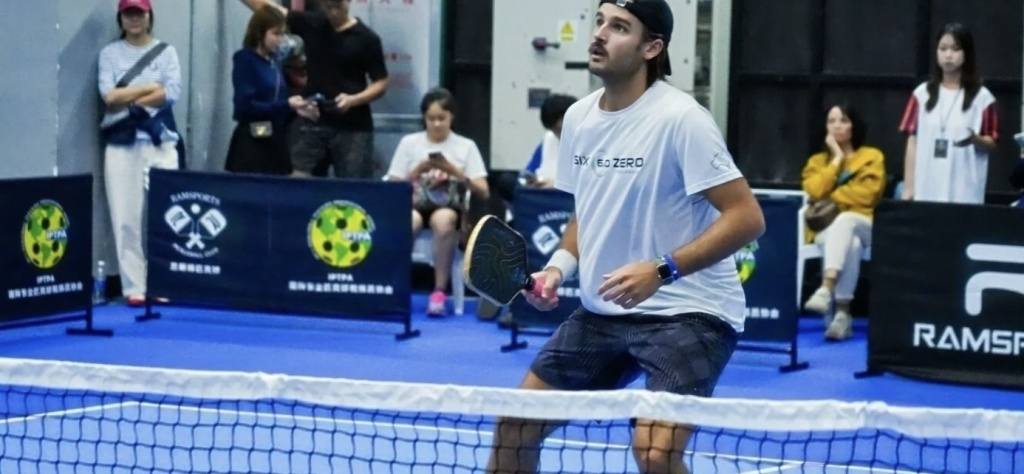
On court, the action matched the scale of the event. Matches across divisions delivered intensity and drama, with players pushing deep into rallies and testing endurance in Hainan’s humid conditions.
The 19+ brackets showcased athleticism and evolving tactics, with younger competitors displaying confidence and creativity that reflected pickleball’s rapid technical evolution. Meanwhile, the 50+ and 60+ divisions provided masterclasses in shot selection, patience, and game management — reminders that experience remains a formidable weapon in the sport.
This blend of energy and expertise reinforced one of pickleball’s most compelling traits: it rewards both physicality and intelligence, making it accessible yet fiercely competitive at every level.
Women’s Doubles 19+ 5.0: Chemistry at Championship Level
The Women’s Doubles 19+ 5.0 division delivered some of the tournament’s most polished and tactically refined play. Emerging as champions were Karina Aditya Dwipayani and Kwan Wun Man, whose partnership was defined by composure, communication, and control at the kitchen line.
Their ability to absorb pressure, reset points, and strike decisively in key moments proved decisive throughout the draw. Silver went to Caroline Nothnagel and Karolina Owczarek, whose aggressive net play and physical presence pushed opponents relentlessly, while Alma Thell Lenntorp and Klara Thell Lenntorp completed the podium with a hard-earned bronze.
Women’s Singles 19+ 5.0: Precision Under Pressure
In Women’s Singles 19+ 5.0, Sarah Dennehy delivered one of the most controlled performances of the tournament. Her gold-medal run was built on intelligent shot placement, patience in extended rallies, and an ability to manage momentum in high-pressure situations.
Katie Morris claimed silver after a resilient run through the draw, while Lam Ying Suet earned bronze with consistent defensive play and timely counter-attacks. The division highlighted the rising tactical sophistication in women’s singles across Asia.

Men’s Singles 19+ 5.0: Experience Prevails
The Men’s Singles 19+ 5.0 bracket was among the most physically demanding of the event, featuring explosive rallies and relentless pace. Standing atop the podium was Hong Kit Wong, whose experience and court intelligence once again proved decisive.
Wong’s gold-medal performance emphasised precision over power, neutralising aggressive opponents through disciplined point construction. Bako Balint Gergo finished second with an attacking style that tested every opponent, while Harrison Brown secured bronze, showcasing athleticism and adaptability throughout the draw.
Mixed Doubles 19+ 5.0: Balance and Trust
The Mixed Doubles 19+ 5.0 division highlighted the importance of balance and communication. Champions Karina Aditya Dwipayani and Hong Kit Wong combined composure with opportunistic aggression, navigating transitions seamlessly and maintaining positional discipline under pressure.
Silver went to Katie Morris and Joshua Bright, whose athletic play kept matches tight, while Sarah Dennehy and Harrison Brown completed the podium with bronze, capping off impressive multi-event campaigns.
Men’s Doubles 19+ 5.0+: Precision at the Summit
At the highest level, Men’s Doubles 19+ 5.0+ delivered a showcase of refined teamwork and tactical execution. Hong Kit Wong and Louis Laville emerged as champions, controlling the non-volley zone with discipline and patience.
They were pushed hard by Xiang Cai and Yaxuan Miao, who earned silver with quick hands and explosive reflexes, while Minh Le and Wang Guangmao claimed bronze after a gritty, composed run through the bracket.
A Powerful Opening Statement for 2026
As the first major international event on Asia’s 2026 calendar, the WPC China Masters carried symbolic weight. It wasn’t just about medals or rankings — it was about momentum. By drawing a truly global field and delivering a smooth, high-level tournament, Hainan sent a clear message: Asia is ready for a bigger role in pickleball’s global narrative. The region is no longer simply a growth market; it is becoming a destination.

For players, the China Masters offered early-season clarity. For organisers and stakeholders, it confirmed that the sport’s upward trajectory in Asia remains strong.
Looking Ahead
With the Ramsports WPC China Masters now in the books, attention turns to what comes next. More tour stops, larger fields, and higher stakes lie ahead — but the tone has already been set.
The 2026 pickleball season in Asia has begun with confidence, inclusivity, and international appeal. And if Hainan is any indication, the year ahead promises not just growth, but genuine global relevance.
Asia has opened the season with intent.
The rest of the pickleball world has taken notice.
If you enjoyed this article, you can download the whole beautifully designed magazine here.
Chris Beaumont is the founder and Editor-in-Chief of World Pickleball Magazine. Chris follows the global game closely, reporting on the latest news, developments, stories and tournaments from all five continents. He also hosts the World Pickleball Podcast, interviewing people at all levels of pickleball. Chris is also an avid player, currently struggling to make the breakthrough from 4.0 to 4.5.